

Introduction
Denim is a fabric that can trace its history. From the industrial age to today, it has gradually integrated into our lives from wear-resistant workwear and then influenced fashion. How to identify and distinguish different fabrics is crucial for design development and purchasing decisions. This article classifies denim fabrics according to weaving style, functional innovation, environmental protection, and performance, and briefly introduces the characteristics of each type of denim, the appropriate cutting type, and purchasing guidelines.

I. Basic Weaving Classifications
1. Pure Twill Classic (Right-Hand Twill Denim)
Definition: Traditional denim woven in a three-up-one-down right-hand twill, with indigo-dyed cotton warp and white weft.
Features:
– Strong abrasion resistance
– Moderate weight (10–14 oz)
– Naturally develops fading and aging character after washing
Suitable Cutting Types and Advantages:
– Ideal for straight-leg, tapered, and regular-fit jeans
– Excellent for creating vintage looks and stiff, structured silhouettes
2. Dobby Denim
Definition: Produced on a dobby loom to create geometric or textured weave patterns (e.g., micro-diamonds, basket weaves).
Features:
– Enhanced visual texture and 3D fabric effects
– Requires high-density yarn; relatively high production cost
Suitable Cutting Types and Advantages:
– Best suited for statement pieces, tailored denim tops, or casual trousers
– Adds value through visual complexity, even in basic silhouettes
3. Slub (Rain Slub) Denim
Definition: Utilizes irregular slub yarns that create natural-looking vertical streaks or grain textures after washing.
Features:
– Available in warp, weft, or bi-directional slubs
– Weft-stretch versions improve fit and body contouring
Suitable Cutting Types and Advantages:
– Suitable for relaxed, slim-fit, or cropped styles
– Appeals to buyers seeking a hand-crafted, textured finish
II. Functional and Process-Derived Denim Types
4. Stretch Denim
Core: Integrated with spandex or PTT memory yarn in the weft to achieve 20–40% elasticity.
Features:
– Enhanced comfort and body shaping
– Available in low or high-stretch categories
Suitable Cutting Types and Advantages:
– Low-stretch: ideal for classic straight or tapered cuts
– High-stretch: ideal for skinny, jegging, or body-contour fits
5. Siro Spinning Denim
Process: Uses Siro spinning technology, which combines two rovings during spinning, resulting in a more compact, smoother, and stronger yarn than conventional ring-spun yarn.
Features:
– Improved yarn uniformity and dimensional stability
– Fabric has a cleaner surface and slightly softer hand feel
– Enhances drape and color evenness after dyeing and finishing
Suitable Cutting Types and Advantages:
– Ideal for midweight skinny jeans, slim tapered silhouettes, and polished or refined denim styles
– Excellent for garments requiring a smoother surface and less visual slub
6. Super Indigo Denim
Dyeing Profile: Contains over 4% indigo concentration, resulting in deep, saturated tones and noticeable red hues after washing.
Features:
– Requires controlled dyeing and sizing process
– Rich visual depth with fade potential
Suitable Cutting Types and Advantages:
– Ideal for fashion-forward, dark-wash silhouettes
– Great for contrast-stitch garments and high-visual-impact pieces
7. Suede Denim
Construction: Made with double-layer fabric and brushed or cut pile on one side to mimic suede.
Features:
– Enhanced warmth and softness
– Fluff height 4–6mm; often blended with stretch yarns
Suitable Cutting Types and Advantages:
– Best for fall/winter trousers, outerwear, and soft silhouettes
– Balances warmth with denim’s durability
III. Eco-Conscious and Performance Denim Types
8. Organic Cotton and Recycled Denim
Sustainability Focus: Made from organically grown or recycled cotton, reducing pesticide, water, and resource use.
Features:
– Aligned with global ESG trends
– Often certified (e.g., GOTS, OEKO-TEX)
Suitable Cutting Types and Advantages:
– Can be used across all denim styles with a sustainability selling point
– Appeals to eco-conscious consumers and global buyers
9. Pre-Shrunk Denim
Processing: Pre-treated to ensure final garments have <3% shrinkage.
Features:
– Excellent dimensional stability
– Reduces size-related return issues
Suitable Cutting Types and Advantages:
– Ideal for office-ready jeans, denim trousers, and standardized sizing lines
– Preferred in retail products requiring size accuracy
10. Functional Coated Denim
Technology: Enhanced with anti-bacterial, waterproof, or thermal-regulating coatings.
Features:
– Useful in activewear and transitional wear
– Durable and often resistant to environmental wear
Suitable Cutting Types and Advantages:
– Excellent for commuter jeans, urban outdoor pants, or protective workwear
– Adds technical value to basic silhouettes
IV. Sourcing Strategy for Wholesalers and Designers
Suggested Stock Mix
– Classic Basics: 50%: pure twill, bamboo denim for core commercial products
– Experimental: 10–15%: dobby, suede, and super indigo for seasonal drops
– Eco/Functional: Growing segment: invest early in organic/recycled stock
Quality Risk Notes
– Super indigo requires careful dye control
– Suede denim must be tested for shrinkage and pile durability
– Stretch denim recovery should be verified in high-movement zones
ZEVA DENIM: Your Trusted Partner in Professional Denim Fabric Supply
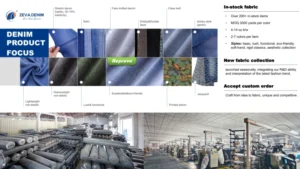
As a leading denim fabric manufacturer in China, ZEVA DENIM integrates research and development, production, and global marketing, delivering both classic and cutting-edge denim to the world.
We offer:
– Over 200+ denim fabrics, from rigid twill to sustainable and functional blends
– Small MOQ, ideal for both brands and boutiques
– Fast delivery, typically within 10 days
– Responsive, expert support throughout your sourcing journey
Whether you need high-performance stretch denim, specialty textures, or eco-conscious materials, ZEVA DENIM supports you in building a strong and flexible product line.
Explore our collections at: https://www.zevadenim.com
 English
  Russian
  Spanish
  Arabic
  French
  Vietnamese