
From Botanical Restraint to the Future of Elevated Texture Denim
As denim continues moving beyond basic indigo and traditional wash-driven differentiation, a noticeable shift is emerging: statement fabrics are becoming more refined rather than more aggressive. Instead of relying on oversized graphics, heavy embellishment, or extreme washes, many FW26/27 developments are focusing on texture, structure, and controlled decoration.
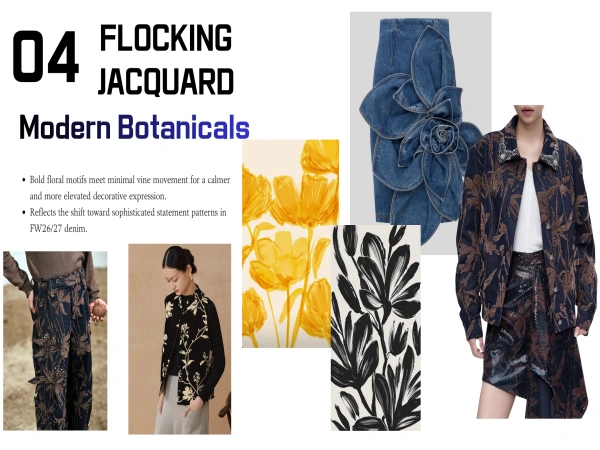
Modern Botanicals Chenille Denim reflects this transition particularly well.
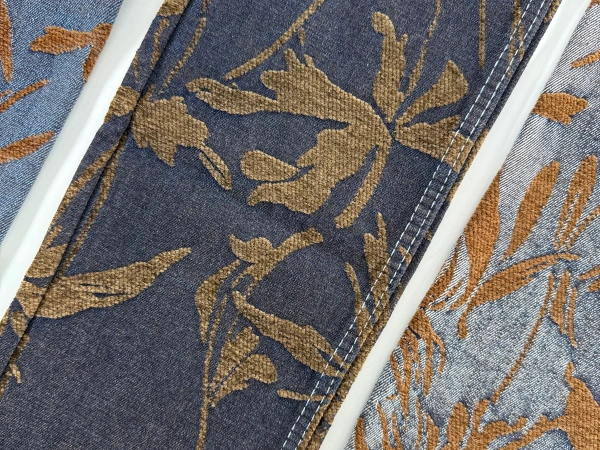
Using oversized floral motifs, restrained vine movement, and chenille flocking texture, the design creates visual richness without visual noise. It belongs to a growing category of “sophisticated statement fabrics”—materials that attract attention through depth and texture rather than loudness.
In this article, we will explore:
- Why botanical motifs continue evolving in modern denim collections
- How contemporary floral denim differs from traditional floral fashion cycles
- What happens when chenille denim undergoes garment washing
- Which wash effects work best with flocking jacquard denim
- Why texture preservation is becoming increasingly important in product development
- How Modern Botanicals aligns with upcoming FW26/27 denim directions
Rather than simply examining a floral pattern, this article explores how texture-driven botanical denim is becoming a strategic product category in modern denim development.
PART 1
Decoding Modern Botanical Motifs in Chenille Denim
Why This Design Is Worth Attention — When Floral Patterns Become More Mature
Floral patterns have always occupied a complicated position within denim.
On one hand, florals offer immediate visual recognition and broad consumer appeal.
On the other hand, floral denim often risks becoming overly decorative, seasonal, or trend-dependent.
This challenge becomes especially apparent in womenswear denim, where floral themes frequently swing between two extremes:
- overly romantic
- overly commercial
Modern Botanicals avoids both.
Instead of emphasizing sweetness or nostalgia, it introduces a more controlled and mature interpretation of botanical imagery.
Large-scale flowers dominate the surface, while delicate vine structures provide movement without overwhelming the composition.
The result feels less like a decorative print and more like a textile architecture.
This distinction is important because contemporary consumers increasingly seek products that feel elevated rather than embellished.
The visual language shifts from:
“Look at the pattern.”
to:
“Look at how the fabric behaves.”
The Evolution of Botanical Motifs — From Decoration to Atmosphere
Botanical imagery has appeared repeatedly throughout fashion history.
Several key periods shaped how floral motifs are understood today.
Art Nouveau (1890–1910)
Originating primarily in France and Belgium, Art Nouveau transformed flowers and vines into flowing organic forms.
Rather than copying nature literally, designers stylized it.
This period established one of the earliest foundations for modern botanical aesthetics.
Mid-Century Decorative Textiles (1950s–1970s)
Floral motifs became increasingly decorative and repetitive.
The emphasis was on ornament rather than atmosphere.
Contemporary Botanical Revival (2020–Present)
Today’s botanical trend differs significantly.
Rather than filling surfaces with dense floral repetition, designers increasingly focus on:
- larger scale motifs
- more spacing
- softer movement
- structural integration
The objective is no longer decoration.
It is visual balance.
This explains why oversized floral motifs have returned strongly across fashion, interiors, and textiles since 2022.
Why Modern Botanicals Feels Different From Traditional Floral Denim
Traditional floral denim generally relies on one of three approaches:
- printing
- embroidery
- patchwork decoration
These methods create visual interest but often sit on top of the fabric.
Modern Botanicals works differently.
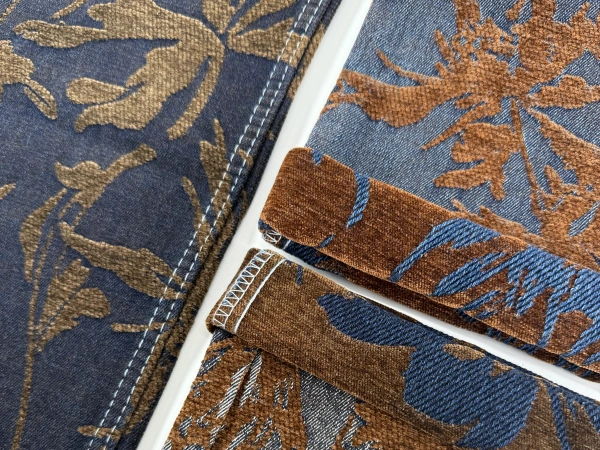
The botanical elements become part of the textile structure itself.
This creates several important differences:
Traditional Floral Denim
- graphic-focused
- surface-applied
- trend-driven
Modern Botanical Chenille Denim
- texture-focused
- structurally integrated
- atmosphere-driven
The distinction may seem subtle, but it dramatically changes how the fabric behaves after washing and wear.
Cultural Meaning — Why Botanical Themes Keep Returning
One reason botanical imagery continues reappearing throughout fashion history is its universality.
Flowers and vines are understood across cultures.
Unlike abstract graphics, they require little explanation.
Historically, floral motifs have symbolized:
Western cultures:
- beauty
- growth
- romance
- prosperity
Eastern cultures:
- harmony
- balance
- seasonal change
- renewal
Today, these meanings have evolved.
Modern consumers rarely purchase floral products because of symbolic meaning alone.
Instead, botanical imagery increasingly represents something broader:
connection to nature.
As consumers spend more time in digital environments, natural forms provide visual relief from rigid, screen-based aesthetics.
This is one reason botanical themes continue outperforming many trend-based graphics.
Visual Characteristics — Controlled Movement and Elevated Density
Several design characteristics define Modern Botanicals.
Oversized Floral Scale
Large flowers create strong visual identity.
Unlike dense floral repeats, oversized motifs allow the eye to rest between elements.
This creates a more premium appearance.
Minimal Vine Movement
The vines serve a specific purpose.
They connect motifs without overcrowding the surface.
This creates:
- rhythm
- flow
- continuity
without excessive complexity.
Chenille Texture
Perhaps the most distinctive characteristic is texture.
The chenille construction introduces:
- dimensional depth
- tactile softness
- subtle light variation
As a result, the pattern remains interesting even when viewed from a distance.
The fabric communicates through both texture and imagery simultaneously.
Why This Type of Pattern Works Naturally with Denim
Denim is a fabric that improves through aging.
Many decorative treatments become weaker after washing.
Texture-driven designs often become stronger.
Because chenille exists as part of the fabric structure:
- washing increases contrast
- fading reveals depth
- texture remains visible
This compatibility makes botanical chenille particularly suitable for denim.
Rather than fighting denim’s evolution, the design evolves with it.
Closing Insight of Part 1
Modern Botanicals is not simply another floral denim pattern.
It represents a broader shift occurring across fashion:
from decoration to atmosphere.
from graphics to texture.
from trend-driven design to material-driven design.
And that transition is precisely why sophisticated botanical chenille fabrics are becoming increasingly relevant in FW26/27 denim collections.
PART 2
Product Development & Washing Analysis — How Chenille Denim Evolves After Washing
What Happens to Chenille Denim After Washing?
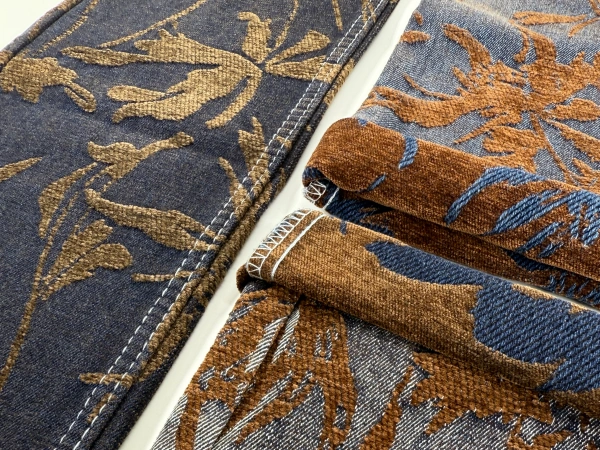
One of the most important characteristics of chenille denim is that washing does not simply change the color.
It changes the texture perception.
After garment washing:
- indigo softens
- contrast increases
- chenille becomes more pronounced
The surface often gains depth because fading exposes differences between the chenille elements and the denim ground.
This is why chenille denim frequently appears more attractive after washing than before.
Which Washes Work Best for Chenille Denim?
Not all denim washes perform equally on chenille structures.
The most suitable options include:
Enzyme Wash
Creates:
- soft handfeel
- clean appearance
- controlled texture enhancement
Ideal for premium collections.
Light Stone Wash
Introduces:
- dimensional contrast
- vintage depth
- texture visibility
Without excessive damage.
Snow Wash
Particularly effective for flocking chenille denim.
The contrast between faded indigo and textured motifs becomes dramatically more visible.
This creates a highly commercial fashion appearance.
Why Snow Wash Works Particularly Well on Flocking Denim
Snow wash selectively brightens the denim ground while preserving much of the flocking texture.
The result:
- stronger visual separation
- enhanced dimensionality
- richer garment character
Because texture already exists within the fabric, snow wash amplifies it rather than replacing it.
This is why many chenille developments are specifically designed with snow-wash applications in mind.
How to Maintain Chenille Texture After Washing
Texture preservation is critical.
Recommended approaches include:
- controlled enzyme dosage
- shorter wash cycles
- lower mechanical abrasion
- reduced stone quantities
The objective is enhancement rather than destruction.
Well-developed chenille denim should reveal texture, not lose it.
Why Overwashing Damages Texture Denim
One common mistake is treating chenille denim like ordinary denim.
Excessive washing can:
- flatten chenille surfaces
- reduce pile height
- weaken texture contrast
This creates a paradox.
The more aggressively the garment is washed, the less unique the fabric becomes.
For texture-driven denim, restraint often produces better results than intensity.
PART 3
This Design Element in Practice — Modern Botanicals in Contemporary Denim Collections
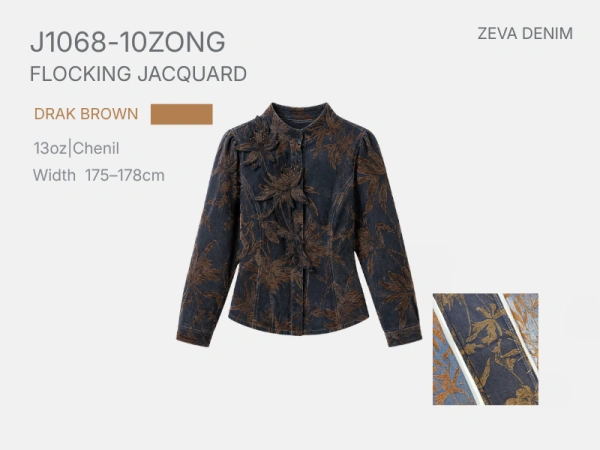
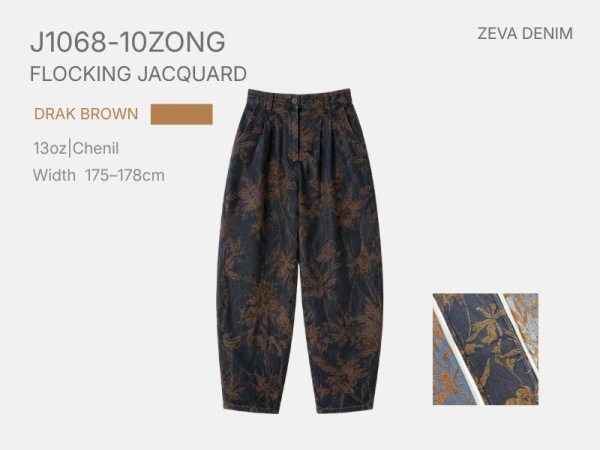
Where This Fabric Works Best
Because Modern Botanicals is a non-stretch chenille denim with large-scale motifs, it performs best on silhouettes that allow the pattern to remain visible.
Recommended applications:
Women’s wear:
- relaxed jeans
- barrel-leg jeans
- wide-leg jeans
- skirts
- dresses
- cropped jackets
- fashion overshirts
The imagery naturally aligns with premium womenswear positioning.
Less suitable:
- skinny fits
- highly segmented garments
- technical utility styles
These interrupt the visual flow of the botanical composition.
Trend Alignment — Why It Fits FW26/27
Modern Botanicals aligns strongly with several emerging directions:
Sophisticated Statement
Attention through texture rather than logos.
Elevated Decorative
Decoration remains present but controlled.
Soft Retro
Historical botanical references interpreted through contemporary proportions.
Quiet Luxury Texture
Depth created through material rather than branding.
These trends are expected to remain influential throughout FW26/27.
What Makes This Pattern Different on Denim?
Three factors separate it from ordinary floral denim.
Structure
Integrated into fabric rather than added afterward.
Color Behavior
Texture remains visible even after fading.
Density
Large motifs with controlled spacing create a cleaner and more premium visual effect.
The pattern feels deliberate rather than crowded.
Closing Insight of Part 3
Modern Botanicals succeeds because it balances:
- decoration and restraint
- texture and clarity
- statement and sophistication
It is not designed to dominate the garment.
It is designed to elevate it.
PART 4
Closing Insight — When Texture Becomes the New Luxury in Denim
As denim product development continues evolving, one trend is becoming increasingly clear:
texture is replacing excess.
Rather than relying on heavier washes, louder graphics, or more embellishment, many premium developments are finding value through material depth.
Modern Botanicals reflects this shift perfectly.
Its oversized florals, controlled vine movement, and chenille texture create a sophisticated form of differentiation that remains relevant beyond short-term fashion cycles.
For buyers and designers, the lesson is increasingly practical:
The future of specialty denim may not belong to the most complicated pattern.
It may belong to the fabric that continues revealing value after washing, wearing, and repeated use.
One example of this direction can be seen in J1068 Modern Botanicals, where botanical imagery and chenille texture are integrated directly into the fabric structure to create a refined, texture-led denim experience.
 English
  Russian
  Spanish
  Arabic
  French
  Vietnamese