
Today’s denim market is no longer driven solely by color, weight, or washing techniques. As brands compete for differentiation, surface texture is becoming one of the most valuable tools for creating perceived value. J2076 “Rust Marks” reflects this shift through a chenille jacquard interpretation of weathered industrial surfaces and oxidized textures.
In this article, we will explore:
- Why industrial-inspired texture denim is gaining momentum in modern fashion.
- The origins and evolution of weathered surface aesthetics.
- How chenille jacquard denim transforms architectural and oxidized textures into wearable fabrics.
- Which garments and markets are best suited for this type of textured denim.
- Why texture-rich denim aligns perfectly with the Quiet Luxury and elevated casualwear movements.
- What buyers and product developers should understand before introducing chenille texture denim into their collections.
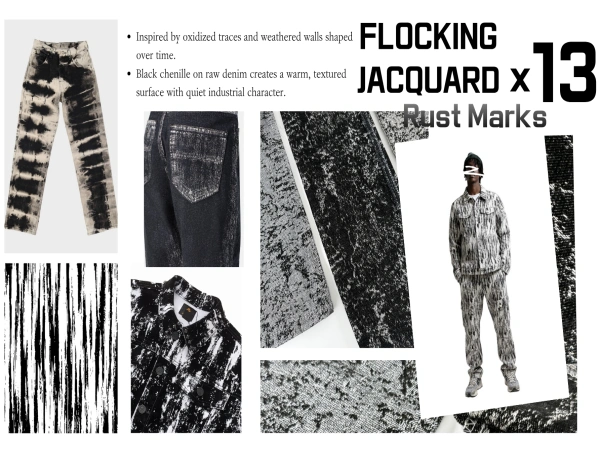
J2076 Rust Marks: Reimagining Industrial Decay Through Denim
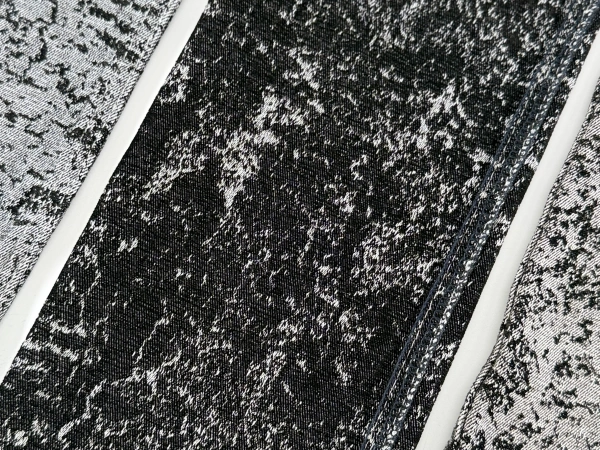
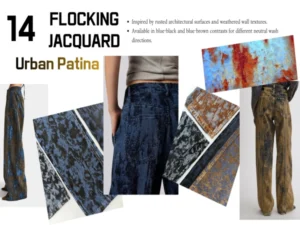
J2076 Rust Marks is inspired by the visual language of oxidized metal, aging concrete walls, weather-beaten surfaces, and industrial materials shaped by time.
Unlike floral, geometric, or heritage jacquard motifs, this design does not originate from traditional decorative art. Instead, it draws inspiration from environmental textures—surfaces that naturally develop character through exposure, erosion, and aging.
The result is a denim surface that feels authentic rather than decorative.
In many ways, the design reflects a broader shift happening across fashion. Consumers are increasingly attracted to products that feel lived-in, imperfect, and genuine. Rather than pursuing flawless surfaces, designers are embracing materials that tell stories through texture.
Rust Marks embodies this philosophy.
Where Does This Aesthetic Come From?
The fascination with aged surfaces can be traced back to several design movements.
Japanese Wabi-Sabi aesthetics celebrated imperfection and weathering long before they became mainstream fashion concepts. Industrial architecture in Europe and North America later popularized exposed concrete, rusted steel, and unfinished materials as symbols of authenticity.
During the 1990s and early 2000s, distressed fashion translated these ideas into garments through heavy washing, destruction, and vintage effects.
However, the modern interpretation differs significantly.
Instead of artificially damaging garments after production, contemporary designers increasingly build texture directly into the fabric structure.
This is where chenille jacquard denim becomes particularly relevant.
Rather than imitating age through washing alone, the texture becomes part of the fabric itself.
The visual effect appears deeper, richer, and more permanent.
Why Rust-Inspired Texture Feels Relevant Again in FW26/27
Several macro trends are driving the return of industrial-inspired surfaces.
First, fashion is moving away from obvious logos and graphic-heavy storytelling.
Second, consumers are showing greater appreciation for tactile experiences. Materials are expected not only to look interesting but also to feel distinctive.
Third, the popularity of Quiet Luxury has created demand for subtle complexity.
Rust Marks fits perfectly into this environment.
The pattern is visually rich without being loud.
The texture creates interest without relying on bright colors.
The result feels premium because it rewards close inspection rather than immediate attention.
Visual Characteristics of J2076 Rust Marks
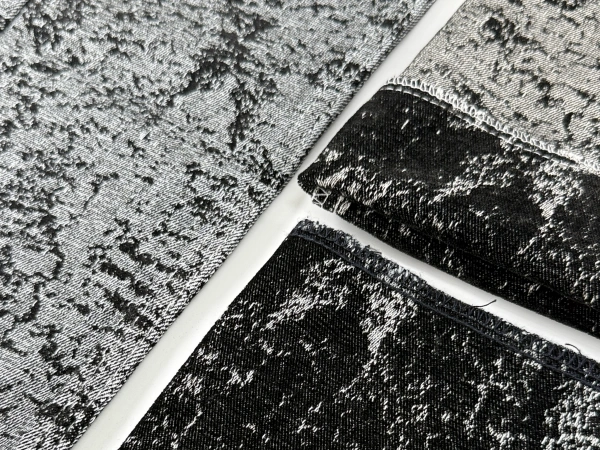
One of the most compelling aspects of this fabric is its layered visual structure.
At first glance, the surface resembles weathered concrete or oxidized metal.
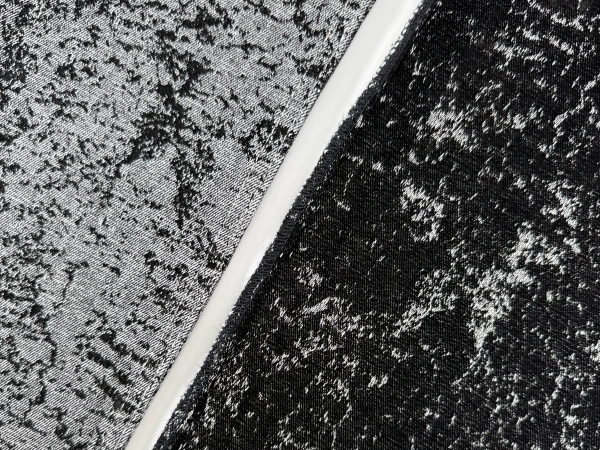
Looking closer, the viewer begins to notice irregular texture clusters, fragmented shapes, and subtle transitions between raised chenille areas and denim ground cloth.
Several characteristics define the aesthetic:
Organic Irregularity
No obvious repeat dominates the design.
This creates a more natural appearance than conventional geometric jacquards.
Tonal Depth
The contrast between black chenille and the lighter denim ground creates visual depth without excessive color variation.
Architectural Texture
The surface resembles aged building materials rather than traditional textile motifs.
Matte Sophistication
Unlike shiny coatings or metallic treatments, chenille delivers a softer, more understated finish.
This contributes significantly to its premium appearance.
Product Application & Fashion Direction: Which Garments Work Best for Chenille Jacquard Denim?
One of the most common questions buyers ask is:
Which garments can successfully use chenille jacquard denim?
The answer depends largely on the scale and complexity of the texture.
For J2076 Rust Marks, several categories stand out.
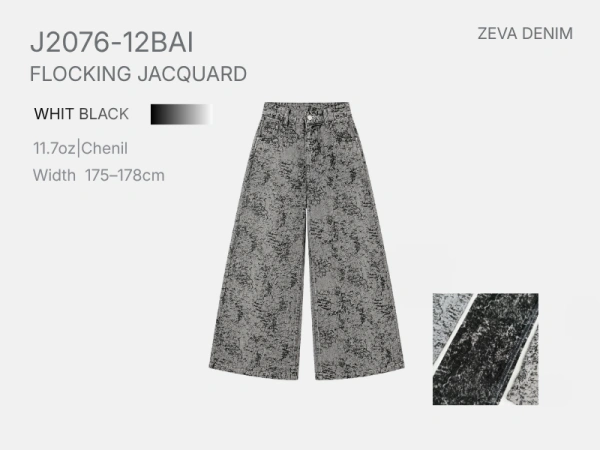
Wide-Leg Jeans
The pattern benefits from larger uninterrupted surfaces.
Wide-leg silhouettes allow the texture to remain visible and impactful.
Denim Jackets
Workwear-inspired trucker jackets and oversized silhouettes provide ideal canvases for industrial textures.
Utility Overshirts
The weathered appearance pairs naturally with utility-inspired fashion.
Structured Skirts
A-line and maxi skirts create movement while showcasing the fabric’s surface variation.
Matching Sets
Coordinated jackets and pants amplify the visual impact of texture-rich denim.
Because J2076 is a rigid, non-stretch construction, it is particularly suitable for garments that benefit from shape retention and structural stability.
Why Chenille Jacquard Denim Performs
Especially Well in Women’s Fashion
Women’s fashion typically adopts texture innovation faster than men’s fashion.
Several factors explain this trend.
First, women’s collections often prioritize surface differentiation.
Second, consumers tend to be more receptive to tactile experimentation.
Third, premium women’s denim increasingly competes with luxury ready-to-wear rather than basic casualwear.
Chenille jacquard denim helps bridge that gap.
It introduces a fashion-forward surface while retaining the familiarity and versatility of denim.
As a result, designers can create products that feel elevated without alienating mainstream consumers.
Is Chenille Denim Suitable for Menswear?
The short answer is yes—but not in the same way.
Menswear generally favors texture over ornamentation.
This is why industrial-inspired patterns like Rust Marks often perform better than floral or decorative motifs in male collections.
The weathered surface communicates authenticity, durability, and craftsmanship.
These qualities align closely with modern menswear preferences.
Applications include:
- Workwear jackets
- Carpenter pants
- Utility trousers
- Overshirts
- Coordinated denim sets
For men’s collections, darker washes tend to perform particularly well because they emphasize texture while maintaining versatility.
Why Chenille Denim Is Ideal for Winter Denim Collections
Seasonality plays an important role in fabric selection.
Winter collections naturally benefit from materials that communicate warmth.
Although chenille jacquard denim does not dramatically increase thermal performance, it creates a psychological sense of warmth through texture.
Consumers often associate raised surfaces with comfort and softness.
Compared with flat denim constructions, chenille jacquard appears more substantial and luxurious.
This makes it especially suitable for:
- Fall/Winter collections
- Holiday capsules
- Premium casualwear
- Elevated everyday denim
The black-on-ecru coloration of J2076 further reinforces this seasonal appeal.
How Texture Denim Aligns with the Quiet Luxury Trend
Quiet Luxury is often misunderstood as simply neutral colors and minimal styling.
In reality, the movement places greater emphasis on material quality and subtle craftsmanship.
Texture becomes a key storytelling tool.
Instead of relying on logos or graphics, products communicate value through:
- Fabric development
- Surface complexity
- Construction quality
- Material depth
Rust Marks embodies this principle perfectly.
The pattern is not immediately obvious from a distance.
Its value emerges through closer observation.
This aligns directly with how luxury consumers increasingly evaluate products.
What Makes Rust Marks Different from Other Texture Denim Designs?
Many texture-inspired denim fabrics focus on geometric repetition.
Others imitate reptile skin, camouflage, or distressed washes.
Rust Marks occupies a different space.
Structure
The pattern behaves more like environmental texture than a decorative motif.
Color Strategy
Rather than introducing multiple colors, the design relies on tonal contrast.
Density Distribution
The texture appears uneven and naturally fragmented.
This irregularity contributes to its authenticity.
Emotional Tone
The fabric feels industrial, architectural, and mature rather than playful or ornamental.
This expands its appeal across both women’s and men’s collections.
Why Industrial Texture May Become a Long-Term Denim Direction
Fashion cycles are increasingly moving toward authenticity.
Consumers want products that feel unique without appearing forced.
Industrial texture denim addresses this demand by introducing complexity through structure rather than decoration.
As digital design tools continue evolving, buyers will likely see more fabrics inspired by:
- Concrete surfaces
- Oxidized metals
- Erosion patterns
- Architectural materials
- Geological formations
Rust Marks represents an early example of this broader movement.
It demonstrates how denim can evolve beyond traditional washes while still remaining recognizable as denim.
Final Thoughts
By combining black chenille with a raw denim foundation, the fabric captures the visual language of oxidized walls, weathered structures, and naturally aged materials. The result is a textured denim that feels contemporary, premium, and highly relevant to FW26/27 market directions.
For designers, buyers, and product developers seeking alternatives to traditional floral, geometric, or vintage denim concepts, industrial texture denim offers a compelling new pathway.
If you would like to explore additional specifications, garment examples, washing effects, or video demonstrations of J2076 Rust Marks, you can continue with the product page and accompanying development video to see how the texture performs across different washes and garment applications.https://youtube.com/shorts/kMOKBYLutY4?feature=share
 French
  English
  Russian
  Spanish
  Arabic
  Vietnamese