
From Romantic Ribbon Details to Refined Feminine Texture in Modern Denim
PART 1
Decoding “Ribbon Bouquet” in Chenille Jacquard Denim
Why This Design Is Worth Attention — When Feminine Denim Becomes More Refined
For a long time, feminine denim often relied on obvious decoration to communicate softness:
- heavy floral prints
- lace-inspired embroidery
- bright embellishments
- oversized romantic graphics
But in recent years, especially in premium casual and elevated womenswear, a different direction has started emerging.
Femininity is becoming quieter.
Instead of loud decoration, brands are increasingly using:
- texture
- movement
- subtle detailing
- tonal layering
to create emotional softness in a more wearable way.
This is exactly where “Ribbon Bouquet” becomes relevant.
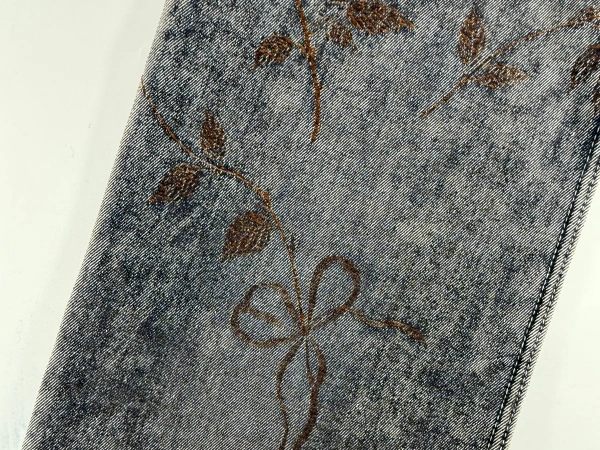
The design combines flowing ribbon bows with delicate floral movement, creating the feeling of a carefully wrapped bouquet carried through motion.
The visual effect is not dramatic.
It is controlled and refined.
That difference matters increasingly in modern denim.
Because consumers are now drawn toward products that feel:
- elegant but wearable
- decorative but not overwhelming
- feminine without becoming fragile
especially in contemporary premium casual collections.
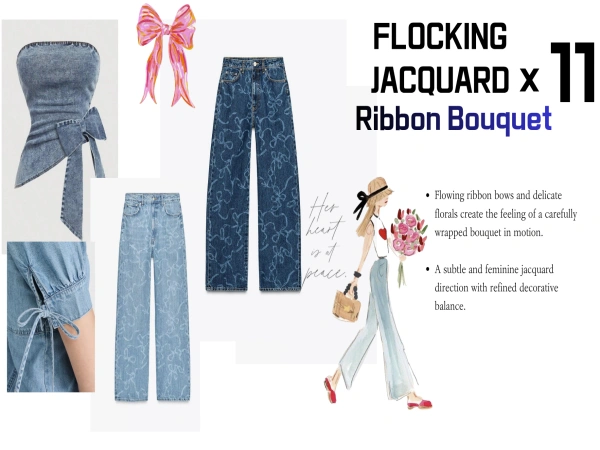
From Ribbon Ornament to Modern Surface Language
Ribbon motifs have a long history across European and East Asian decorative culture.
Historically, ribbons symbolized:
- celebration
- affection
- femininity
- craftsmanship
- ceremonial beauty
They appeared frequently in:
- couture dressmaking
- gift wrapping aesthetics
- Rococo-inspired decoration
- bridal accessories
- romantic textile ornamentation
But traditional ribbon design often depended heavily on:
- symmetry
- volume
- highly visible decoration
Modern fashion has gradually softened this approach.
Instead of using ribbons as direct ornament, contemporary textile development increasingly extracts:
- flow
- softness
- movement
- emotional delicacy
from ribbon structures themselves.
This shift is important.
Because modern consumers often prefer emotional suggestion over obvious decoration.
In “Ribbon Bouquet,” the ribbon is not presented as a literal accessory.
It becomes part of the fabric rhythm itself.
The jacquard no longer behaves like surface decoration.
It behaves like movement woven into denim.
Why Romantic Texture Is Returning in Modern Womenswear
One major trend shift since around 2023 is the return of “soft romantic texture” in premium fashion.
After years dominated by:
- minimalism
- clean tailoring
- logo-driven fashion
- streetwear graphics
many womenswear brands are moving toward:
- emotional softness
- tactile femininity
- poetic detailing
- understated romance
This movement is especially visible in:
- premium denim
- resort collections
- elevated casualwear
- capsule collections
But the new romantic direction is very different from older decorative fashion.
Previously:
- romance = heavy decoration
Now increasingly:
- romance = atmosphere + texture + movement
That is why subtle jacquard directions like “Ribbon Bouquet” feel more commercially relevant today.
The softness is integrated into:
- structure
- spacing
- tonal depth
- chenille tactility
rather than relying on visual overload.
Why Chenille Changes the Feeling of Feminine Denim
If this design were printed on flat denim, much of its softness would disappear.
Chenille jacquard changes the experience because it introduces:
- tactile warmth
- raised softness
- dimensional shadow variation
- fluid surface movement
This is especially important for feminine denim because chenille naturally softens the emotional perception of the fabric.
Compared with rigid flat denim, chenille creates a surface that feels:
- gentler
- warmer
- more layered
- more emotionally comfortable
As garments move under light, the ribbon-inspired structure develops subtle depth shifts across the surface.
This creates a more refined and premium feeling than direct decorative graphics.
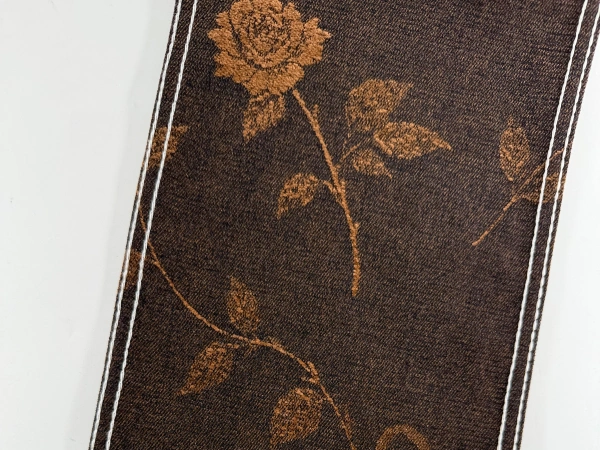
Visual Characteristics: Softness, Spacing, and Controlled Femininity
One reason “Ribbon Bouquet” works commercially is because it avoids the biggest risk in feminine denim:
over-decoration.
Instead, the fabric balances:
- softness
- elegance
- wearability
- decorative detail
through controlled structure.
Key visual characteristics include:
- Flowing Ribbon Movement
The ribbon-inspired lines create soft directional movement across the fabric.
This gives the surface:
- rhythm
- fluidity
- lightness
instead of static decorative placement.
- Delicate Floral Layering
The floral details remain refined and dispersed rather than dense.
This preserves femininity without making the fabric visually heavy.
- Tonal Decorative Depth
Instead of relying on bright contrast, the fabric builds richness through:
- chenille height variation
- tonal shadow depth
- soft reflection changes
This allows the fabric to remain elegant after washing and garment construction.
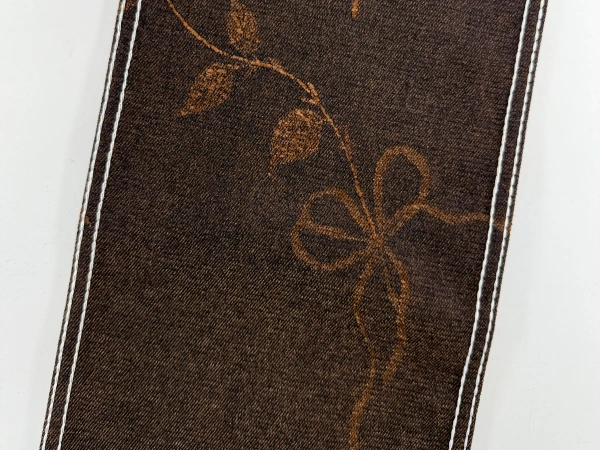
Why This Type of Pattern Works Naturally on Denim
Decorative motifs often struggle on denim because denim naturally:
- fades
- softens
- develops irregularity
Highly precise decorative layouts can lose balance after garment washing.
But “Ribbon Bouquet” behaves differently because:
- the spacing remains breathable
- the movement is fluid
- the structure already contains softness and irregularity
As a result, washing does not flatten the design.
Instead, it enhances:
- tonal layering
- texture depth
- emotional softness
especially under lighter vintage and enzyme washing directions.
Closing Insight of Part 1
The value of “Ribbon Bouquet” is not based on obvious decoration.
Its strength lies in refined softness.
By combining:
- ribbon-inspired movement
- delicate floral structure
- chenille tactility
- breathable spacing
the fabric creates a more emotionally wearable direction for feminine denim.
In this context, chenille jacquard is no longer functioning simply as decorative texture.
It becomes a way for denim to express softness, elegance, and movement simultaneously.
PART 2
Chenille Jacquard Denim Market Analysis:
Why Chenille Denim Is Becoming a Fast Differentiation Tool for Brands
Texture Denim Is Expanding Beyond Seasonal Fashion
For many years, chenille jacquard denim was considered a niche category mainly associated with:
- boutique fashion
- runway experimentation
- limited seasonal collections
But over the past few years, the market has shifted noticeably.
Texture-driven denim is now appearing more frequently in:
- premium casualwear
- capsule collections
- fashion denim programs
- elevated womenswear categories
This shift is not only aesthetic.
It reflects a broader industry change:
brands are increasingly searching for differentiation at the fabric level instead of relying entirely on washing or graphics.
As denim products become more visually repetitive, texture itself is becoming a faster and more effective way to create perceived newness.
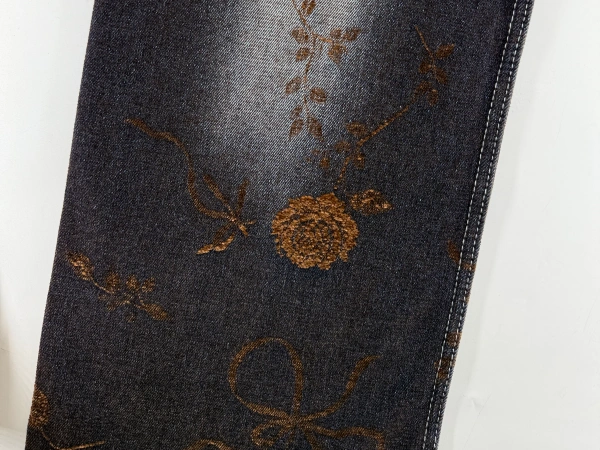
Why Chenille Denim Helps Brands Differentiate Faster
One major advantage of chenille jacquard denim is development efficiency.
Traditional differentiation often depends on:
- complex washing
- embroidery
- prints
- heavy garment finishing
These methods increase:
- sampling time
- production instability
- development cost
Chenille jacquard changes the process because part of the visual identity is already integrated into the fabric structure itself.
This allows brands to create:
- richer surfaces
- stronger product recognition
- more emotional texture
with simpler garment development.
For many brands, this is becoming increasingly important in fast-moving collections where:
- SKU rotation is faster
- development cycles are shorter
- consumers expect constant freshness
Texture denim allows products to look differentiated immediately — even before washing.
Why Chenille Denim Works Especially Well for Capsule Collections
Capsule collections rely heavily on:
- strong visual identity
- quick recognition
- controlled product quantity
- emotional storytelling
This is exactly where chenille jacquard performs well.
Because chenille texture naturally creates:
- tactile richness
- surface layering
- elevated appearance
- emotional atmosphere
without requiring excessive styling.
In capsule programs, brands often need fabrics that can:
- carry the collection identity quickly
- feel special immediately
- support premium positioning with fewer SKUs
Texture-driven denim helps achieve this efficiently.
Especially for womenswear capsule collections, softer chenille jacquards like “Ribbon Bouquet” allow brands to create products that feel:
- refined
- feminine
- modern
- emotionally distinctive
without becoming visually overwhelming.
Why Mid-to-High-End Brands Increasingly Focus on Fabric-Level Differentiation
Another major shift in denim is the growing importance of “fabric-first” development.
Previously, many products relied mainly on:
- silhouette
- washing
- branding
to create product identity.
Now increasingly, brands want the fabric itself to communicate:
- value
- craftsmanship
- emotional depth
- premium positioning
This is especially important because:
washing effects are becoming easier to imitate across suppliers.
Fabric structure, however, is harder to replicate quickly.
That gives chenille jacquard a stronger premium advantage.
Compared with flat denim surfaces, chenille naturally creates:
- dimensionality
- warmth
- movement
- tactile sophistication
which consumers often associate with:
- higher quality
- richer material value
- more exclusive product development
Regional Growth: Where Chenille Jacquard Denim Is Growing Fastest
Growth is especially visible in:
Europe
Especially:
- Italy
- France
- Spain
where premium womenswear brands increasingly prefer:
- softer texture
- tonal decoration
- refined feminine surfaces
Middle East
Texture-driven denim performs strongly in:
- premium casualwear
- decorative capsule collections
- occasion-inspired denim products
where richer surfaces often create stronger perceived luxury.
Latin America
In:
- Colombia
- Mexico
- Peru
chenille denim is increasingly used to elevate:
- boutique fashion denim
- feminine statement bottoms
- premium casual collections
especially in womenswear-focused retail programs.
Closing Insight of Part 2
The growth of chenille jacquard denim is not simply about decoration returning to fashion.
It reflects a larger shift toward:
- fabric-level differentiation
- emotionally layered products
- texture-driven identity
As brands search for faster ways to create differentiation without relying entirely on washing or graphics, chenille jacquard is becoming increasingly valuable.
Because it allows the fabric itself to become part of the collection language.
PART 3
This Design Element in Practice:
Ribbon Bouquet Chenille Jacquard in Denim
Where This Fabric Works Best
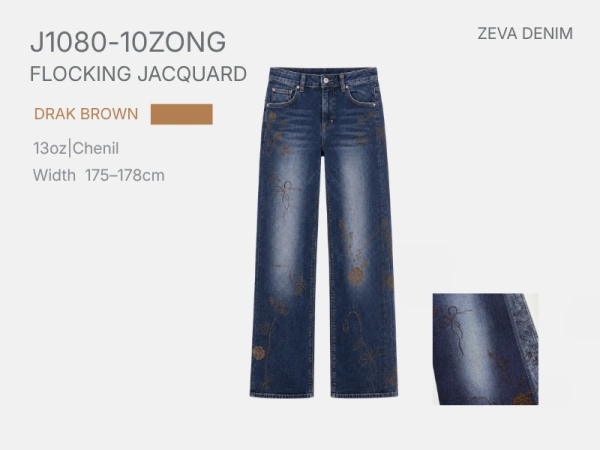
Unlike heavy decorative jacquards, “Ribbon Bouquet” performs best on products that allow the surface to remain soft, breathable, and fluid.
Its refined feminine movement makes it especially suitable for:
- womenswear denim
- elevated casualwear
- capsule collections
- resort-inspired products
particularly in:
- wide-leg jeans
- skirts
- relaxed jackets
- overshirts
- lightweight outerwear
These silhouettes allow the ribbon-inspired movement and delicate floral spacing to remain visually continuous across the garment surface.
Why It Aligns Naturally with Current Trends
This type of feminine texture fits especially well into:
- quiet luxury
- soft vintage denim
- modern romantic styling
- premium casualwear
- clean but layered aesthetics
What these trends share is a preference for:
- softness over visual aggression
- detail over decoration
- atmosphere over graphic impact
“Ribbon Bouquet” creates richness through:
- tonal movement
- chenille tactility
- breathable spacing
- refined layering
rather than through strong visual contrast.
What Makes This Pattern Different on Denim
The key difference lies in three areas:
- Structure
The ribbon and floral elements are integrated into flowing directional movement rather than centralized decorative layouts.
This creates:
- softer rhythm
- more natural garment movement
- better washing compatibility
- Color Behavior
The design relies more on:
- tonal depth
- chenille reflection
- shadow variation
than strong color contrast.
This helps preserve elegance after garment washing.
- Density
Unlike dense romantic florals, the spacing remains breathable.
This improves:
- wearability
- styling flexibility
- long-term visual comfort
Closing Insight of Part 3
The value of “Ribbon Bouquet” lies in controlled softness rather than decorative intensity.
It allows feminine denim to feel:
- refined
- layered
- emotionally wearable
- commercially versatile
while still maintaining strong surface identity through texture and movement.
PART 4 — Closing
When Feminine Denim Starts Feeling More Refined
One of the clearest shifts in modern womenswear denim is that femininity is becoming quieter, softer, and more texture-driven.
Instead of relying on obvious decoration, brands increasingly use:
- movement
- tactility
- tonal layering
- emotional softness
to create product identity.
“Ribbon Bouquet” reflects this direction clearly.
By combining ribbon-inspired flow, delicate floral movement, and chenille texture, the fabric creates a more refined interpretation of feminine textured denim.
One example of this approach can be seen in J1080, where flowing ribbon structures and soft floral chenille detailing are integrated directly into the denim surface to create subtle movement, decorative balance, and elevated softness.
If you are exploring how refined texture denim could fit into future collections, it is often worth observing not only how the fabric looks before washing — but how the movement and tonal depth continue evolving after garment processing and wear.
 French
  English
  Russian
  Spanish
  Arabic
  Vietnamese