
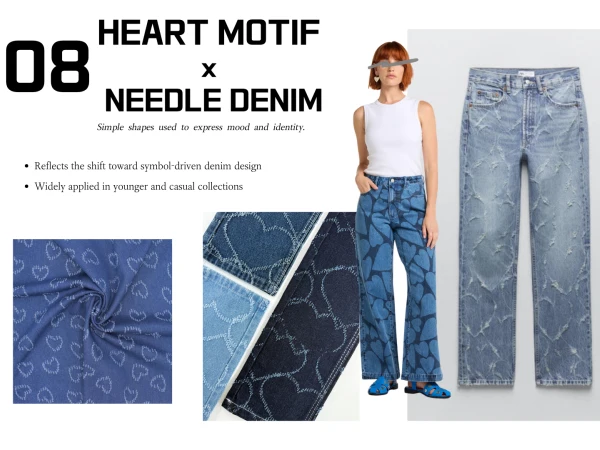
Introduction: Why Symbol-Driven Needle Denim Is Quietly Becoming a Commercial Winner
In recent seasons, denim design has been moving away from loud statements and toward something more subtle—but not simpler. Instead of complex jacquards or aggressive distressing, a new category is emerging: symbol-driven textured denim.
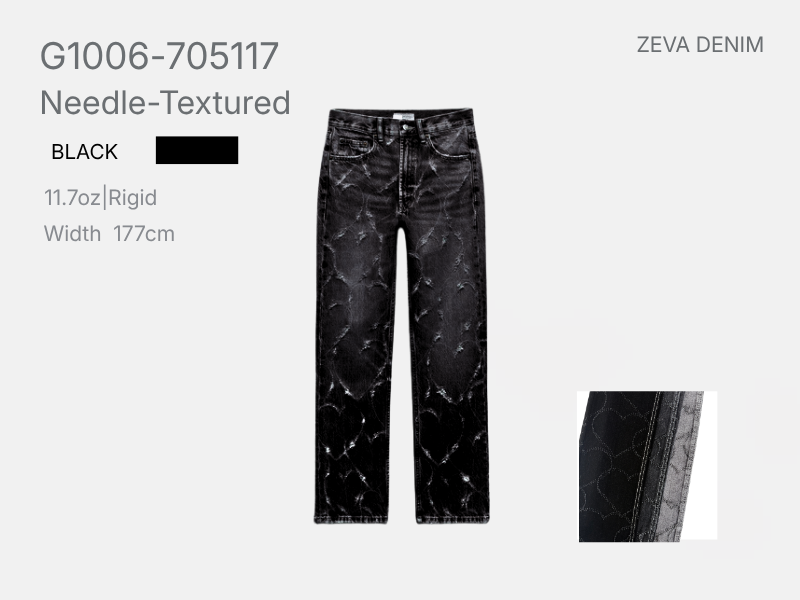
At first glance, fabrics like G1006-705117 may appear understated. The pattern is small, repetitive, and almost hidden within the indigo base. But this is exactly where its commercial power lies.
Unlike bold statement fabrics that dominate attention, this type of needle-punched denim integrates texture into the garment in a way that feels natural, wearable, and scalable. It doesn’t force a design—it supports it.
For denim buyers, wholesalers, and brands targeting younger or casual markets, this shift signals something important:
The future of denim texture is not louder—it’s smarter.
Part 1: Design Element Breakdown – The Rise of Symbol-Based Denim Texture
1. Why This Design Deserves Attention
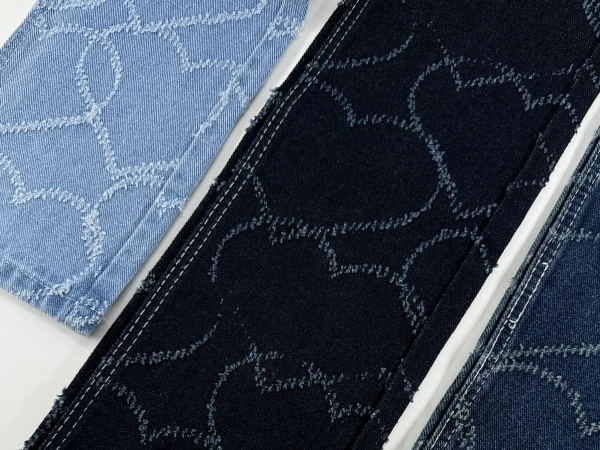
G1006 represents a transition point in denim design. Instead of relying on large florals or decorative motifs, it uses small symbolic shapes arranged in a dense, almost rhythmic pattern.
From a distance, the fabric reads as texture.
From a closer view, the pattern emerges.
This dual-layer visual effect is critical:
- It keeps garments clean and wearable
- It adds depth without overwhelming the silhouette
- It works across multiple product categories
In short, it solves one of the biggest problems in modern denim:
How to add differentiation without reducing versatility
2. From Ornament to Symbol: Evolution of Pattern in Denim
Historically, patterned denim followed a clear path:
- Early stage: embroidery and decorative florals (highly visible, often feminine)
- Mid stage: jacquard denim (structured, but still visually dominant)
- Current stage: symbol-driven micro-patterns
The difference today is not just aesthetic—it’s functional.
Older patterns were designed to be seen immediately.
Modern patterns like G1006 are designed to be discovered gradually.
This reflects a broader shift in fashion:
- From statement → to layering
- From decoration → to texture
- From gender-specific → to universal
3. Cultural Meaning: Identity Over Decoration
Symbol-based patterns are not just visual—they are conceptual.
Instead of representing flowers literally, the shapes become abstract markers of identity and mood. This is especially important for younger consumers, who are less interested in traditional symbolism and more focused on:
- individuality
- subtle differentiation
- personal styling flexibility
This is why G1006 feels more “modern” than classic floral denim.
It doesn’t say “this is a flower.”
It says “this is a texture you can make your own.”
4. Visual Characteristics Based on Fabric Analysis
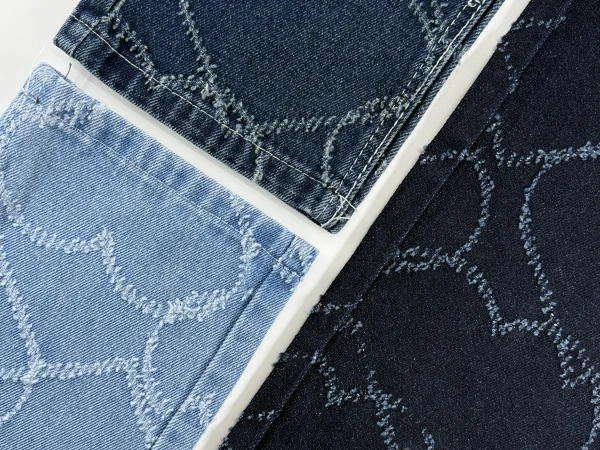
Looking at the fabric structure (as shown in the images), several key features stand out:
- High-density micro motifs→ creates a uniform surface effect
- Needle-punched texture→ adds a slightly raised, tactile finish
- Low contrast between pattern and base→ ensures wearability
- Indigo variation after washing→ enhances pattern visibility over time
One of the most important characteristics is how the pattern behaves after washing:
The texture becomes more visible, but never aggressive
This is crucial for commercial products, especially in casual and men’s denim.
Part 2: Industry Analysis – Selection Logic Behind Needle Denim
1. Development Style vs Commercial Style
One of the biggest mistakes buyers make when entering needle denim is confusing:
- “Interesting design”
with - “Sellable design”
Highly experimental needle fabrics often look impressive in showrooms but fail in production because:
- they are too visible
- too directional
- too difficult to style
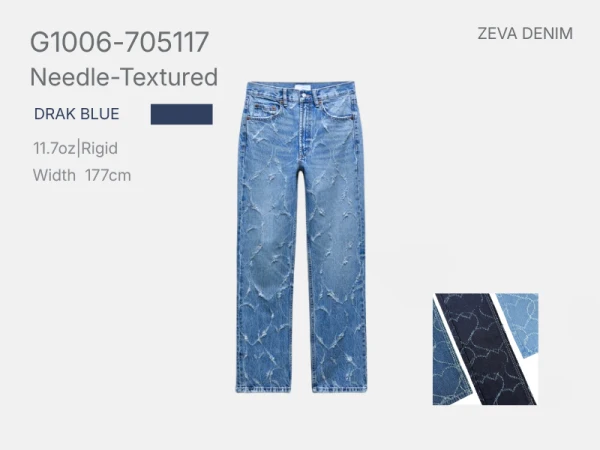
G1006, however, clearly falls into the commercial style category:
- balanced visual impact
- repeatable pattern
- easy integration into existing collections
This is what makes it scalable.
2. What Makes a Needle Denim Suitable for Long-Term Programs
Not all textured denim can become a repeat style.
For a needle fabric to work long-term, it must meet three conditions:
- Low styling risk
Designers should be able to use it across multiple silhouettes without redesigning the whole collection. - Wash adaptability
The pattern must evolve—not disappear or become too harsh—after washing. - Visual tolerance
Consumers should not feel “tired” of the pattern after repeated exposure.
G1006 performs well across all three.
3. The Most Overlooked Factor: Pattern Density
Many buyers focus on pattern shape—but ignore density.
Density determines:
- how the fabric reads from a distance
- how “busy” the garment feels
- how easy it is to match with other pieces
G1006 uses high-density micro repetition, which creates a semi-solid visual effect.
This is extremely important because:
It allows the fabric to function like a basic—while still being differentiated
4. How to Judge If a Needle Effect Is Too Much
A simple test:
If the pattern defines the garment, it’s too strong.
If the garment still defines itself, the pattern is correct.
G1006 passes this test.
Even when used in full garments, the structure and silhouette remain the focus—not the pattern.
5. Reverse Selection Logic: Start From Your Customer
Instead of asking:
“Is this fabric good?”
Buyers should ask:
“Who is this fabric for?”
G1006 is clearly suited for:
- young casual brands
- mid-market denim programs
- buyers targeting repeatable styles
It is not designed for:
- high-fashion statement collections
- luxury directional pieces
This clarity makes it easier to position and sell.
Part 3: Application Analysis – Where This Design Works Best
1. Garment Applications
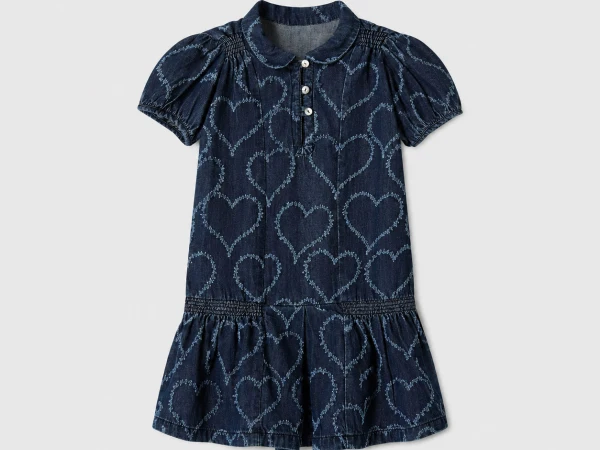
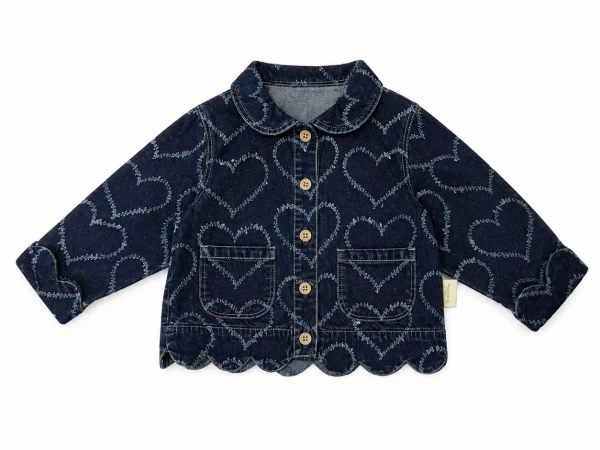
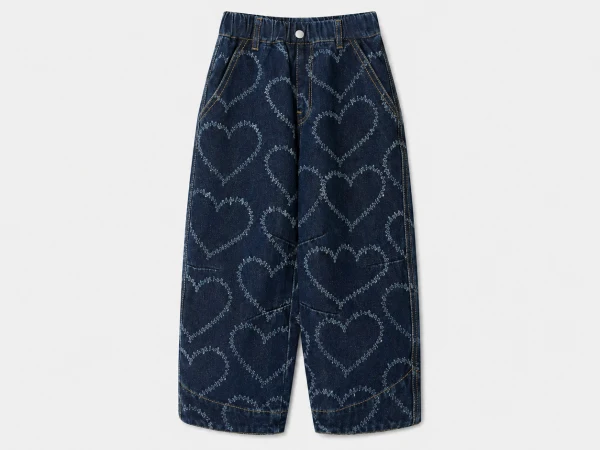
Based on the fabric behavior and pattern scale, G1006 is particularly suitable for:
- men’s casual jackets
- relaxed-fit jeans
- workwear-inspired overshirts
- unisex denim sets
- youth-oriented collections
Compared to larger floral designs (like G1003), this pattern is:
more neutral
more versatile
more scalable
2. Trend Alignment
This design aligns strongly with current trends such as:
- clean casual
- quiet texture
- everyday statement denim
It does not belong to:
- retro vintage floral
- heavy decorative denim
Instead, it fits into a newer category:
“functional texture denim”
3. What Makes This Pattern Different on Denim
When applied to denim, this pattern behaves differently compared to other fabrics:
Structure:
The twill base stabilizes the pattern, preventing distortion.
Color:
Indigo dyeing creates depth variation, making the pattern evolve after washing.
Density:
The micro-repeat ensures the fabric reads as texture, not print.
This combination is difficult to achieve in other fabric categories.
Conclusion: The Shift Toward Smarter, Not Louder Denim Design
Denim is no longer about making the boldest statement.
It is about making the most adaptable one.
G1006 represents a direction where:
- texture replaces decoration
- symbols replace literal patterns
- usability replaces visual impact
For buyers, this means a shift in mindset:
The best-selling fabrics are not always the most eye-catching
They are the ones that integrate seamlessly into real products
As the industry continues to evolve, fabrics like this will not dominate headlines—but they will dominate orders.
And in the end, that is what matters.
 French
  English
  Russian
  Spanish
  Arabic
  Vietnamese