
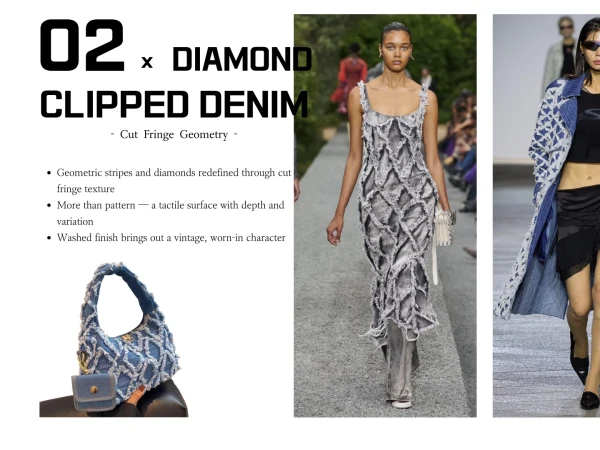
PART 1
Decoding Geometric Diamond Patterns in Clipped Denim
Why This Pattern Is Worth Attention — When Geometry Becomes Texture Instead of Structure
At first glance, diamond and geometric stripe patterns feel familiar in textiles. They are among the most widely used visual systems across weaving traditions, appearing in everything from classic shirting to heritage workwear and decorative fabrics. In denim, however, geometric motifs have historically played a limited role. They tend to appear either as clear, repetitive jacquard patterns or as subtle dobby textures, both of which rely heavily on visual clarity to communicate their identity.
What makes this type of clipped denim different is that it deliberately removes that clarity.
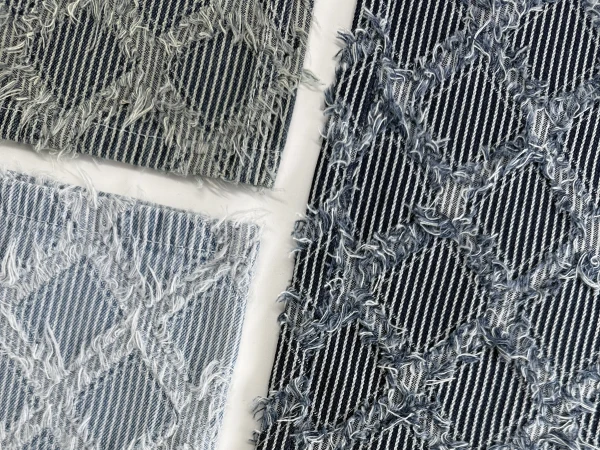
Instead of presenting a clean, readable diamond structure, the pattern is partially disrupted through a cut-fringe process. The geometric lines are still there, but they are no longer sharply defined. They break, soften, and dissolve into the surface. As a result, the pattern is no longer something you simply “see.” It becomes something you perceive through both sight and touch.
This shift—from visual geometry to tactile geometry—is what makes the design worth attention.
In a market where most patterned denim still depends on contrast and precision, this type of fabric introduces a different logic: the pattern does not need to be perfectly visible to remain effective. Its presence is carried by texture, not by outline. That changes how the fabric performs not only visually, but also commercially.
———————————————————————
From Traditional Diamond Motifs to Modern Reinterpretation
Geometric diamond patterns have deep roots across multiple textile cultures. Variations of this motif can be traced back to traditional weaving systems in regions such as Central Asia, the Middle East, and parts of South America, where diamonds and repeating geometric structures often symbolized order, protection, or continuity. In industrial textiles, similar structures later appeared in twills, dobby weaves, and jacquard constructions, becoming associated with durability and structured design.
In denim, however, the application of geometric motifs has always been constrained by the material itself. Denim fades, distorts, and evolves through washing and wear. Patterns that rely on strict alignment or sharp edges tend to lose their clarity after processing, which is why geometric jacquards in denim have historically been either bold and short-lived, or subtle to the point of being unnoticed.
The current reinterpretation addresses this limitation directly.
Instead of preserving geometric precision, modern clipped denim embraces its breakdown. The diamond structure is still used as a base system, but it is intentionally softened through fringe creation. The edges are no longer fixed; they become flexible and irregular. This transforms a traditionally rigid motif into a dynamic surface.
The difference between past and present is therefore not the pattern itself, but how it behaves:
Traditional geometric jacquard aims to maintain structure.
Clipped geometric denim allows structure to evolve.
This shift aligns closely with how denim naturally performs, making the pattern more compatible with the material rather than working against it.
———————————————————————
Cultural Meaning: From Symbolic Geometry to Material Expression
Historically, geometric patterns carried clear symbolic meanings. Diamonds, in particular, were often associated with protection, balance, and continuity. In many traditional textiles, these shapes were not purely decorative; they formed part of a visual language tied to identity and cultural storytelling.
In modern denim, these symbolic meanings are no longer the primary focus.
Instead, the geometric system becomes a framework for material exploration. The pattern does not need to communicate a narrative. It provides a structure that can be manipulated, disrupted, and reinterpreted through textile techniques. In clipped denim, this results in a shift from symbolic clarity to sensory experience.
The diamond no longer acts as a symbol to be read. It becomes a rhythm within the fabric—sometimes visible, sometimes hidden, but always influencing how the surface feels and behaves.
This reflects a broader transition in contemporary design: from meaning-driven motifs to material-driven aesthetics. What matters is not what the pattern represents, but how it interacts with the wearer and the product over time.
———————————————————————
Visual Characteristics: Controlled Disruption of Order
One of the defining features of clipped geometric denim is how it manages the balance between order and irregularity.
From a distance, the fabric often appears structured and relatively clean. The geometric layout provides an underlying sense of organization, preventing the surface from feeling chaotic. However, as the viewer moves closer, the controlled disruption becomes more apparent. The lines of the diamonds are no longer continuous. Fringe elements break the edges, introducing softness and variation.
This creates a layered visual behavior:
At long range, the fabric reads as a structured surface.
At mid-range, the geometric pattern becomes partially visible.
At close range, the texture dominates, and the pattern dissolves into fiber-level detail.
Unlike traditional jacquard, which relies on consistent repetition, clipped denim avoids a rigid repeat perception. The distribution of fringe and the variation in fiber behavior introduce micro-level differences across the surface. This reduces visual fatigue and enhances long-term wearability.
Another key characteristic is how the pattern interacts with light. Because the surface is no longer flat, light is reflected unevenly. Raised fibers catch light differently from the base fabric, creating a subtle interplay of highlights and shadows. This effect is not dependent on color contrast, which makes it more stable under washing conditions.
———————————————————————
Behavior Under Washing: When Geometry Becomes Organic
In denim, the true performance of a pattern is only revealed after washing.
Before washing, clipped geometric denim appears relatively controlled. The diamond structure is more readable, and the fringe remains compact. The surface shows texture, but it is still restrained.
After washing, the transformation begins.
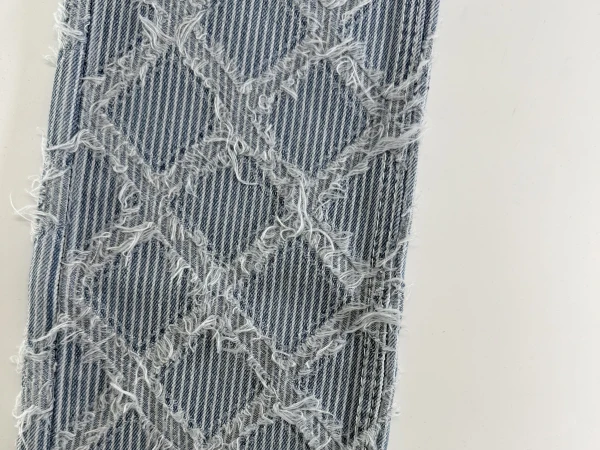
Light to medium washing processes, such as enzyme or stone wash, loosen the clipped fibers. The fringe opens up, creating a softer and more irregular surface. At the same time, the tonal variation increases, allowing the geometric structure to appear and disappear in different areas.
With repeated wear, this effect continues to evolve. Micro-fraying increases, and the distinction between pattern and texture becomes less defined. What started as a geometric system gradually transitions into a more organic surface.
The key point is that the pattern is not lost—it is redistributed.
This is a critical advantage compared to traditional geometric designs, which often degrade under washing. In clipped denim, washing does not destroy the pattern. It transforms it into a different expression.
———————————————————————
A Functional Advantage: Built-In Variation Without Over-Reliance on Processing
One of the most practical advantages of this type of fabric lies in its ability to generate variation without excessive reliance on post-processing.
In conventional denim development, achieving depth and differentiation often requires multiple washing steps, increasing both cost and production risk. Results can vary significantly between batches, especially when heavy processing is involved.
Clipped geometric denim reduces this dependency. Because part of the texture is already embedded in the fabric, washing becomes a process of enhancement rather than creation. This leads to more predictable outcomes and better consistency across production.
For buyers and developers, this translates into a more controlled development process. The fabric carries a portion of the design responsibility, reducing the need for complex finishing while still delivering a differentiated product.
———————————————————————
Closing Insight of Part 1
The significance of clipped geometric denim does not lie in the novelty of the diamond pattern itself, but in how that pattern is redefined.
By moving from precise geometry to controlled disruption, the design aligns more naturally with the inherent behavior of denim. It allows the fabric to evolve through washing and wear without losing its identity.
In this context, the pattern is no longer a fixed visual element. It becomes part of a dynamic surface system—one that is shaped by structure, texture, and time.
———————————————————————
PART 2
Clipped Denim in the Market:
From Structural Complexity to Differentiation Advantage
Why Clipped Denim Is Harder to Replicate — Not Just a Design, but a Process System
At a glance, clipped denim may appear as a variation of jacquard. In practice, however, its replication difficulty is significantly higher, and this has less to do with the pattern itself and more to do with the production system behind it.
Unlike standard jacquard, which relies primarily on loom capability and pattern programming, clipped denim introduces an additional layer of post-weaving intervention. The process involves selective cutting or releasing of yarns, followed by controlled finishing to ensure the fringe behaves as intended. Each of these steps introduces variables: yarn type, density, weave structure, clipping precision, and finishing balance all interact with one another.
This creates a compounded technical requirement. A mill may be able to weave a similar geometric pattern, but achieving the same surface behavior—how the fringe opens, how it reacts to washing, how stable it remains in production—is far more difficult to standardize. Small differences in yarn twist or finishing tension can lead to large differences in outcome.
From a market perspective, this means clipped denim is less exposed to rapid imitation. It cannot be easily replicated by simply copying a visual reference. It requires process control, experience, and iteration. This is one of the key reasons why it retains differentiation value longer than most pattern-based fabrics.
———————————————————————
Why Clipped Denim Works Better as a Differentiation Tool Than a Basic Fabric
In denim product development, fabrics typically fall into two categories: volume-driven basics and differentiation-driven materials. Clipped denim clearly belongs to the latter, and attempting to position it as a basic fabric often leads to misalignment.
The reason lies in how value is perceived and distributed.
Basic denim competes primarily on cost, consistency, and scalability. Its role is to support large-volume production with predictable outcomes. Differentiation fabrics, on the other hand, are expected to create visual or material distinction that justifies a higher price point or a more defined product identity.
Clipped denim inherently carries visible and tactile complexity. Its surface is not neutral, and it cannot be easily simplified. When used in basic products, this complexity becomes redundant, as the product structure does not support or communicate the added value. In contrast, when used in differentiation-focused products, the fabric can directly contribute to the product’s identity.
This is why clipped denim is more effective as a strategic tool within a collection rather than as a foundation across all SKUs. It works best when it is allowed to define a product, not when it is forced to conform to a cost-driven structure.
———————————————————————
Why “Dimensional Jacquard” Is Returning After 2024
Since around 2024, there has been a noticeable shift in denim development toward what can be described as “dimensional jacquard”—fabrics that go beyond flat patterning and introduce physical depth into the surface. Clipped denim is part of this broader movement.
The return of dimensional structures is not driven by a single trend, but by several converging factors.
First, the market has reached a saturation point in washing-based differentiation. For years, brands relied on increasingly complex washing techniques to create visual impact. However, as these techniques became widely accessible, the visual gap between products narrowed. Consumers and buyers began to see similar effects repeated across different brands and suppliers.
Second, there is growing pressure to balance design impact with production stability. Heavy washing processes introduce variability, longer lead times, and higher costs. Fabrics that already contain part of the visual effect reduce the need for extreme processing, making development more efficient.
Third, digital retail has changed how products are evaluated. Online platforms require immediate differentiation at the thumbnail level, but they also reward products that maintain interest after purchase. Dimensional fabrics provide both: they are visually distinctive at first glance and continue to reveal detail upon closer inspection.
Clipped denim fits precisely into this shift. It offers depth without relying entirely on post-processing, making it aligned with both design and operational needs.
———————————————————————
From Jacquard to Clipped: Why the Market Is Moving Toward Stronger Texture
The transition from traditional jacquard to clipped denim reflects a deeper change in what the market expects from fabric.
Jacquard introduced pattern into the structure of the fabric, moving away from surface-applied decoration. This was a significant step, but it remained largely visual. The fabric still relied on contrast, repeat, and pattern clarity to communicate its value.
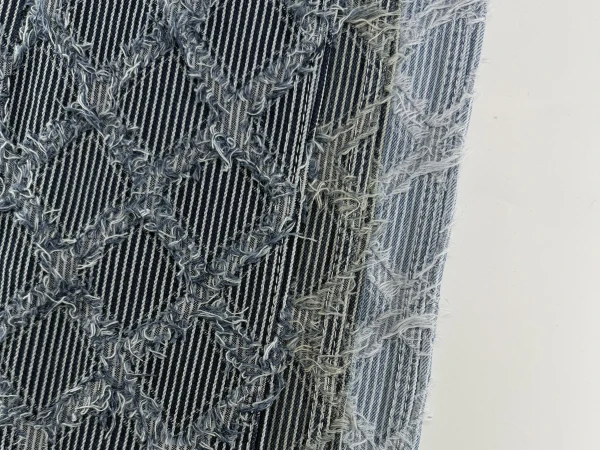
Clipped denim takes this one step further by introducing tactile texture as a primary element. The emphasis shifts from what the pattern looks like to how the surface behaves.
There are several reasons behind this shift.
Consumers are increasingly interacting with products beyond visual evaluation. In physical retail, touch plays a critical role in perceived value. In digital retail, where touch is not possible, visual cues of texture become even more important, as they suggest material richness.
At the same time, there is a growing preference for materials that feel less uniform and more natural. Perfectly flat and consistent surfaces are often associated with mass production, while irregular textures are perceived as more authentic and higher in value.
Clipped denim responds to both dynamics. It creates a surface that is visually and physically varied, without requiring excessive decoration. This makes it particularly effective in communicating quality in a subtle but immediate way.
———————————————————————
Why Clipped Denim Has Stronger Potential in Womenswear
While clipped denim can be applied across multiple categories, its strongest growth potential currently lies in womenswear. This is not coincidental; it is closely related to how products are designed and consumed in this segment.
Womenswear generally allows for greater surface visibility. Silhouettes such as skirts, wide-leg pants, and relaxed outerwear provide larger, uninterrupted panels where the fabric can be fully expressed. This is critical for clipped denim, which relies on surface continuity to perform.
In addition, womenswear is more receptive to material-driven differentiation. Compared to menswear or workwear, where durability and uniformity often dominate, womenswear places greater emphasis on texture, detail, and variation. This creates a more suitable environment for fabrics that deviate from flat surfaces.
Another factor is the pace of product turnover. Womenswear collections tend to have shorter cycles and higher SKU variation, increasing the demand for fabrics that can quickly create a sense of newness without requiring entirely new silhouettes. Clipped denim, with its built-in differentiation, fits this requirement well.
As a result, the adoption curve for clipped denim is often faster in womenswear, where both design freedom and market demand align with the fabric’s characteristics.
———————————————————————
Closing Insight of Part 2
Clipped denim is not simply a more decorative extension of jacquard. It represents a shift in how differentiation is created and maintained in the denim market.
By combining structural complexity with tactile texture, it moves part of the product’s value from post-processing into the fabric itself. This makes it harder to replicate, more suitable for differentiation-driven products, and better aligned with current market expectations.
For buyers, the implication is clear: the value of clipped denim does not lie in its pattern alone, but in how it integrates process, material, and product strategy into a single system.
———————————————————————
PART 3
This Design Element in Practice:
Geometric Clipped Denim in Product Development
Where This Fabric Actually Works — Letting the Surface Lead the Product
When working with clipped geometric denim, the key question is not whether the pattern is attractive, but whether the product structure allows the fabric to perform. This type of material is not driven by graphic clarity; it is driven by surface continuity and texture behavior. As a result, its success depends heavily on how much uninterrupted space the garment provides and how much freedom the surface has to evolve.
In practical terms, clipped denim performs best in product categories where the fabric can remain visually continuous. Womenswear bottoms, particularly wide-leg, straight-leg, and A-line silhouettes, are among the most suitable applications. These shapes provide larger panels, allowing the geometric base and the fringe texture to develop together. Movement further enhances the effect, as the clipped fibers react dynamically rather than remaining static.
Skirts and dresses offer a similar advantage. In these categories, the interaction between structure and motion becomes more visible. The geometric framework provides order, while the fringe introduces softness and variation. This balance allows the fabric to express both its structured origin and its evolving surface, which is difficult to achieve in more restrictive garment types.
Lightweight jackets and overshirts also represent a strong application area. Their relatively flat construction preserves the integrity of the surface, while their casual positioning allows the texture to become the primary visual element without competing with excessive design details. In these products, the fabric is not just supporting the design—it becomes the design.
By contrast, clipped denim is less effective in highly fitted garments. Slim silhouettes compress the surface, reducing the visibility of the fringe and distorting the underlying geometric structure. Similarly, garments with heavy panel segmentation interrupt the continuity of the pattern, breaking the surface into fragments that lose the intended rhythm. Over-designed products—those combining strong prints, embroidery, or aggressive washing—tend to compete with the fabric rather than complement it, diminishing its value.
The principle is therefore straightforward: clipped geometric denim performs best when the garment allows the surface to remain readable as a whole. When the design steps back, the fabric can fully deliver its effect.
———————————————————————
Trend Alignment — Why It Fits Multiple Directions at Once
One of the key strengths of geometric clipped denim is that it does not rely on a single trend narrative. Instead, it aligns with several ongoing directions in denim development, making it more versatile across collections and seasons.
First, it fits naturally within the broader shift toward texture-driven denim. As the industry moves away from flat surfaces and over-reliance on washing, fabrics that already contain depth and variation are becoming more relevant. Clipped denim provides this depth structurally, reducing the need for extreme processing while still achieving a rich surface.
Second, it connects with the “clean but not flat” aesthetic that has gained traction in recent years. From a distance, the geometric base creates a sense of order and simplicity. Up close, the fringe disrupts this order, introducing detail and irregularity. This dual behavior allows products to remain wearable while still offering a level of differentiation expected in mid-to-high-end segments.
Third, the fabric aligns with the evolution of retro-inspired design. Traditional geometric motifs have long been associated with heritage textiles. By softening and partially breaking these motifs, clipped denim reinterprets retro elements without becoming nostalgic. The result feels familiar but not dated, which is critical in maintaining long-term relevance.
Finally, it supports the growing preference for material-led design in womenswear. Rather than relying on bold prints or decorative additions, many collections are shifting toward subtle complexity embedded in the fabric itself. Clipped geometric denim fits this direction by offering texture as the primary design language.
———————————————————————
What Makes It Different on Denim — Structure, Color, and Density
When applied to denim, this type of geometric clipped design behaves differently from both traditional jacquard and basic twill constructions. The distinction can be understood across three key dimensions: structure, color behavior, and pattern density.
From a structural perspective, clipped denim introduces a layered surface. The geometric pattern is first established through weaving, then partially disrupted through clipping. This creates a dual-level system: a base structure that provides order, and a surface layer that introduces variation. Unlike flat jacquard, where the pattern remains within the plane of the fabric, clipped denim extends beyond it, creating a more dimensional effect.
In terms of color behavior, the fabric relies less on contrast and more on tonal variation. Indigo or overdyed bases interact with the raised fibers, producing subtle shifts in light and shadow. This approach is more compatible with denim’s natural fading process. As the garment is washed and worn, the tonal differences become more pronounced, enhancing the perception of depth without relying on artificial contrast.
Pattern density also plays a critical role. In clipped geometric denim, the repeat is present but visually softened. The distribution of fringe elements introduces irregularity, preventing the pattern from appearing overly repetitive. This creates a more natural rhythm across the surface, which improves long-term wearability by reducing visual fatigue.
Together, these factors create a fabric that is structured but not rigid, detailed but not overwhelming, and dynamic rather than static.
———————————————————————
A Practical Advantage: Balancing Differentiation and Development Stability
From a product development perspective, one of the main challenges today is balancing differentiation with production stability. Highly distinctive fabrics often come with higher risk, while stable fabrics tend to lack uniqueness. Clipped geometric denim offers a balance between these two extremes.
Because part of its visual impact is embedded in the fabric, it reduces reliance on precise washing execution. This leads to more predictable results across batches and lowers the risk of variation. At the same time, the built-in texture ensures that the product remains distinctive without requiring additional design layers.
For buyers, this translates into a more efficient development process. Fewer iterations are needed to achieve the desired effect, and the final product is less sensitive to small production variations. This combination of differentiation and stability is one of the reasons why clipped denim is gaining traction as a practical, not just aesthetic, solution.
———————————————————————
Closing Insight of Part 3
The value of geometric clipped denim lies not in the pattern alone, but in how it connects fabric structure, surface behavior, and product application. It works best when the garment allows the material to remain continuous and when the design does not compete with the texture.
In this context, the fabric is not an addition to the product. It becomes the foundation of the product’s identity.
———————————————————————
PART 4 — Closing
Final Thought: When Structure Replaces Surface Decoration
As denim continues to evolve, one of the most important shifts is the redistribution of design responsibility. Where surface decoration and washing once carried the majority of visual impact, more of that responsibility is now moving into the fabric itself.
Geometric clipped denim represents this shift clearly. By combining a traditional structural motif with a modern textural intervention, it transforms a familiar pattern into a more dynamic and adaptable surface. It does not eliminate the role of washing, but it reduces the need for it to create differentiation from scratch.
For buyers and developers, the implication is not that clipped denim should replace existing materials, but that it offers a different way to build value. It allows products to achieve distinction earlier in the development process and to maintain that distinction more consistently through production and wear.
In practice, the difference of this type of fabric is rarely defined at first glance. It becomes more apparent after washing, through movement, and over repeated use. This extended lifecycle of visual interest is what makes it particularly relevant in a market where products need to perform beyond the initial moment of purchase.
A development such as J2D02-10, where geometric stripes and diamond structures are reinterpreted through cut fringe texture, reflects this approach. The pattern is no longer fixed; it evolves with the fabric, creating a surface that becomes more expressive over time.
For those exploring how texture-driven fabrics can fit into future collections, it is often useful to evaluate not only how they appear as swatches, but how they behave after processing and in real garments.
 Vietnamese
  English
  Russian
  Spanish
  Arabic
  French