
PART 1
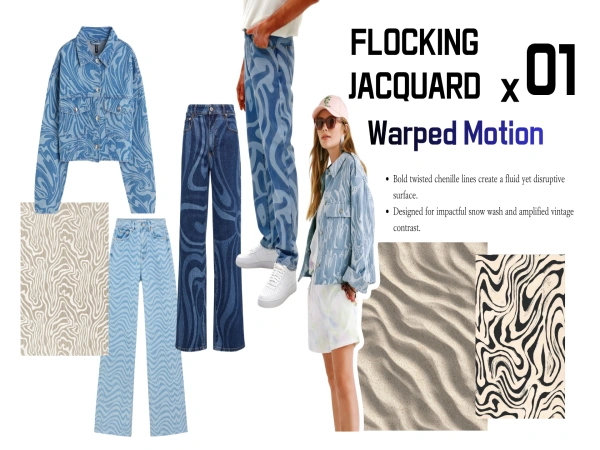
Decoding “Warped Motion” in Chenille Jacquard Denim
Why This Pattern Is Worth Attention — When Texture Starts Replacing Graphics
For a long time, most denim differentiation relied on two things:
- Washing contrast
- Graphic visibility
But the problem is becoming increasingly obvious.
Strong washes are easier to imitate.
Printed graphics lose freshness quickly.
And overly decorative denim often struggles to stay commercially wearable.
This is exactly why texture-driven denim is returning.
Not as decoration.
But as structure.
“Warped Motion” represents this shift very clearly.
Instead of using a recognizable motif — such as florals, geometric repeats, or logos — this design creates movement through irregular chenille lines that feel twisted, flowing, and partially disrupted at the same time.
It does not behave like a traditional pattern.
It behaves like surface energy.
At first glance, the fabric almost feels unstable:
the lines move in different directions,
the texture appears broken and reconstructed,
and the visual rhythm never fully settles.
But this controlled instability is precisely what gives the fabric value.
Because in modern denim development, consumers are no longer only attracted to “clean surfaces.”
Increasingly, they are drawn to fabrics that already feel lived-in, tactile, and emotionally layered before washing even begins.
This is especially important in FW26/27, where texture is becoming more commercially powerful than obvious graphics.
From Vintage Damage to Controlled Motion: Where This Surface Language Comes From
The visual language behind “Warped Motion” does not originate from traditional textile ornamentation.
Its references are closer to:
- Twisted industrial rope marks
- Cracked painted surfaces
- Distorted wall textures
- Vintage denim abrasion patterns
- Uneven snow-washed garments from the 1980s and 1990s
Historically, these kinds of effects were created after fabric production through:
- Heavy bleaching
- Stone washing
- Acid washing
- Grinding and destruction processes
But those methods share one limitation:
The texture is added afterward.
Chenille jacquard changes that logic.
Instead of creating surface damage after weaving,
the disruption is already embedded into the fabric structure itself.
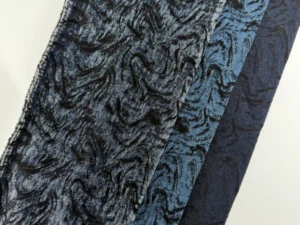
The twisted chenille yarns create:
- Irregular raised surfaces
- Directional distortion
- Broken visual continuity
- Uneven light reflection
This makes the fabric feel dynamic even before garment washing.
In other words:
The texture is not an effect applied onto denim.
The texture becomes part of the denim’s architecture.
Why Chenille Changes the Behavior of Jacquard Denim
Traditional jacquard denim mainly creates visual depth.
Chenille jacquard introduces something different:
physical depth.
That distinction matters.
Because chenille yarn behaves differently under light, washing, and movement.
Compared with flat woven jacquard:
This is why chenille jacquard often feels more “premium” in finished garments.
Not because it is louder.
But because it reacts more actively with washing and wearing.
Especially under snow wash, enzyme wash, and vintage abrasion,
the raised chenille areas catch fading differently from the denim base.
This creates layered contrast that is difficult to reproduce through printing or ordinary weaving alone.
Why “Twisted Motion” Feels More Modern Than Traditional Repeating Patterns
A major shift happening in fashion right now is the movement away from static symmetry.
Consumers increasingly prefer surfaces that feel:
- Organic
- Imperfect
- Fluid
- Non-repetitive
- Less obviously engineered
This is why many clean geometric repeats are starting to feel dated in premium denim categories.
“Warped Motion” works differently because the eye never fully locks onto one repeat cycle.
The surface behaves more like:
- Movement instead of pattern
- Rhythm instead of decoration
- Distortion instead of symmetry
That subtle difference changes how the fabric feels emotionally.
Traditional patterns often communicate:
“Look at the design.”
Warped surface textures communicate:
“Feel the material.”
That shift from visual storytelling to sensory storytelling is becoming increasingly important in modern denim.
Why This Surface Works Especially Well with Snow Wash
One of the most important aspects of this fabric is how it reacts after washing.
Because in denim,
the real design process starts after weaving.
Many jacquards lose clarity under aggressive washing.
This one becomes stronger.
Why?
Because snow wash naturally emphasizes uneven surfaces.
The bleaching particles settle differently across:
- Raised chenille areas
- Flat denim areas
- Twisted sections
- Dense vs open structures
As a result:
- Contrast becomes amplified
- Vintage depth increases
- Surface movement becomes more visible
- The garment gains stronger dimensionality
This is why the fabric was specifically developed for impactful vintage washing directions.
Instead of fighting heavy washing,
it collaborates with it.
Cultural Shift: Why Consumers Are Returning to “Imperfect” Surfaces
For many years, premium fashion was associated with refinement:
- Clean finishes
- Flat surfaces
- Controlled appearance
- Perfect consistency
But after years of minimalism and polished aesthetics,
consumer fatigue is becoming visible.
Now, increasingly, people are attracted to products that feel:
- Tactile
- Irregular
- Emotionally aged
- Material-driven
- Less digitally perfect
This is not simply nostalgia.
It reflects a deeper shift:
from visual perfection → to sensory authenticity.
Warped chenille jacquard fits directly into this movement because it already carries tension, abrasion, and movement within the fabric itself.
It feels unfinished in a deliberate way.
And in modern denim, that “controlled imperfection” is becoming commercially valuable.
Closing Insight of Part 1
The value of “Warped Motion” is not in having a recognizable motif.
Its value lies in how the surface behaves:
- It evolves under washing
- It creates depth through structure
- It transforms irregularity into identity
- It turns texture into the main design language
In this context, chenille jacquard is no longer acting as decoration.
It is becoming part of how modern denim builds emotional and material value from the fabric level upward.
PART 2
Chenille Jacquard Denim Market Analysis:
Why Texture Denim Is Returning to the Mainstream Again
Texture Denim Is Growing Again — But This Time, It’s Not Just About Fashion
Over the past two years, one shift has become increasingly visible across denim sourcing markets:
Texture denim is returning.
Not only in runway collections,
but in commercial product development.
From Europe to Latin America,
from premium brands to fast fashion retailers,
textured denim fabrics — especially jacquard and irregular surface constructions — are seen much frequently in fashion trend.
But this is not simply another “trend cycle.”
What is happening now is different from previous texture booms in denim history.
In the past, textured denim was often treated as:
- seasonal
- decorative
- niche
- difficult to commercialize
Today, texture is becoming part of mainstream product strategy.
That shift matters.
Because it means the industry is no longer viewing texture as an “extra feature.”
It is starting to treat texture as part of the product’s core value system.
Why Chenille Jacquard Denim Is Returning in FW26/27
One of the clearest developments in FW26/27 is this:
Denim is becoming more tactile.
For many years, the industry focused heavily on:
- cleaner surfaces
- minimal construction
- flat visual appearance
- lightweight comfort
But after years of simplification,
many products started looking interchangeable.
Consumers began seeing:
- similar washes
- similar silhouettes
- similar blue shades
- similar clean finishes
As a result, brands are now searching for a different type of differentiation.
Not louder graphics.
Not more logos.
But richer material surfaces.
This is exactly where chenille jacquard denim becomes relevant again.
Because it introduces:
- touchability
- dimensionality
- movement
- irregularity
- emotional vintage depth
without necessarily requiring extreme washing or aggressive decoration.
In other words:
The fabric itself starts carrying part of the emotional value.
Why Texture Denim Is Returning to the Mainstream Market
Texture denim used to belong mainly to:
- niche designer collections
- luxury capsules
- experimental fashion lines
But the market structure has changed.
Today, texture is becoming commercially important for three major reasons.
Consumers Are Buying Less — But Expecting More
Post-pandemic consumption behavior has shifted significantly.
Consumers are purchasing fewer garments,
but expecting:
- stronger individuality
- higher perceived quality
- longer emotional lifespan
- more sensory experience
Basic denim still sells.
But purely basic products are increasingly vulnerable to price competition.
Texture changes this.
Because texture creates perceived value immediately —
even before consumers understand construction details.
This is especially important in online retail,
where products have only seconds to create interest.
Texture Performs Better Digitally Than Flat Surfaces
Flat denim often struggles online because:
- basic indigo looks repetitive in thumbnails
- subtle wash differences are difficult to communicate digitally
- consumers scroll too quickly
Texture solves this problem.
Even through a mobile screen,
structured denim creates:
- light variation
- visible depth
- stronger visual retention
This is why textured denim increasingly performs better in:
- online capsule collections
- fashion drops
- social-media-driven retail
- premium casual categories
Texture Helps Brands Escape Wash Competition
For years,
many denim products depended heavily on washing to create differentiation.
But aggressive washing creates problems:
- unstable production results
- high development costs
- longer lead times
- higher rejection risk
- environmental pressure
Texture denim changes the balance.
Instead of relying entirely on washing:
- part of the visual complexity is already built into the fabric
- washing becomes refinement instead of creation
This reduces dependence on:
- extreme bleach
- over-processing
- unstable hand-scraping effects
For buyers,
this is not only aesthetic improvement.
It is operational improvement.
Why “Tactile Denim” Feels More Premium Than Basic Denim
One of the biggest changes happening in premium denim right now is:
Luxury is shifting from visibility → to material experience.
In the past,
premium products often relied on:
- logos
- branding
- hardware
- decoration
Now, increasingly,
premium perception is built through:
- texture
- weight
- surface behavior
- touch response
- material depth
This is why tactile denim feels more expensive.
Because consumers subconsciously associate:
- irregular surfaces with craftsmanship
- layered texture with development complexity
- tactile response with material richness
Chenille jacquard performs especially well here because it activates both:
- visual texture
- physical texture
That combination creates stronger perceived value than flat denim surfaces.
From Basic Denim to Texture Denim: What Is the Industry Actually Moving Toward?
The denim industry is not abandoning basics.
Basics will always remain commercially important.
But what is changing is the role of basics.
Previously:
- basic denim = main product
- textured denim = supporting product
Now increasingly:
- basic denim = commercial stability
- texture denim = differentiation strategy
This creates a hybrid product structure inside collections.
Brands now commonly balance:
- clean core styles
- texture-led statement styles
- moderate vintage texture styles
instead of relying entirely on either side.
This shift is especially visible in:
- women’s denim
- fashion workwear
- premium casualwear
- modern vintage collections
Why Texture Denim Aligns So Well with Premium Retro and Modern Vintage
One reason texture denim is growing strongly in FW26/27 is because it fits multiple trend directions simultaneously.
Especially:
- Premium Retro
- Modern Vintage
- Quiet Luxury
- Contemporary Workwear
- Clean but Layered aesthetics
These trends all share one thing:
They prefer depth over decoration.
Texture denim supports this perfectly because:
- it creates richness without excessive graphics
- it feels aged without looking costume-like
- it feels expressive without becoming visually loud
Warped chenille jacquard fits particularly well into this direction because its distorted movement already carries:
- vintage tension
- irregular fading potential
- industrial surface emotion
without requiring overly complicated garment design.
Regional Growth: Where Chenille and Texture Denim Are Growing Fastest
The return of texture denim is not equal across all markets.
Growth is especially visible in:
Europe
Strong demand for:
- subtle texture
- tonal jacquard
- premium surface development
- quiet differentiation
Texture is often used here for refinement rather than visibility.
Latin America
Fast-growing interest in:
- heavier textured denim
- visible vintage surfaces
- strong wash interaction
- statement bottoms and jackets
Especially in:
- Colombia
- Mexico
- Peru
Middle East
Growing preference for:
- visually rich surfaces
- premium tactile fabrics
- statement texture products
Structured denim performs particularly well in premium casual collections.
Why Texture Denim Is Likely to Continue Growing Beyond FW26/27
Some trends disappear because they depend on novelty.
Texture denim behaves differently.
Its growth is supported by long-term structural changes:
- digital retail behavior
- sensory-driven consumption
- pressure for differentiation
- washing cost optimization
- premium casual expansion
- vintage revival movements
This is why texture denim is not behaving like a short seasonal direction.
It is increasingly becoming part of how modern denim collections are constructed.
Closing Insight of Part 2
Texture denim is returning because the industry is changing how value is created.
Not everything can rely on washing anymore.
Not everything can rely on graphics anymore.
Increasingly,
fabric itself must carry:
- emotion
- identity
- depth
- differentiation
Chenille jacquard fits this shift naturally.
Because it transforms texture from a decorative detail
into a structural product language.
PART 3
This Design Element in Practice:
Warped Motion Chenille Jacquard in Denim
Where This Fabric Actually Works Best
One of the biggest misunderstandings about texture-driven jacquard denim is assuming that stronger texture automatically works across every product category.
In reality, fabrics like “Warped Motion” perform best when the garment allows the surface to remain visually continuous.
Because this fabric is not built around a clear motif.
Its value comes from:
- movement
- irregular rhythm
- surface depth
- washing interaction
That means silhouette matters.
Recommended Applications: Why It Works Especially Well for Menswear
This type of chenille jacquard is particularly suitable for:
- men’s denim
- gender-neutral collections
- fashion workwear
- modern vintage products
especially in:
- relaxed jeans
- wide-leg silhouettes
- jackets
- overshirts
Why?
Because larger garment panels allow the texture to “flow” naturally across the surface.
The twisted chenille lines need space to breathe.
On wider silhouettes:
- the movement feels continuous
- the texture feels more dimensional
- the washing contrast develops more naturally
This is especially effective on:
- baggy jeans
- carpenter pants
- trucker jackets
- utility outerwear
Why It Performs Better on Jackets Than Highly Fitted Products
This fabric behaves differently from decorative jacquard.
Decorative patterns often rely on visibility.
Warped Motion relies on surface behavior.
That is why highly fitted garments are less ideal.
On slim silhouettes:
- the texture becomes compressed
- movement gets interrupted
- the visual rhythm feels distorted rather than fluid
But jackets work particularly well because:
- larger flat surfaces preserve continuity
- structure supports dimensional texture
- snow wash interaction becomes more visible
In many cases,
the fabric itself becomes the garment’s main visual identity —
reducing the need for excessive trims or decoration.
Why This Texture Aligns Strongly with Current Denim Trends
One reason this type of chenille jacquard has strong commercial potential is because it fits multiple trend directions simultaneously.
Especially:
- Premium Retro
- Contemporary Workwear
- Modern Vintage
- Distressed Luxury
- Clean but Textured aesthetics
These trends all share one important shift:
They prefer material depth over graphic decoration.
Warped Motion fits naturally into this movement because:
- it already feels aged before washing
- it creates irregularity without chaos
- it carries vintage emotion without looking costume-like
This balance is increasingly important in premium casual denim.
Why “Controlled Distortion” Feels More Modern Than Traditional Pattern Repeats
Traditional jacquard often depends on:
- symmetry
- repeat clarity
- decorative rhythm
But modern denim aesthetics are moving toward:
- irregularity
- tension
- movement
- disrupted continuity
This is why “Warped Motion” feels more contemporary.
Its surface never fully settles into a predictable repeat.
Instead, it behaves almost like:
- fractured motion
- distorted abrasion
- moving texture fields
This creates stronger emotional depth than ordinary geometric repeats.
Because the fabric feels less “designed”
and more “naturally evolved.”
Structure, Color, and Density: What Makes It Different on Denim
When applied to denim,
this texture behaves very differently from ordinary jacquard constructions.
The difference mainly comes from three dimensions.
1. Structure: Texture Becomes the Main Design Language
Instead of using motifs,
the fabric uses:
- chenille height variation
- directional distortion
- irregular weaving density
to create identity.
This allows:
- washing to enhance texture naturally
- fading to integrate into the structure
- abrasion to become part of the visual system
2. Color Behavior: Vintage Contrast Instead of Sharp Contrast
This type of chenille jacquard works best with:
- deep indigo
- blue-black
- overdyed vintage tones
Because the texture itself already creates enough movement.
It does not require aggressive color contrast.
Instead,
the vintage depth comes from:
- uneven fading
- shadow variation
- raised chenille highlights
- low-to-mid tonal transitions
This creates a more mature visual effect than high-contrast graphic denim.
3. Density: Rich Surface Without Visual Overload
One key advantage of this fabric is density control.
Many textured fabrics become visually exhausting because:
- patterns are too dense
- repeats are too obvious
- surfaces become overcrowded
Warped Motion avoids this problem.
Its texture distribution feels:
- broken
- breathable
- unevenly balanced
This allows the fabric to remain:
- expressive
- but still wearable
especially for larger commercial collections.
A Practical Advantage for Buyers: Strong Vintage Effect with Lower Washing Dependency
Traditionally,
achieving strong vintage texture required:
- aggressive washing
- multiple chemical treatments
- unstable abrasion development
This increases:
- cost
- production risk
- inconsistency
Warped chenille jacquard changes the equation.
Because part of the vintage depth is already woven into the fabric.
This allows brands to achieve:
- richer vintage appearance
- dimensional snow wash effect
- stronger visual layering
with more controlled washing programs.
For buyers,
this is not only a design advantage.
It is also:
- a development advantage
- a stability advantage
- a production efficiency advantage
Closing Insight of Part 3
The value of “Warped Motion” is not based on a recognizable pattern.
Its strength comes from how it behaves:
- under washing
- across movement
- through fading
- inside modern silhouettes
It does not rely on decoration to share its image.
Instead,
it allows texture itself to become the product language.
And that is precisely why this type of chenille jacquard is becoming increasingly relevant in modern denim development.
PART 4 — Closing
When Texture Starts Replacing “Extra Design”
One of the clearest shifts in modern denim is this:
Fabric itself is starting to carry more of the product identity.
For years, brands relied heavily on:
- stronger washing
- graphic treatments
- surface destruction
to create differentiation.
But as the market becomes saturated with similar vintage effects, texture is becoming more valuable again.
Not because it is louder —
but because it feels more authentic.
Chenille jacquard fits naturally into this direction because it builds:
- depth
- tactility
- vintage tension
- washing interaction
directly into the fabric structure.
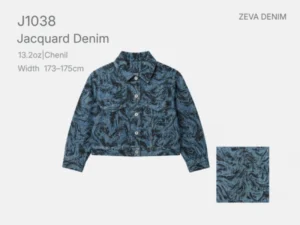
In fabrics like J1038, the value is not based on a recognizable motif.
It comes from movement, irregularity, and evolving surface behavior after washing.
That is also why this type of texture-driven denim is becoming increasingly relevant:
it allows the fabric itself to become part of the product language — not just the background for washing.
One example of this direction can be seen in J1038, where twisted chenille lines are integrated directly into the denim surface to create stronger vintage depth and amplified snow-wash interaction.
If you are exploring how texture-driven denim could fit into future collections, it is often worth observing not only how the fabric looks before washing — but how it evolves after washing, movement, and repeated wear.
 French
  English
  Russian
  Spanish
  Arabic
  Vietnamese