
Why Imperfect Texture Is Becoming the New Luxury in Jacquard Denim Development
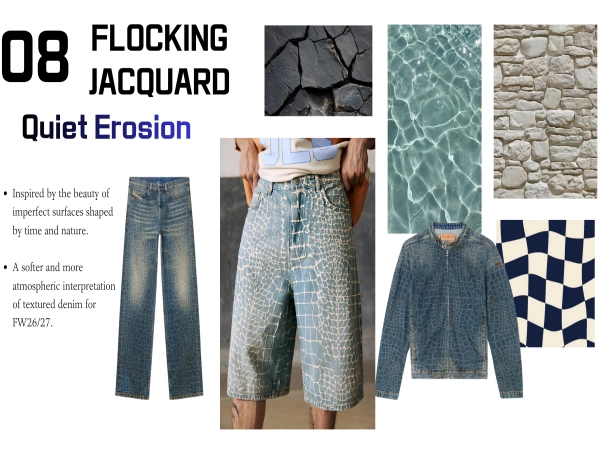
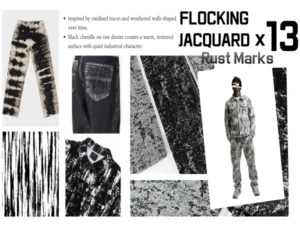
In recent denim trend forecasting, the industry has begun shifting away from obvious decorative effects and toward more subtle forms of surface expression. Instead of relying on bold prints, oversize graphics, or heavily distressed finishes, many FW26/27 developments focus on texture, depth, and material storytelling. J1072 “Quiet Erosion” is a representative example of this movement.
This article explores:
- Why erosion-inspired textures are becoming increasingly relevant in contemporary denim design;
- The historical and cultural origins of weathered surface aesthetics;
- How textured jacquard denim is evolving beyond traditional decorative applications;
- Why chenille jacquard denim presents unique challenges from a supply chain and manufacturing perspective;
- How yarn selection, fabric structure, and finishing processes determine the final appearance of textured denim;
- Where this type of denim fits within current market trends and garment development strategies.
Rather than functioning as a visual statement piece, Quiet Erosion demonstrates how texture itself can become the primary design language—a direction gaining momentum across premium denim, contemporary fashion, and elevated casual-wear.
Understanding the Design Language Behind Quiet Erosion
Why Is This Design Worth Attention?
Many denim developments aim to attract attention through contrast, color, or decorative motifs. Quiet Erosion takes the opposite approach.
Instead of adding something onto the fabric surface, the design attempts to recreate the visual effect of natural aging itself.
The pattern resembles surfaces slowly transformed by time:
- Weathered stone
- Eroded architecture
- Mineral deposits
- Cracked earth
- Oxidized metal
- Faded industrial materials
The result is a denim surface that feels organic rather than manufactured.
This distinction is important.
As consumers increasingly seek authenticity and emotional value in products, fabrics that appear naturally evolved often generate stronger emotional connections than fabrics that appear intentionally decorated.
Quiet Erosion aligns with this broader movement toward material honesty and understated sophistication.
The Origins of Imperfect Surface Aesthetics
The appreciation of imperfect surfaces is not new.
Many cultures have historically associated beauty with aging, weathering, and transformation.
Perhaps the most recognized example is the Japanese concept of wadi-sabi, which values imperfection, transience, and natural evolution.
In architecture, ceramics, furniture, and textiles, surfaces showing evidence of time are often perceived as richer and more meaningful than perfectly uniform ones.
During the 1980s and 1990s, fashion embraced distressed aesthetics through vintage denim and work-wear reproductions.
By the early 2000s, the industry began developing increasingly aggressive wash effects:
- Destroyed denim
- Sandblasting
- Heavy whiskers
- Extreme abrasion
However, contemporary consumers are becoming less interested in obvious distressing and more interested in subtle material depth.
Rather than looking “damaged,” fabrics now aim to look naturally evolved.
Quiet Erosion reflects this evolution perfectly.
How Modern Interpretations Differ From Traditional Vintage Denim
Traditional vintage denim often relied on washing techniques to create age.
Modern textured denim increasingly builds age directly into the fabric structure.
This is a significant difference.
Traditional vintage approach:
- Fabric first
- Wash later
- Surface character created during finishing
Modern texture-first approach:
- Surface character engineered during weaving
- Wash enhances existing texture
- Fabric already contains visual storytelling
This structural approach creates:
- Greater depth
- Better durability
- More consistent results
- Stronger visual identity
Quiet Erosion belongs firmly within this newer generation of texture-led denim development.
Visual Characteristics of Quiet Erosion
Several elements make this pattern particularly effective.
Irregular Rhythm
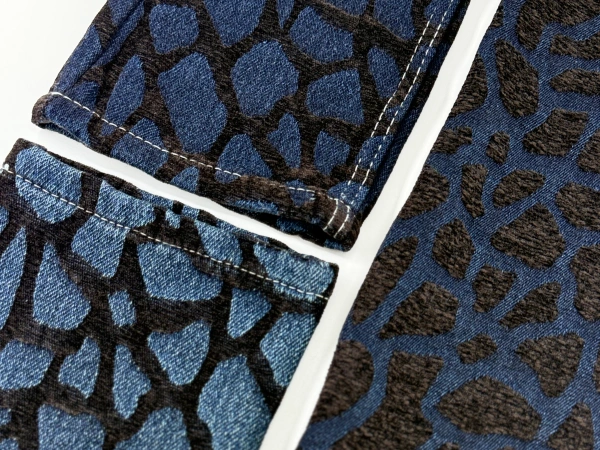
Unlike geometric repeats or floral motifs, the pattern avoids obvious repetition.
The eye continuously discovers new areas of texture.
This creates a more natural and less manufactured appearance.
Soft Surface Contrast
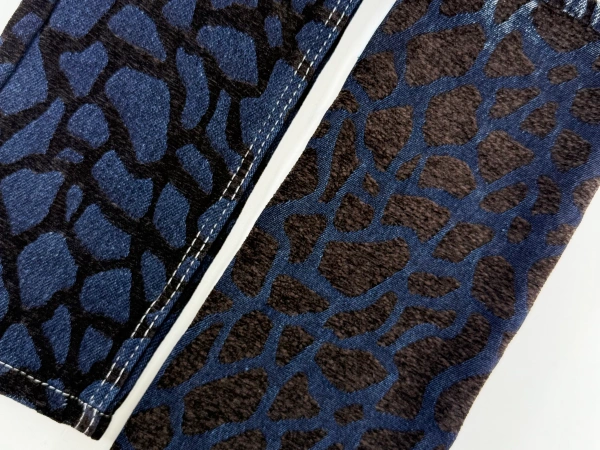
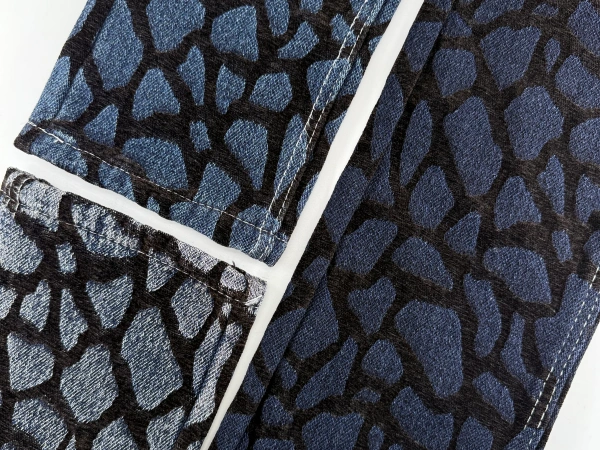
The chenille construction introduces subtle tonal variation without relying on multiple colors.
The texture becomes visible before the pattern itself.
Atmospheric Depth
The surface appears layered.
Different areas catch light differently, creating movement even when the garment remains static.
Quiet Luxury Appeal
Rather than attracting attention through decoration, the fabric communicates value through construction and material complexity.
This aligns strongly with current premium fashion directions.
Jacquard Denim Industry Analysis: Supply Chain and Production Perspective
Why Is Chenille Jacquard Denim More Difficult Than Ordinary Jacquard Denim?
Many buyers assume jacquard development is primarily about pattern design.
In reality, chenille jacquard introduces an entirely different level of manufacturing complexity.
Standard jacquard denim typically relies on yarn color and weave variation.
Chenille jacquard adds texture as an additional variable.
Manufacturers must simultaneously manage:
- Pattern clarity
- Yarn tension
- Surface height
- Weaving efficiency
- Fabric stability
Every variable influences the final appearance.
A small tension variation can dramatically alter texture visibility.
This makes chenille denim significantly more challenging than conventional jacquard structures.
How Does Chenille Weft Yarn Influence Surface Appearance?
The chenille yarn is the heart of the fabric.
Unlike standard yarns, chenille creates volume.
Its soft pile reflects light differently from surrounding denim yarns.
This creates three important effects:
Enhanced Texture
The pattern becomes physically dimensional rather than visually printed.
Natural Shadowing
Raised areas generate subtle shadows, increasing depth.
Improved Wash Character
As indigo fades during washing, texture becomes increasingly visible.
This dynamic evolution is one reason textured denim has become attractive for premium product development.
How Is Stability Controlled in Chenille Denim?
One of the biggest challenges in chenille denim production is maintaining consistency.
Several factors require careful management.
Yarn Quality
Poor chenille yarns often shed excessively during weaving and finishing.
Weaving Density
Overly loose construction reduces pattern definition.
Excessively tight construction may damage chenille yarns.
Finishing Conditions
Temperature and mechanical action must remain controlled.
Aggressive finishing can flatten texture permanently.
Shrinkage Control
Differential shrinkage between yarn systems can distort pattern appearance.
For this reason, experienced manufacturers often perform multiple stability evaluations before production approval.
What Is the Most Commonly Overlooked Issue in Chenille Denim Development?
Many development teams focus heavily on appearance but underestimate wash interaction.
A texture that looks impressive in greige fabric may behave very differently after washing.
Potential issues include:
- Texture collapse
- Excessive fiber loss
- Pattern distortion
- Uneven abrasion
Therefore, successful chenille development should always evaluate:
- Greige appearance
- Post-wash appearance
- Repeated wash performance
Ignoring any of these stages often leads to disappointing results.
Why Is Yarn Selection So Important?
Yarn selection determines nearly everything.
Different chenille constructions influence:
- Surface fullness
- Pattern visibility
- Durability
- Wash response
- Garment comfort
For Quiet Erosion-style fabrics, yarn selection becomes even more critical because the pattern depends on subtle texture rather than strong visual contrast.
If the yarn is too coarse, the effect becomes aggressive.
If too fine, the pattern disappears.
The balance is extremely delicate.
This is why successful textured denim development often begins with yarn engineering rather than pattern engineering.
Quiet Erosion in Denim Product Development
Which Garments Suit This Design Best?
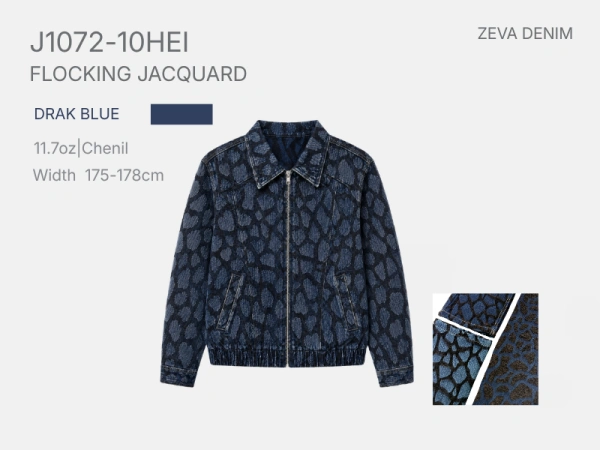
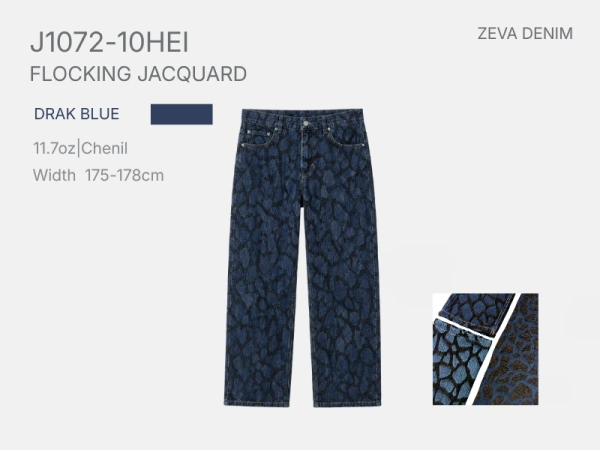
Based on the fabric structure and visual character, Quiet Erosion performs particularly well in rigid denim categories.
The pattern works best when garment silhouettes allow the surface texture to remain visible.
Recommended applications include:
Denim Jackets
The texture creates depth without requiring additional embellishment.
Relaxed Trousers
Wide-leg and straight-leg silhouettes provide large surfaces for pattern appreciation.
Overshirts
A growing category where fabric character becomes more important than garment complexity.
Utility-Inspired Sets
Matching tops and bottoms highlight the texture across larger visual areas.
Premium Workwear
Texture adds sophistication while preserving functionality.
Because the construction appears rigid and non-stretch, structured silhouettes are generally more suitable than body-conscious designs.
Which Trends Does Quiet Erosion Align With?
Interestingly, this fabric sits between several major fashion directions.
Quiet Luxury
The design communicates value through material quality rather than branding.
Elevated Workwear
Texture enriches traditional work-wear forms without altering functionality.
Contemporary Minimalism
Although textured, the pattern remains restrained and sophisticated.
Nature-Inspired Design
The erosion concept reflects broader consumer interest in organic forms and environmental narratives.
This versatility increases its commercial potential across multiple market segments.
What Makes This Texture Different When Applied to Denim?
Many textured fabrics exist outside denim.
However, denim contributes several unique characteristics.
Indigo Evolution
Texture changes appearance as indigo fades.
The fabric effectively ages alongside the wearer.
Structural Stability
Denim provides a strong foundation for dimensional surfaces.
Authenticity
Consumers naturally associate denim with aging and character development.
This makes erosion-inspired textures feel believable.
Contrast Generation
The combination of indigo depth and chenille texture creates richer visual complexity than most non-denim applications.
Quiet Erosion therefore feels particularly natural within denim rather than artificially transferred onto it.
Structure, Color, and Density Analysis
Structure
The pattern is built through surface relief rather than graphic repetition.
Couleur
The monochromatic approach allows texture to remain dominant.
No competing colors distract from the fabric construction.
Density
The pattern density appears carefully balanced.
Dense enough to create impact.
Open enough to preserve readability.
This balance is essential.
Overly dense textures often become visually heavy.
Overly sparse textures lose identity.
Quiet Erosion successfully occupies the middle ground.
The Future of Texture-Led Denim
Over the past decade, denim development has gradually moved through several phases.
First came wash innovation.
Then sustainability innovation.
Now, increasingly, the focus is shifting toward material innovation.
Quiet Erosion reflects this new stage of denim evolution.
Rather than relying on prints, embellishments, or aggressive washes, the fabric itself becomes the story.
For brands developing FW26/27 collections, this direction offers several advantages:
- Strong visual identity
- Timeless appeal
- Better product differentiation
- Compatibility with premium positioning
- Reduced dependence on excessive garment complexity
Most importantly, it demonstrates how texture can create emotional value.
Consumers may not immediately recognize the technical construction behind the fabric, but they instinctively respond to surfaces that feel authentic, layered, and naturally evolved.
Quiet Erosion captures precisely that sentiment.
For readers interested in exploring this development further, the product page and accompanying video provide a closer look at how the fabric behaves in both material and garment form, revealing details that photographs alone cannot fully capture.
 French
  English
  Russian
  Spanish
  Arabic
  Vietnamese