
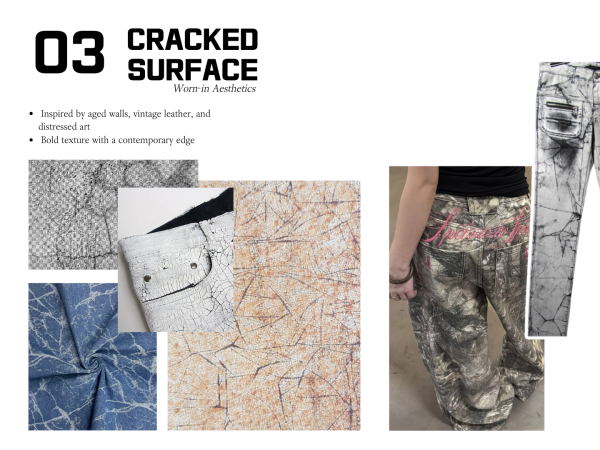
PART 1
Decoding Cracked Surface Patterns in Jacquard Denim
Why This Pattern Is Worth Attention — Imperfection as a Design System
At first glance, cracked surface jacquard may appear irregular, even unfinished.
There is no clear motif.
No symmetry.
No traditional sense of “pattern.”
But that is precisely what defines its value.
In a category like denim—where fading, abrasion, and wear are not flaws but essential characteristics—designs that already embrace imperfection behave differently.
They do not resist change.
They absorb it.
The idea behind cracked surface patterns is simple but powerful:
Instead of designing a perfect surface and letting washing break it,
it starts with a surface that already feels aged, fragmented, and lived-in.
This creates a different relationship between fabric and process:
- Washing does not destroy the pattern
- Washing completes the pattern
That shift—from resisting wear to integrating wear—is what makes this type of jacquard increasingly relevant.
From Aged Surfaces to Fabric Language: Where the Inspiration Comes From
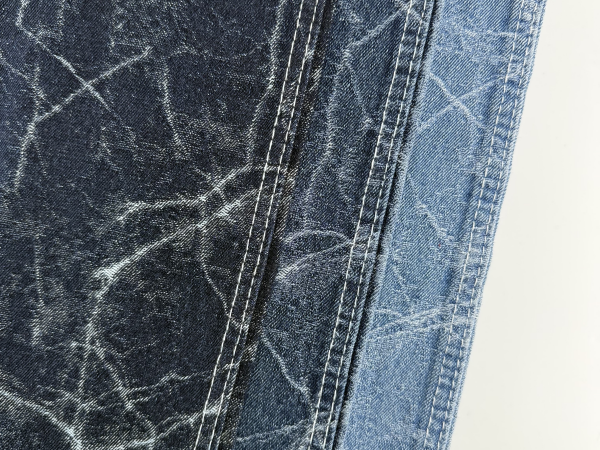
Cracked surface aesthetics are not new—but their application in denim is evolving.
Historically, similar visual languages appeared in:
- Aged architectural walls (plaster cracks, peeling surfaces)
- Vintage leather (natural creases, tension marks)
- Distressed art and industrial textures
These elements were traditionally recreated through finishing techniques—coating, printing, heavy washing.
But these methods share a limitation:
They simulate aging.
They do not build aging into the structure.
Jacquard changes that.
Instead of imitating cracks, it reconstructs them through:
- Yarn tension variation
- Irregular weave density
- Controlled disruption of surface continuity
This transforms “damage” into design logic.
From Decoration to Surface Behavior
Traditional distressed effects in denim are visual.
They rely on contrast—light vs dark, worn vs unworn.
But cracked surface jacquard works differently.
It is not based on contrast.
It is based on surface behavior.
Key difference:
- Traditional distress → applied visually
- Cracked jacquard → embedded structurally
This leads to a different experience:
- The pattern is not immediately readable
- The texture is felt before it is clearly seen
- The surface evolves gradually through wear
In other words:
It is less about what you see,
and more about how the fabric behaves over time.
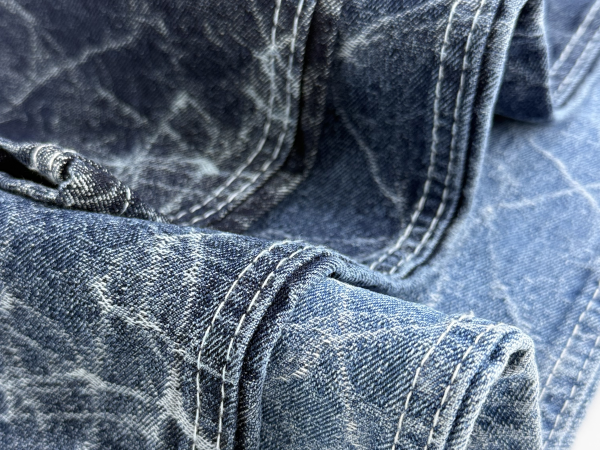
Visual Characteristics: Controlled Chaos Instead of Randomness
Although cracked surface jacquard appears irregular, it is not random.
Its complexity is controlled.
Key characteristics:
Surface language
- Fragmented lines, broken planes
- No clear directional flow
- Organic yet structured disruption
Color behavior
- Usually tonal (indigo / black / overdyed bases)
- Low contrast at first glance
- Depth revealed through micro-variation
Pattern perception
- No focal point
- No hierarchy
- Entire surface acts as one continuous field
This creates a unique visual balance:
- Chaotic at micro level
- Controlled at macro level
A combination that is difficult to achieve through printing or washing alone.
Cultural Shift: From Clean Surfaces to Worn-In Authenticity
The rise of cracked surface aesthetics is closely linked to a broader cultural shift.
Since long time, “novelty” in fashion world means:
- Clean surfaces
- Perfect finishes
- Uniform color
But this perception is changing.
Increasingly, consumers are drawn to materials that feel:
- Tactile
- Imperfect
- Already lived-in
Not as a nostalgic reference,
but as a response to over-polished, over-produced products.
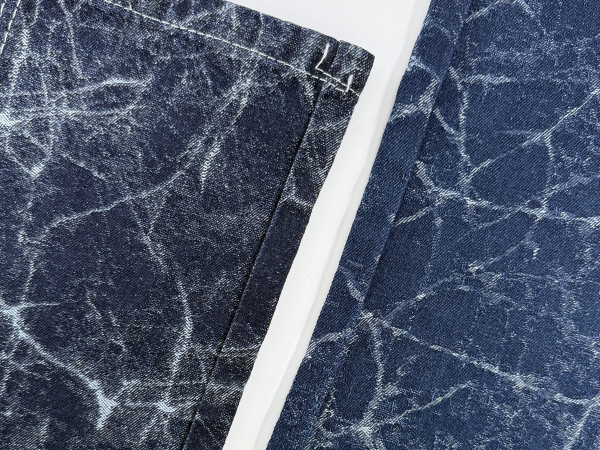
In this context, cracked surface jacquard offers something different:
It does not simulate aging after production.
It introduces a sense of authentic wear from the beginning.
Why This Type of Pattern Works Naturally with Denim
Denim is not a static material.
- Fades
- Creases
- Develops irregularity
Patterns that require precision often lose clarity under these conditions.
Cracked surface jacquard behaves differently.
Because:
- It does not rely on precision
- It does not depend on symmetry
- It does not require stability
It works with denim’s natural behavior, not against it.
Fading enhances it.
Creasing integrates into it.
Wear completes it.
Closing Insight of Part 1
Cracked surface jacquard is not about creating a “distressed look.”
It is about redefining how distress is built into the fabric.
Not as an after-effect,
but as a starting point.
In this context, imperfection is not a flaw.
It is a system.
PART 2
Jacquard Denim Industry Analysis: Regional Market Distribution
Jacquard Denim Is Not Growing Evenly — It Follows Market Logic
While jacquard denim is gaining global traction, its adoption is far from uniform.
Different regions are not just at different stages of adoption—
they are responding to jacquard for different reasons.
Understanding this difference is critical.
Because in practice, jacquard is not a single category.
It behaves differently depending on:
- Price sensitivity
- Product structure
- Consumer preference
- Retail channel dynamics
This is why the same fabric can perform strongly in one market,
and remain niche in another.
Europe: Where Design-Led Jacquard Finds Its Natural Market
Among all regions, Europe remains the most receptive to high-design jacquard denim.
This is not accidental.
European markets—especially Western Europe—have long been driven by:
- Design identity
- Fabric innovation
- Mid-to-high-end positioning
In this context, jacquard is not treated as decoration,
but as part of the product’s core value.
Key reasons behind its strong acceptance:
- Higher tolerance for subtle design
- Consumers are accustomed to tonal, low-contrast fabrics
- “Quiet differentiation” is widely accepted
- Mature product segmentation
- Clear distinction between entry, mid, and premium levels
- Jacquard fits naturally into mid-to-premium tiers
- Brand-driven storytelling
- Fabric is part of brand narrative
- Structure and texture are used to communicate quality
As a result:
Jacquard denim in Europe is often:
- Subtle rather than bold
- Structural rather than decorative
- Integrated rather than highlighted
Latin America: Why Demand Concentrates in Mid-to-Heavy Weights (11–12 oz)
In Latin American markets, jacquard denim demand shows a very specific pattern:
It is concentrated in mid-to-heavy weight fabrics, typically around 11–12 oz.
This is not a coincidence—it reflects how denim is used in the region.
Key drivers:
- Product focus on durability and structure
- Strong demand for jeans with shape retention
- Heavier fabrics perceived as higher value
- Climate vs usage balance
- Despite warmer climates, consumers still prefer structured denim
- Weight is associated with quality and longevity
- Price-value sensitivity
- Buyers need visible differentiation without significant cost increase
- Jacquard provides texture without requiring complex washing
As a result:
Jacquard in Latin America tends to be:
- More visible than in Europe
- More structured than in Asia
- Often applied to core products (jeans, uniforms, workwear-inspired styles)
Middle East: Pattern Preference Shaped by Cultural Aesthetics
In Middle Eastern markets, jacquard denim demand is more selective—but highly specific.
Pattern preference here is strongly influenced by:
- Cultural aesthetics
- Traditional decorative language
- Visual richness expectations
This leads to a different type of jacquard demand:
- Preference for recognizable patterns
- Geometric, ornamental, or structured motifs
- Less interest in abstract or “hidden” patterns
- Higher acceptance of visual density
- Rich surfaces are associated with value
- Subtle patterns may be perceived as too minimal
- Occasion-driven consumption
- Denim used beyond casual wear
- Requires more expressive surface
As a result:
Jacquard denim in this region tends to be:
- More decorative
- More visible
- More pattern-driven
Compared to cracked surface jacquard:
→ It may require adaptation (stronger contrast / clearer structure)
to fully align with local preference.
Southeast Asia: Why Jacquard Growth Is Slower Than Basics
In Southeast Asia, jacquard denim adoption is growing—but at a slower pace compared to basic denim.
This is primarily driven by structural factors:
- Price sensitivity dominates decision-making
- Basic denim remains the most competitive segment
- Jacquard seen as non-essential upgrade
- Climate-driven product preferences
- Lightweight, breathable fabrics preferred
- Heavy textured jacquard less practical
- Fast turnover retail environment
- Speed and cost outweigh differentiation
- Visual complexity is less prioritized
As a result:
Jacquard in Southeast Asia tends to:
- Remain niche
- Be used selectively in fashion-forward collections
- Grow slower than the global average
North America: Where Jacquard Is Segmented by Product Line
The North American market presents a different dynamic.
Jacquard denim does not spread evenly across categories.
Instead, it is highly segmented.
Key applications:
- Women’s fashion denim
- Used for differentiation in seasonal collections
- Often subtle and tonal
- Workwear-inspired lines
- Structured jacquard adds texture without compromising durability
- Fits well with heritage aesthetics
- Premium / niche brands
- Focus on fabric storytelling
- Use jacquard for identity rather than volume
Unlike Europe, where jacquard is integrated into broader ranges,
in North America it is more:
- Category-specific
- Brand-specific
- Strategy-driven
Closing Insight of Part 2
Jacquard denim does not operate as a universal solution.
Its relevance depends on how well it aligns with each market’s structure.
- In Europe, it supports refinement
- In Latin America, it adds value to core products
- In the Middle East, it must adapt to visual expectations
- In Southeast Asia, it competes with cost-driven basics
- In North America, it functions within defined product lines
For buyers, this means:
Choosing jacquard is not just about selecting a pattern—
it is about selecting the right level of expression for the right market.
PART 3
This Design Element in Practice: Cracked Surface Jacquard in Denim
Where This Fabric Actually Works: Designed for Structure, Not Decoration
One of the key misunderstandings about cracked surface jacquard is treating it as a “visual effect.”
In reality, it behaves more like a material characteristic.
That distinction matters when translating fabric into product.
Unlike decorative jacquards—which require space to display motifs—
cracked surface patterns do not depend on readability.
They depend on surface continuity and structural presence.
This makes them particularly suitable for categories where:
- The fabric defines the product
- The silhouette supports texture
- The design does not compete with the surface
Recommended applications (high compatibility)
- Menswear bottoms (core application)
- Straight-leg / relaxed / workwear-inspired fits
- Structured silhouettes enhance the “worn-in” effect
- Surface texture replaces the need for heavy washing
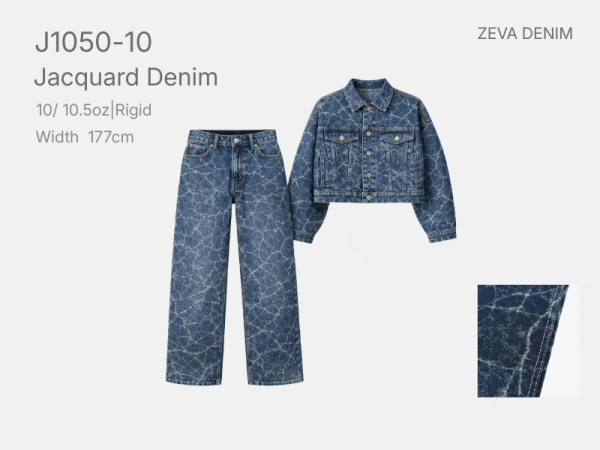
- Jackets & outerwear
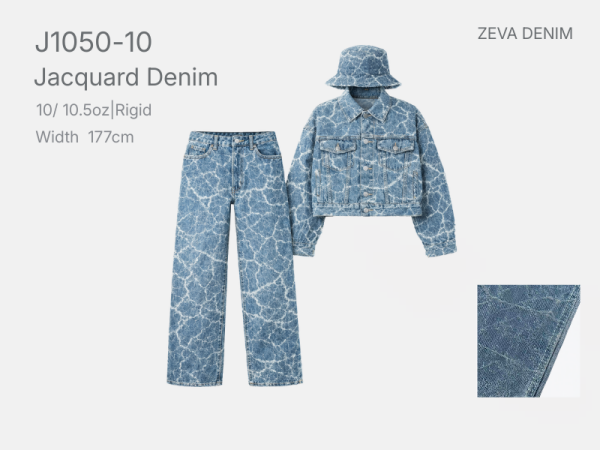
- Trucker jackets / chore jackets / utility styles
- Flat panels allow the cracked surface to read as a continuous field
- Works well with mid-to-heavy weights
- Shirts & overshirts
- Especially in mid-weight denim (7–9 oz)
- Adds depth without making the product visually heavy
- Suitable for layering pieces
- Accessories (underestimated category)
- Caps, bags, small leather-like applications
- Texture translates well in smaller formats
Less suitable applications (higher risk)
- Highly fitted garments
- Surface distortion becomes uneven
- Breaks the controlled texture
- Highly segmented designs
- Too many panels interrupt the “continuous surface” effect
- Over-designed products
- Added prints, embroidery, or heavy washes compete with the texture
Trend Alignment: Why It Naturally Fits Workwear and Modern Retro
Cracked surface jacquard does not align with soft or decorative trends.
It aligns with structure-driven and material-driven directions.
- Contemporary Workwear
- Emphasis on durability and authenticity
- Surface irregularity feels natural, not artificial
- Replaces heavy washing while keeping rugged character
→ The fabric itself communicates “wear and use”
- Premium Retro (Industrial Direction)
- Inspired by aged materials rather than vintage silhouettes alone
- Less about nostalgia, more about material depth
- Cracked textures echo aged leather, worn surfaces
→ Adds maturity to retro-inspired products
- Clean but Textured
- From distance: minimal and clean
- From close: rich and irregular
→ Fits the growing demand for “simple but not basic”
- Masculine Minimalism
- Avoids decorative patterns
- Focuses on material and structure
- Supports understated design language
What Makes It Different on Denim: Structure, Color, and Density
When applied to denim, cracked surface jacquard creates a different kind of differentiation compared to both:
- Basic denim
- Traditional patterned jacquard
- Structure: Disruption Instead of Pattern
- No defined motif or repeat
- Surface defined by irregular breaks
- Texture replaces pattern
→ More stable under washing
→ Less dependent on visual precision
- Color Behavior: Depth Through Variation, Not Contrast
- Typically tonal (indigo / black / overdyed bases)
- Depth created through micro-shading
- No reliance on sharp contrast
→ Works better with fading
→ Avoids “over-designed” appearance
- Density: Continuous Surface Instead of Repetition
- No visible repeat grid
- Density varies across surface
- Reads as one unified texture
→ Enhances material perception
→ Reduces visual fatigue
A Practical Advantage: Reducing Dependence on Heavy Washing
One of the most valuable aspects of cracked surface jacquard is operational.
In traditional denim:
- Texture is created through washing
- Requires multiple steps, higher risk, more variation
With this type of fabric:
- Part of the texture is already built-in
- Washing becomes refinement, not creation
This leads to:
- More consistent results
- Lower development risk
- Reduced production complexity
For buyers, this is not just design—it is efficiency.
Closing Insight of Part 3
Cracked surface jacquard does not rely on visibility.
It relies on material presence.
It works best when the product allows the fabric to lead—
not when design tries to override it.
In that sense, its strength is not in how much it shows,
but in how consistently it performs across product, process, and wear.
PART 4 — Closing
Final Thought: When Imperfection Becomes a Stable Design Language
As denim continues to evolve, one shift is becoming increasingly evident:
not all value comes from refinement.
For a long time, product development in denim focused on control—
cleaner surfaces, more precise finishes, more predictable results.
But in parallel, another direction has been developing:
materials that are intentionally less controlled,
yet more aligned with how denim behaves in real use.
Cracked surface jacquard belongs to this second category.
It does not aim to create a perfect surface and maintain it.
Instead, it begins with a surface that is already disrupted—
and allows wearing, washing, and time to integrate into it naturally.
This changes the role of design.
Not as something that needs to be protected,
but as something that can evolve without losing coherence.
A Practical Perspective: Where This Type of Fabric Fits
From a product development perspective, fabrics like this do not compete with basics,
nor do they aim to replace high-visibility statement designs.
They occupy a more specific position:
- Between raw denim and heavily processed denim
- Between clean surfaces and aggressive distressing
- Between stability and variation
This makes them particularly relevant for collections that need:
- Texture without over-design
- Character without instability
- Differentiation without additional processing
In that sense, their role is not to create attention,
but to support longer-lasting product value.
From Concept to Application
One example of this approach can be seen in a cracked surface jacquard development like J1050-10, where irregular textures are constructed directly into the fabric to create a worn-in effect that remains stable across different washes and product applications.
If you are exploring how this type of structure-driven fabric could fit into your next collection, it can be useful to observe not only how it looks as a fabric—but how it performs after washing, garment construction, and repeated wear.
Cracked Surface Jacquard Denim
Cracked Surface Jacquard Denim-Video


 French
  English
  Russian
  Spanish
  Arabic
  Vietnamese