
PART ONE
Decoding Floral and Botanical Patterns in Jacquard Denim
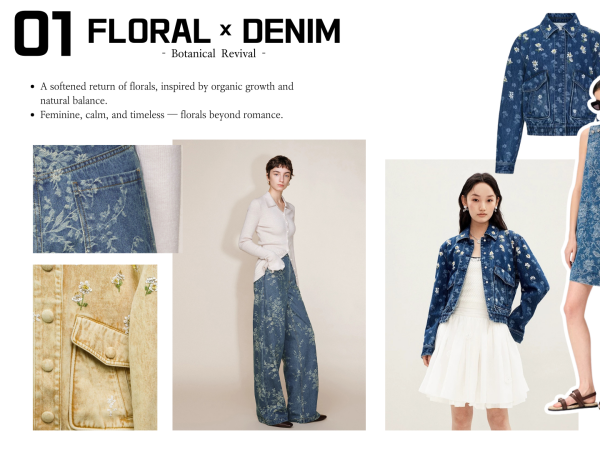
Why Floral Jacquard Is Returning — But Not the Way You Remember
Floral motifs have never truly disappeared from fashion—but in denim, they have always been unstable.
Too decorative, and they feel seasonal.
Too subtle, and they lose identity after washing.
For a long time, this contradiction limited floral denim to short-lived trends.
What is happening now is different.
Since around 2023, floral jacquard has started to reappear—not as a visual highlight, but as a structural language embedded in the fabric. This shift is quiet, but important.
Instead of asking “Does this pattern stand out?”, the new direction asks:
“Does this pattern still exist after washing, wearing, and repeating?”
That single change in perspective is what makes the current wave of botanical jacquard worth paying attention to.
From Decoration to Fabric Language: A Shift in How Patterns Are Built
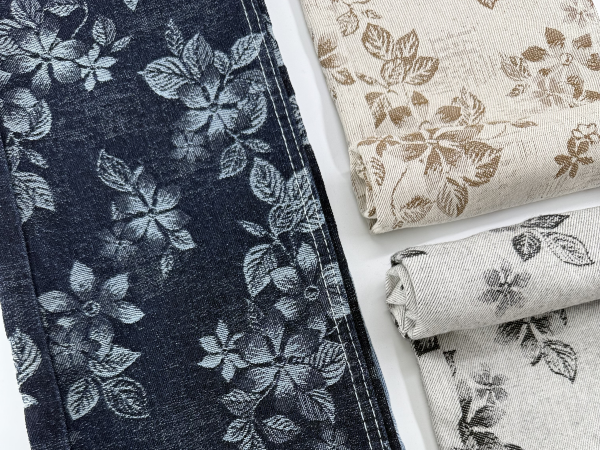
Traditional floral denim relies heavily on surface techniques—printing, coating, embroidery.
These methods are fast, flexible, and visually direct. But they share one limitation:
they sit on top of the fabric. But jacquard works differently.
Instead of adding a pattern, it builds the pattern into the fabric itself, using yarn arrangement and weave structure. The result is not just visual—it is physical.
This structural nature brings two important advantages:
- The pattern evolves together with the fabric during washing
- The texture remains even when color contrast fades
In denim—where washing defines up to 70% of the final look —this difference is not aesthetic, but functional.
The Evolution of Floral Motifs: From Symbolism to Sensory Balance
Historically, florals carried strong meanings—romance, femininity, decoration, even status. But in modern denim, these meanings are being stripped away. What replaces them is something more subtle: a sense of balance.
Contemporary botanical jacquards are less about storytelling and more about atmosphere:
- Less symmetry, more natural irregularity
- Less contrast, more tonal layering
- Less decoration, more surface rhythm
This reflects a broader shift in consumer preference:
from expressive fashion to comfort-driven aesthetics.
Not comfort in touch—but comfort in visual perception.
Why This Type of Pattern Works Better on Denim
Not every pattern works well on denim. Denim has its own constraints:
- It fades
- It distorts slightly after washing
- It gains character over time
Patterns that rely on precision or sharp contrast tend to break under these conditions. Botanical jacquard, however, behaves differently. Because of its organic shapes and softer boundaries, it absorbs these changes instead of resisting them.
Fading becomes part of the design. Irregularity becomes an advantage.
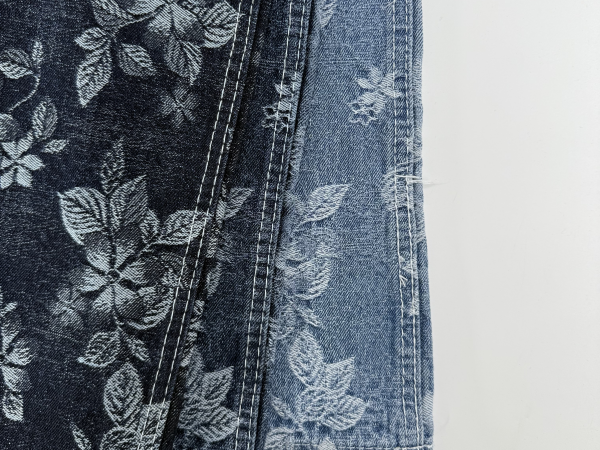
This is why certain floral jacquards feel more “natural” after washing—not less.
A Quiet but Practical Advantage: Reversibility and Layering
One of the less-discussed advantages of jacquard is its reversibility. Because the pattern is woven, the reverse side naturally presents a different expression—often inverted, sometimes more subtle.
For designers and buyers, this opens up a practical possibility:
- Using both sides within one garment
- Creating contrast without additional processes
- Extending one fabric into multiple design directions
In a market where development speed and SKU efficiency matter, this is not just a design feature—it is a production advantage.
Closing Insight of Part 1
The return of floral jacquard in denim is not about bringing back decoration.
It is about redefining how patterns behave inside a fabric that is constantly changing.
In this context, the value of botanical jacquard lies in three things:
- It survives washing
- It adapts to variation
- It integrates into long-term product development
And that is precisely why it is becoming relevant again.
PART 2
Jacquard Denim Market Overview: Growth Patterns and Industry Direction
Jacquard Denim Is Growing Again — But Not Because of Fashion Cycles
After nearly a decade of fluctuating relevance, jacquard denim is entering a new growth phase. From 2023 onward, multiple sourcing markets—from Europe to Latin America and parts of the Middle East—have shown a noticeable increase in demand for textured and patterned denim fabrics, with jacquard among the fastest-growing segments.
This rebound, however, is often misunderstood. It is easy to attribute the growth to “trend cycles”—a return of vintage or decorative styles. But this explanation is incomplete. What is driving jacquard denim today is not a short-term aesthetic shift, but a structural change in how denim products are evaluated and sold.
Over the past five years, the role of denim fabric has been quietly redefined. It is no longer just a base material for washing effects; increasingly, it is expected to carry part of the product’s design identity on its own. This shift has created space for fabrics that can offer visual differentiation before washing, and maintain it after.
Jacquard fits precisely into this gap.
From “Decoration” to “Core Selling Point”: A Shift in Market Position
Historically, jacquard denim occupied a very limited position in the market. It was often used as a highlight in small collections or niche fashion lines, rarely forming the backbone of a product range. Its share within the overall denim category remained relatively low—commonly estimated in the low single digits.
What is changing now is not just demand volume, but positioning.
In many mid-to-high-end collections, jacquard and dobby structures are no longer treated as “special items,” but as part of the main fabric offering. In some segments—particularly women’s wear, fashion denim, and capsule collections—structured fabrics are beginning to compete directly with traditional 3/1 twill basics.
This shift is closely tied to retail realities. As price competition intensifies in basic denim, brands are under pressure to differentiate without significantly increasing cost. Surface treatments alone are no longer sufficient, especially when wash effects can be easily replicated across suppliers. Fabric-level differentiation, on the other hand, is harder to copy and more stable across production.
In this context, jacquard becomes not just a design choice, but a strategic one.
What Is Really Driving Growth: Beyond Surface Trends
If we look at jacquard denim’s estimated growth over the past five years, most industry observations suggest a steady increase, with a CAGR in the range of 6–9%, outperforming the broader denim market, which has remained relatively flat in volume.
But numbers alone do not explain why.
The real drivers can be grouped into three structural shifts.
First, post-pandemic consumption has become more selective. Buyers—both brands and end consumers—are purchasing fewer pieces, but expecting each product to carry more value. This has increased demand for fabrics that can offer visual interest without relying entirely on heavy washing or additional processing.
Second, product development cycles have accelerated. Fast fashion is no longer only about speed to market, but speed to differentiation. Fabrics that already contain design elements reduce development steps, shorten sampling time, and lower the dependency on complex wash programs.
Third, there is a growing alignment between sustainability pressure and design strategy. While jacquard itself is not inherently “sustainable,” it enables a reduction in aggressive washing or chemical-heavy finishing in some applications, because part of the visual effect is already embedded in the fabric.
These factors, combined, are what sustain jacquard’s growth—not seasonal fashion narratives.
Who Is Driving the Demand: Fast Fashion vs. Premium Brands
A common assumption is that jacquard denim is driven primarily by premium brands. This was true in the past, but the current landscape is more complex.
Fast fashion brands are increasingly adopting jacquard—not for luxury positioning, but for efficiency. By using fabrics with built-in patterns, they can create “newness” without redesigning silhouettes or investing heavily in washing development. This is particularly relevant in categories like women’s denim, skirts, and lightweight fashion pieces.
At the same time, mid-to-high-end brands continue to push jacquard further, focusing on refinement rather than visibility. In these collections, patterns are often subtle, tonal, and integrated into the fabric in a way that enhances texture rather than dominates it.
In other words, both ends of the market are contributing to growth—but for different reasons:
- Fast fashion uses jacquard to speed up differentiation
- Premium brands use jacquard to deepen product identity
This dual demand structure is one of the key reasons why jacquard denim is not just growing—but stabilizing.
Closing Insight of Part 2
Jacquard denim is not returning to the market—it is redefining its place within it.
Its growth is not driven by visibility, but by utility. Not by decoration, but by integration.
For buyers, the implication is clear:
understanding jacquard today is less about recognizing patterns, and more about recognizing where fabric can replace process, and where structure can replace surface.
That is where its real value lies.
PART 3 — This Design Element in Industry: Floral Jacquard in Denim
How to Use This Type of Floral Jacquard — Thinking Like a Product Developer
When working with jacquard denim, the key question is not “Is the pattern attractive?”, but “Where will this fabric actually work in a finished product?”In fact, the value of a fabric depends on the final appearance of the garment, not just its appearance as fabric.
Botanical jacquards like this perform best when the fabric surface can remain visually continuous. This is why they are particularly effective in women’s wear, where silhouettes allow more space for the material itself to express.
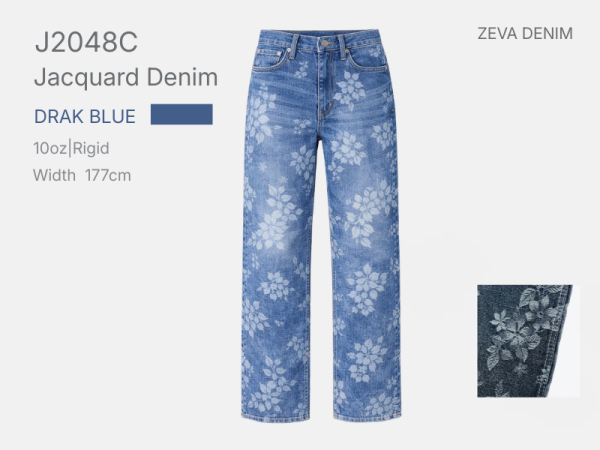
From a product perspective, the most suitable applications are:
- Bottoms: straight-leg, wide-leg, A-line (larger panels, less distortion)
- Skirts: mid-length or structured (pattern flows naturally with movement)
- Jackets / overshirts: relaxed fits (avoid cutting pattern into fragments)
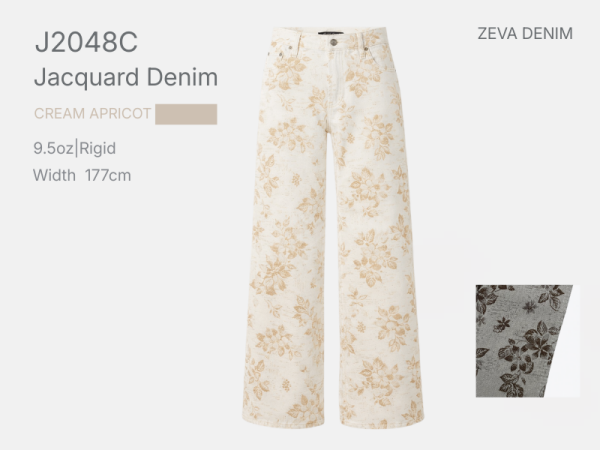
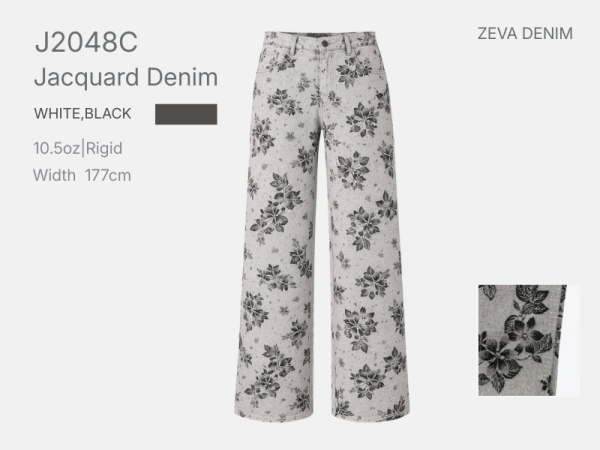
These categories share one common feature: they allow the fabric to remain “readable.”
By contrast, the following applications tend to reduce the value of jacquard:
- Slim fits: pattern gets stretched or compressed
- Heavy panel designs: pattern continuity is broken
- Aggressive washing styles: structure is visually overridden
The takeaway is simple:
this type of fabric works best when the garment design supports it, rather than competes with it.
Why It Fits Current Trends — Multiple Directions, Not Just One
This type of floral jacquard is not tied to a single trend cycle. Its strength lies in how it aligns with multiple market directions at the same time.
It fits particularly well into three key trend movements:
- Softened denim direction
→ less rigid, more fluid, more wearable
- Premium retro
→ heritage-inspired, but refined and modern
- Clean but not flat aesthetics
→ simple at distance, detailed up close
What these trends share is a shift away from aggressive visual impact toward controlled, layered design. Botanical jacquard supports this because it builds depth through structure rather than contrast.
This is also why it performs well across seasons. It is not dependent on bold statements, which tend to go out of trend quickly, but on subtle texture—which tends to last longer.
A Practical Advantage for Buyers: Less Risk in Washing and Production
Beyond design, jacquard also brings operational advantages. One of the most important is reducing dependence on heavy washing processes.
Instead of relying entirely on stone wash or bleaching to create visual depth, jacquard already contains part of that effect in its structure. This allows for simpler wash programs while still achieving differentiation.
For buyers, this translates into:
- More stable production results
- Lower variation between batches
- Better control over cost and lead time
In a market where consistency is as important as creativity, this is a significant advantage.
Closing Insight of Part 3
This type of floral jacquard does not rely on being visually loud. Its strength lies in how it works across product, trend, and production.
It fits garments, aligns with multiple directions, adapts to washing, and reduces development complexity.
That combination is what makes it commercially viable.
PART 4 — Closing
Final Thought: When Fabric Starts Doing More of the Work
As denim continues to evolve, one subtle but important shift is becoming clear:
more of the product’s value is moving upstream—into the fabric itself.
Where washing once carried most of the visual responsibility, today’s development is increasingly shared between structure, material, and process. Fabrics are no longer expected to simply support design; they are becoming part of the design.
This is where jacquard, especially in its more refined and understated forms, starts to make sense. It does not replace washing, nor does it compete with it. Instead, it reduces the role of washing playing on it, that makes the fabric can act purely and more directly key role in the final garment.
For buyers and developers, this shift is less about chasing newness, and more about understanding where value can be built earlier in the process, and carried more reliably through production.
If you’re exploring how structured fabrics like this can fit into your next collection, it’s often worth looking at how they behave not just on the hanger—but after washing, handling, and repeated wear. That’s where their real difference begins to show.
One example of this approach can be seen in a floral jacquard development like J2048C-10LAN, where the pattern is designed to remain visible and adaptable across different washes and product applications.
Floral and Botanical Patterns in Jacquard Denim
Floral and Botanical Patterns in Jacquard Denim-Video


 Vietnamese
  English
  Russian
  Spanish
  Arabic
  French