
Modern denim development is no longer centered solely on color, weight, or washing effects. As consumers increasingly seek tactile experiences and elevated visual depth, texture has become one of the most important value drivers in premium denim collections. Among the newest developments, floral chenille jacquard denim stands out because it combines familiar botanical storytelling with the richness of three-dimensional surfaces.
This article explores J2075 “Monochrome Bloom” from both a design and industry perspective, covering:
- Why monochrome floral motifs are returning to fashion after years of maximalist color trends
- The historical origins and evolution of floral textile patterns
- How chenille jacquard construction transforms traditional floral design into a luxury denim surface
- Why texture-driven denim is becoming more important than print-driven denim
- What happens to flocking denim after washing and how wash development affects final appearance
- Which garment categories can benefit most from this type of floral textured denim
- Why understated floral surfaces are increasingly aligned with FW26/27 market directions
Rather than functioning as a decorative novelty, Monochrome Bloom represents a broader shift toward tactile luxury, quiet sophistication, and texture-led denim design.
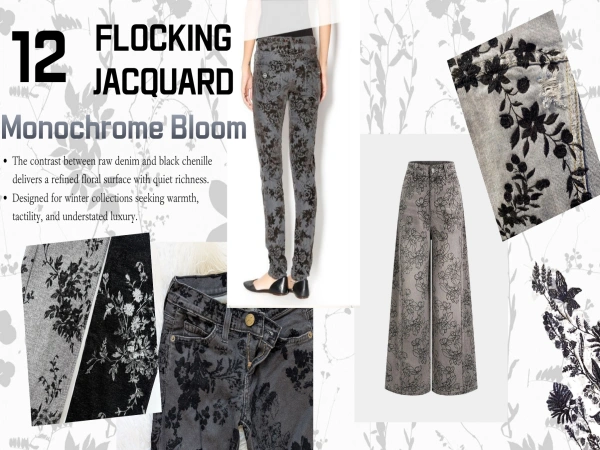
Understanding the Design: The Return of Monochrome Floral Surfaces
Why Is This Design Worth Paying Attention To?
For many years, floral motifs in denim were often associated with heavily printed women’s collections, youthful spring products, or vintage-inspired garments.
Today’s market is moving in a different direction.
Consumers are increasingly attracted to products that reveal their value gradually rather than immediately. Instead of bright florals competing for attention through color, designers are exploring ways to create visual richness through texture, relief, shadow, and surface depth.
J2075 follows this philosophy.
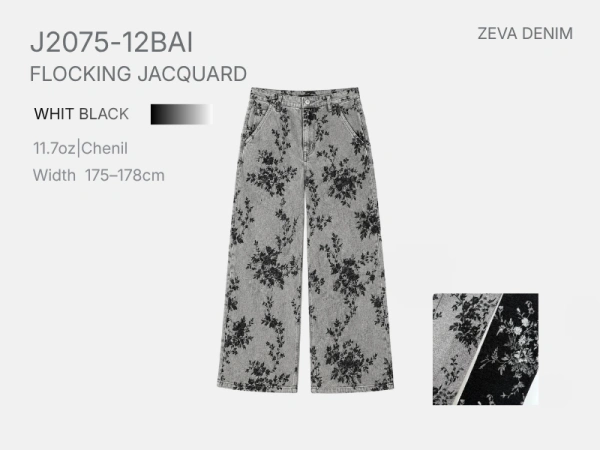
Instead of using colorful floral prints, it uses black chenille yarns woven into a monochrome denim ground. The result is a floral surface that appears sophisticated rather than decorative.
The flowers are present, but they do not dominate.
The texture speaks before the pattern does.
This subtle balance makes the design suitable for premium denim collections that want femininity without becoming overly romantic.
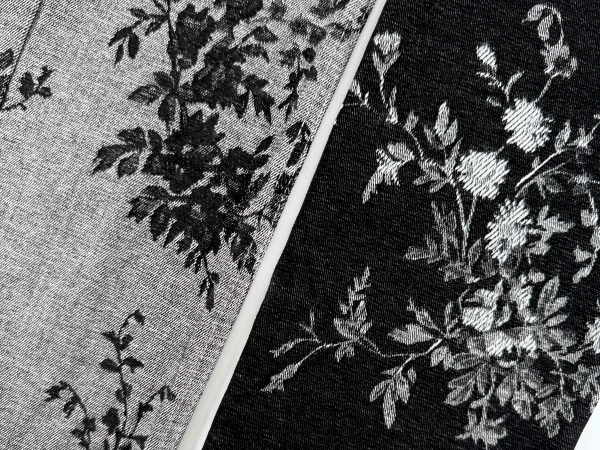
The Origins of Floral Textile Motifs
Floral patterns have existed in textiles for centuries.
Some of the earliest floral weaving traditions can be traced to:
- Persian textiles
- Chinese silk weaving
- French brocades
- English botanical prints
During the 18th and 19th centuries, floral motifs became symbols of craftsmanship, elegance, and refinement.
By the late twentieth century, florals evolved into multiple fashion directions:
- Vintage romantic florals
- Botanical naturalism
- Dark florals
- Minimal floral linework
- Luxury monochromatic florals
The newest evolution is perhaps the most interesting.
Rather than emphasizing color, modern designers focus on material contrast.
Texture becomes the primary storytelling tool.
This is exactly where Monochrome Bloom differs from traditional floral denim.
The Cultural Meaning Behind Floral Design
Flowers are universally associated with growth, renewal, and beauty.
However, monochrome floral surfaces communicate something different.
They suggest:
- Maturity
- Elegance
- Quiet confidence
- Emotional depth
- Timelessness
Unlike colorful floral prints that often feel seasonal, monochrome floral textures tend to feel seasonless.
This makes them particularly attractive for premium winter collections.
The floral motif becomes less about decoration and more about atmosphere.
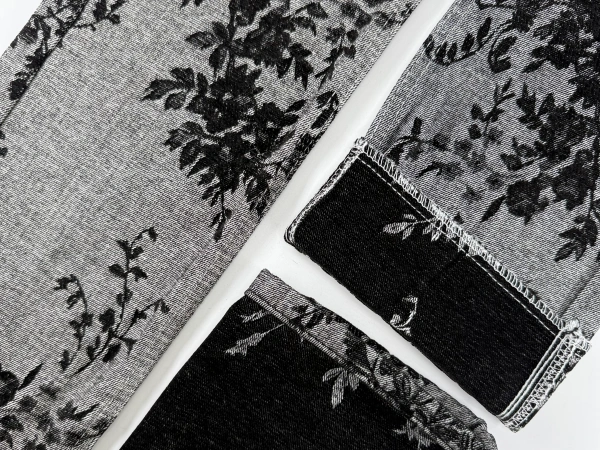
Visual Characteristics of J2075 Monochrome Bloom
Several design decisions make this fabric visually distinctive.
1. Monochrome Contrast
The contrast between the light denim base and black chenille creates immediate visual depth.
Rather than relying on multiple colors, the design achieves richness through tonal variation.
2. Raised Floral Surface
The chenille construction creates a tactile floral relief.
This introduces shadows and highlights that change depending on viewing angle.
As garments move, the floral pattern appears to shift naturally.
3. Controlled Density
The floral arrangement is balanced rather than crowded.
Negative space remains visible.
This prevents visual fatigue and improves garment versatility.
4. Winter-Friendly Character
The darker chenille surface naturally creates a warmer appearance.
Combined with the soft touch of chenille yarns, the fabric immediately feels aligned with autumn and winter product development.
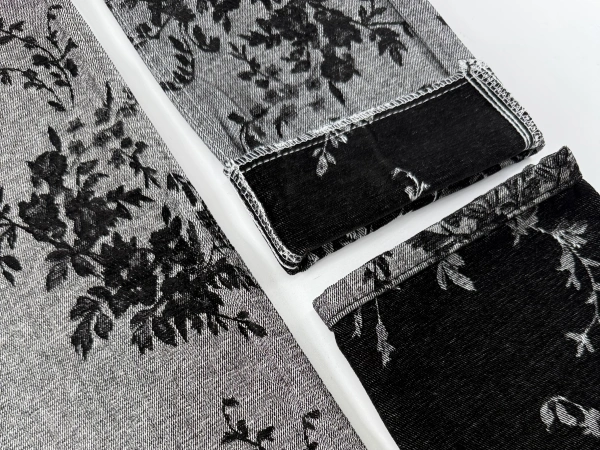
Chenille Jacquard Denim Industry Analysis: Product Development and Washing Direction
What Happens to Chenille Jacquard Denim After Washing?
Unlike ordinary denim, flocking jacquard denim changes in multiple dimensions during washing.
Developers often focus only on color evolution.
However, chenille denim evolves through:
- Color fading
- Texture exposure
- Surface contrast
- Light reflection
- Handfeel variation
The most successful wash programs understand that washing reveals texture rather than simply fading indigo.
After washing, the floral pattern often becomes more visible because the denim ground and chenille surface age differently.
This differential aging creates natural depth.
Which Washes Work Best for Chenille Denim?
Not every denim wash is suitable for textured fabrics.
The most effective options typically include:
Enzyme Wash
Creates soft color transitions while preserving texture.
Ideal for premium commercial products.
Stone-Enzyme Combination
Introduces vintage character without excessively damaging the chenille surface.
Widely used for casual luxury denim.
Snow Wash
Particularly effective for textured denim.
The irregular color contrast highlights surface depth and makes floral motifs appear more dimensional.
Dirty Tint Wash
Creates atmospheric winter aesthetics that complement monochrome floral patterns.
Especially suitable for FW collections.
Why Is Snow Wash Particularly Effective on Flocking Denim?
Snow wash works differently from traditional fading techniques.
Its visual impact comes from randomness.
Texture denim already contains physical surface variation.
When snow washing interacts with raised chenille areas, the effect becomes amplified.
The result is:
- Higher dimensionality
- Stronger visual contrast
- More apparent texture depth
- Increased perceived product value
This explains why many premium texture-denim collections utilize snow wash developments.
The wash does not create the design.
It reveals the design.
How Can Chenille Denim Retain Its Soft Texture After Washing?
This is one of the most overlooked development challenges.
Many factories focus on achieving dramatic visual effects while ignoring tactile quality.
Excessive processing can flatten chenille surfaces and reduce the luxurious handfeel that originally justified the fabric’s higher cost.
To preserve texture:
- Control enzyme dosage
- Limit aggressive abrasion
- Reduce excessive stone exposure
- Optimize drying temperature
- Maintain yarn integrity during finishing
Successful chenille denim should feel as rich as it looks.
Why Can Overwashing Damage Texture Denim?
Texture denim derives value from surface structure.
Every aggressive wash process removes part of that structure.
Overwashing may cause:
- Texture flattening
- Pattern distortion
- Reduced chenille height
- Lower visual contrast
- Shortened garment lifespan
Ironically, many developers chase stronger vintage effects while accidentally destroying the very feature that differentiates the fabric.
For texture-driven products, restraint often produces better results than aggression.
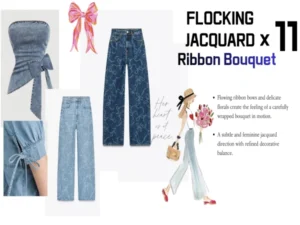
Application Analysis: Why Monochrome Bloom Works So Well in Denim
Best Garment Categories
Based on the fabric structure, pattern density, and non-stretch construction, J2075 is particularly suitable for:
Women’s Denim Jackets
The floral texture creates visual richness without requiring additional embellishment.
Wide-Leg Jeans
Large panels allow the floral surface to be fully appreciated.
The texture becomes part of the silhouette.
Denim Skirts
Midi and maxi skirts benefit especially from the flowing botanical composition.
Fashion Sets
Coordinated jackets and trousers create a powerful yet refined statement.
Premium Workwear-Inspired Pieces
Interestingly, the monochrome palette allows floral surfaces to enter categories traditionally dominated by menswear-inspired design.
Which Trend Does This Fabric Align With?
Several major trends intersect within J2075.
Quiet Luxury
The fabric communicates sophistication through texture rather than logos or excessive decoration.
Elevated Vintage
The monochrome palette and washed denim foundation create a refined vintage character.
Texture-Driven Fashion
Perhaps the strongest alignment.
Across global fashion collections, texture is increasingly replacing print as a premium design language.
Soft Romanticism
The floral theme remains romantic, but the monochrome execution prevents it from becoming overly feminine.
What Makes This Floral Pattern Different in Denim?
Many floral fabrics already exist.
What makes this version unique?
The answer lies in the interaction between:
- Structure
- Màu sắc
- Density
Structure
The floral pattern is physically built into the fabric through chenille jacquard construction.
It is not applied afterward.
This creates permanence and depth.
Màu sắc
The black-on-grey denim palette creates stronger sophistication than traditional floral colorways.
The pattern feels architectural rather than decorative.
Density
The floral motifs occupy enough surface area to be recognizable while preserving sufficient negative space.
This balance allows garments to remain wearable despite their strong visual identity.
Final Thoughts: Texture Is Becoming the New Luxury Language of Denim
Over the past decade, denim innovation has largely revolved around stretch technologies, sustainable finishing, and color development.
The next stage appears increasingly focused on texture.
J2075 Monochrome Bloom demonstrates how traditional floral motifs can be transformed into contemporary denim surfaces through chenille jacquard construction.
Rather than relying on loud colors or oversized graphics, the fabric creates value through depth, touch, and subtle visual complexity.
For brands developing FW26/27 collections, this direction offers something increasingly rare in today’s market:
A product that feels luxurious without being flashy.
A floral design that feels modern without chasing trends.
A denim surface that rewards closer observation.
For readers interested in exploring the fabric further, product specifications, garment developments, and video demonstrations can be viewed through the product page and accompanying collection videos, where the texture and wash evolution can be appreciated in motion rather than only in static images.
 Vietnamese
  English
  Russian
  Spanish
  Arabic
  French