
Why Organic Reptile-Inspired Textures Are Becoming a Key Direction in Chenille Jacquard Denim Development
Before diving into the design details of J1073, it is worth understanding why reptile-inspired textured denim is gaining attention across both fashion and denim supply chains.
This article explores:
- The origin and evolution of reptile-inspired surface patterns in fashion and textiles.
- Why organic geometric textures are replacing conventional prints in premium denim development.
- How chenille jacquard construction transforms reptile motifs into tactile denim surfaces.
- The differences between chenille jacquard denim, flocked denim, corduroy, and traditional textured fabrics.
- Why textured denim is increasingly important for brands pursuing premium casualwear and statement collections.
- How J1073’s raised reptile-inspired structure aligns with emerging FW26/27 denim trends.
Rather than viewing J1073 as simply another jacquard denim, it is more accurate to see it as part of a broader movement toward sensory, dimensional, and emotionally engaging denim surfaces.
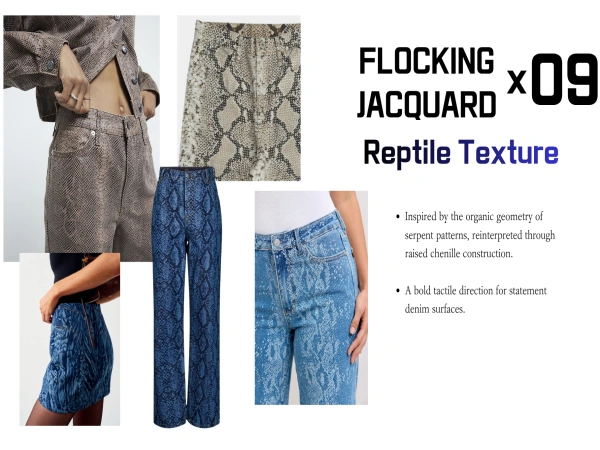
Design Element Analysis: The Appeal of Reptile-Inspired Texture
Why Is This Design Worth Attention?
For decades, denim innovation was largely driven by three variables:
- Màu sắc
- Wash
- Silhouette
Today, these tools alone are becoming less effective.
Consumers are exposed to thousands of denim products every day through social media. Most traditional denim fabrics appear similar at first glance.
As a result, texture has become one of the fastest-growing methods for creating product differentiation.
J1073 addresses this challenge through an organic reptile-inspired surface that creates immediate visual depth without relying on loud colors, heavy printing, or excessive embellishment.
The design achieves what many brands seek today:
A recognizable identity without appearing overly decorative.
The result is bold enough to attract attention while remaining wearable.
The Historical Origin of Reptile Patterns
Reptile-inspired patterns have existed in fashion for centuries.
Their origins can be traced to:
- Snake skin
- Crocodile skin
- Lizard skin
Historically these materials symbolized:
- Strength
- Status
- Protection
- Wealth
Ancient Egyptian, Persian, and Roman cultures often associated serpents with transformation, wisdom, and regeneration.
By the twentieth century, reptile textures became closely linked to luxury accessories.
Luxury houses frequently incorporated:
- Python leather
- Crocodile leather
- Embossed reptile textures
into bags, footwear, belts, and outerwear.
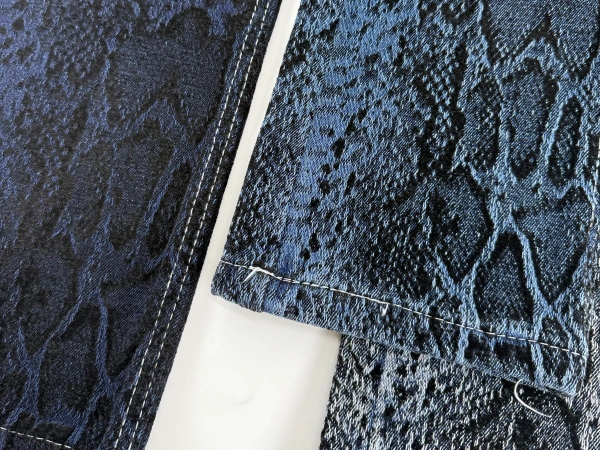
From Animal Print to Abstract Texture
The modern interpretation differs significantly from earlier reptile-inspired fashion.
Previous generations focused on direct imitation.
Designers attempted to recreate actual snake skin or crocodile skin patterns as realistically as possible.
Today’s approach is different.
Instead of copying nature literally, designers borrow:
- Structure
- Rhythm
- Scale variation
- Organic geometry
This shift reflects a broader movement toward abstraction.
J1073 follows this modern direction.
The pattern does not resemble a specific reptile species.
Instead, it captures the irregular geometry found in natural reptile scales and translates it into a contemporary denim surface.
The result feels architectural rather than animalistic.
Cultural Meaning Behind Reptile Geometry
One reason reptile-inspired patterns continue to reappear is their symbolic flexibility.
Across different cultures, serpents represent:
- Renewal
- Adaptability
- Transformation
- Resilience
These meanings align surprisingly well with denim itself.
Denim evolves through wear.
Its appearance changes over time.
It develops character through use.
Similarly, reptiles continuously shed and renew their skin.
This parallel gives reptile-inspired denim an underlying narrative that feels authentic rather than purely decorative.
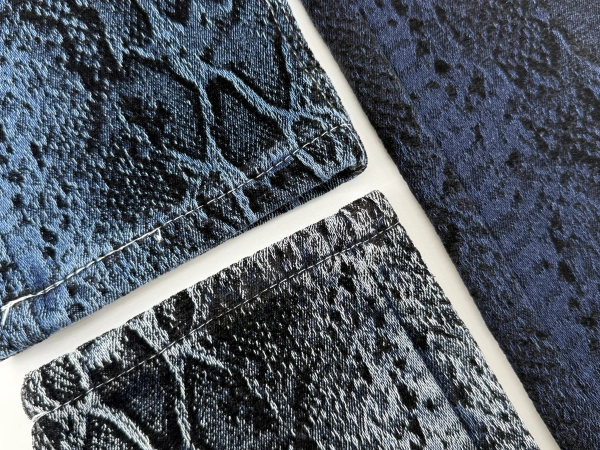
Visual Characteristics of J1073
Several visual features distinguish this design from conventional jacquards.
Organic Irregularity
The pattern avoids predictable repetition.
Unlike plaid, houndstooth, or geometric grids, each section feels slightly different.
This creates a more natural appearance.
Raised Chenille Surface
The chenille yarn introduces physical height.
The design is not merely visible.
It is tactile.
Consumers can both see and feel the pattern.
Strong Light Interaction
The raised areas catch light differently than the denim ground.
This creates shifting highlights and shadows throughout the garment.
Controlled Contrast
Despite its bold texture, the pattern remains integrated into the denim structure.
It avoids the overly graphic appearance often associated with printed fabrics.
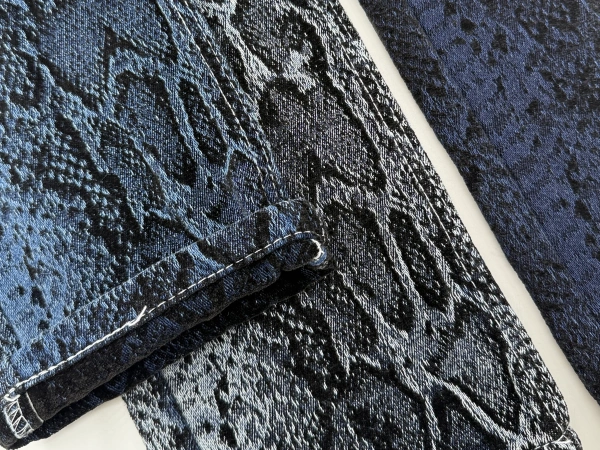
Chenille Jacquard Denim Industry Analysis: Development Logic and Production Perspective
Why Is Chenille Jacquard More Suitable for Denim Than Flocking?
At first glance, both chenille and flocking create texture.
However, they behave very differently in denim production.
Flocking adds texture after fabric construction.
The texture sits on top of the fabric.
Over time, abrasion can reduce the visual effect.
Chenille jacquard works differently.
The texture is integrated during weaving.
It becomes part of the fabric structure itself.
For denim applications, this offers several advantages:
- Better durability
- Improved wash compatibility
- Greater dimensional depth
- More natural aging characteristics
As denim is fundamentally a wash-driven fabric category, chenille construction tends to perform better over the garment lifecycle.
What Does Chenille Jacquard Share with Corduroy?
Although visually different, chenille jacquard and corduroy share several important characteristics.
Both rely on texture rather than color.
Both create depth through surface structure.
Both encourage tactile interaction.
Most importantly, both communicate warmth.
This is particularly valuable for autumn and winter collections.
Consumers often associate textured surfaces with comfort and quality.
That perception can significantly increase product value.
The difference is flexibility.
Corduroy is defined by linear ribs.
Chenille jacquard allows almost unlimited pattern development.
This gives designers much greater creative freedom.
Why Is Chenille Jacquard Ideal for Premium Casualwear?
Premium casualwear occupies a space between luxury fashion and everyday clothing.
Products must feel special without appearing overly formal.
This balance is difficult to achieve.
Chenille jacquard naturally supports this positioning.
The texture adds sophistication.
The denim foundation preserves familiarity.
Consumers experience something different while still recognizing the garment as denim.
This combination is particularly effective for:
- Elevated casualwear
- Designer denim
- Contemporary menswear
- Premium womenswear
- Boutique collections
Why Is Texture Denim Harder to Standardize Than Regular Denim?
Traditional denim quality control focuses primarily on:
- Cân nặng
- Shade
- Chiều rộng
- Sự co ngót
Texture denim introduces additional variables.
Manufacturers must also control:
- Pattern definition
- Texture height
- Chenille yarn consistency
- Surface uniformity
- Wash response
Even small yarn variations can influence the final appearance.
This makes production significantly more demanding.
For buyers, supplier experience becomes especially important when sourcing chenille jacquard denim.
J1073 Reptile Texture Denim Analysis
Which Garment Categories Fit This Fabric Best?
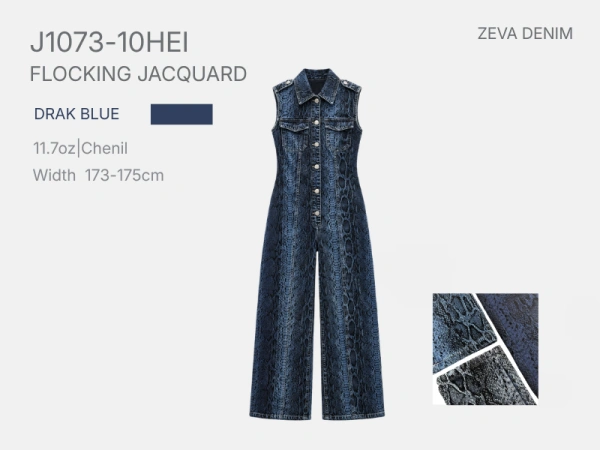
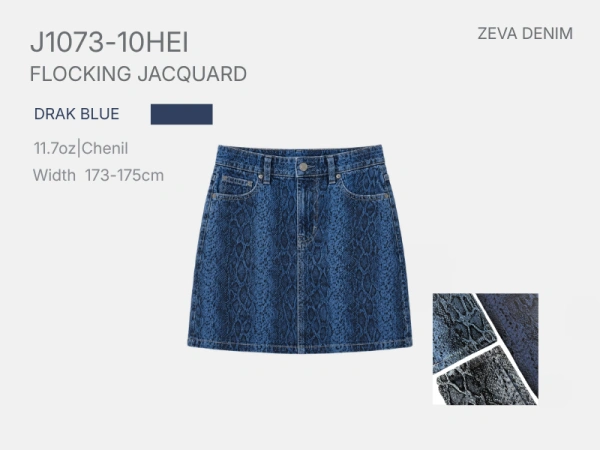
Based on the fabric structure and visual density, J1073 performs best in rigid denim applications.
The texture benefits from stability.
Stretch constructions may reduce pattern definition.
The most suitable categories include:
Men’s Products
- Denim jackets
- Overshirts
- Trucker jackets
- Workwear-inspired outerwear
- Relaxed trousers
Women’s Products
- Cropped jackets
- Wide-leg jeans
- Structured skirts
- Coordinated denim sets
- Fashion outerwear
Gender-Neutral Collections
The organic pattern avoids gender-specific associations.
This makes it highly adaptable for unisex product development.
Which Fashion Trends Does It Match?
Modern Retro
The fabric combines traditional textile craftsmanship with contemporary execution.
This aligns strongly with the continuing retro movement.
Quiet Luxury
Although visually distinctive, the fabric avoids excessive branding.
The value comes from material sophistication.
This supports quiet luxury positioning.
Elevated Utility
Many brands are upgrading workwear silhouettes through better materials.
J1073 fits this trend perfectly.
Sensory Fashion
One of the most important emerging directions is sensory engagement.
Consumers increasingly seek products that offer visual and tactile experiences.
J1073 directly addresses this demand.
What Makes Reptile Texture Different on Denim?
The most important distinction lies in the interaction between texture and indigo.
On leather or synthetic materials, reptile patterns often rely on gloss.
On denim, the effect is created through:
- Structure
- Yarn contrast
- Surface height
- Wash evolution
This produces a softer and more sophisticated appearance.
Structural Difference
The raised chenille areas create dimensional scale-like effects.
The pattern feels integrated rather than applied.
Color Difference
Indigo naturally enhances depth.
Dark areas recede visually.
Raised areas become more prominent.
This creates a dynamic surface without requiring multiple colors.
Density Difference
The pattern uses irregular spacing.
Some areas appear dense.
Others feel more open.
This variation creates movement across the fabric.
The eye naturally travels through the design.
Why Reptile-Inspired Textured Denim Fits the Future of Denim Development
The denim industry is gradually moving away from purely decorative innovation.
Instead of adding more graphics, brands are exploring ways to create richer material experiences.
This shift explains the growing interest in:
- Textured denim
- Chenille denim
- Structured jacquards
- Sensory fabrics
- Dimensional surfaces
J1073 reflects this evolution.
Its appeal comes not from aggressive visual impact but from the balance between texture, depth, and wearability.
The reptile-inspired geometry introduces complexity while maintaining the authenticity of denim.
For brands developing FW26/27 collections, this represents an increasingly relevant direction—one where fabric itself becomes the primary design feature.
For those interested in exploring J1073 further, including fabric specifications, garment applications, wash effects, and video demonstrations, the product page and development resources provide a closer look at how this chenille jacquard structure performs in actual denim collections.
 Vietnamese
  English
  Russian
  Spanish
  Arabic
  French