
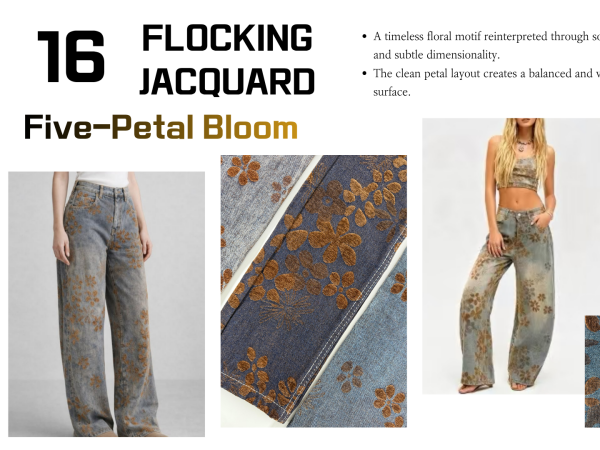
Modern denim development is moving beyond color and wash effects. As consumers become increasingly familiar with vintage washes, distressed finishes, and surface treatments, brands are searching for new ways to create value through texture, tactility, and material storytelling. This shift has accelerated the rise of textured denim, particularly chenille jacquard constructions that introduce depth without relying on heavy graphics or aggressive embellishment.
In this article, we explore the design logic and market significance behind J2079 Five-Petal Bloom, a chenille jacquard denim inspired by a timeless floral motif. Key topics include:
- The historical evolution and enduring appeal of floral patterns in fashion.
- Why floral motifs are being reinterpreted through texture rather than print.
- The rise of “Comfort Texture” as a post-pandemic design direction.
- Why texture denim works especially well with oversized silhouettes and contemporary casualwear.
- How chenille jacquard creates visual richness without overwhelming the garment.
- The commercial opportunities of floral textured denim in modern denim collections.
Rather than examining flowers as decoration alone, this article explores how floral texture is becoming an important structural design element in contemporary denim development.
Understanding the Design Element: Five-Petal Bloom
Why Is This Design Worth Attention?
Among all decorative motifs used in fashion, floral patterns are arguably the most enduring.
Unlike seasonal graphics or trend-driven prints, flowers have maintained relevance across centuries because they carry universal emotional associations. They can represent growth, optimism, femininity, nature, craftsmanship, and renewal depending on context.
However, today’s market is saturated with floral prints.
Consumers have seen countless floral dresses, printed shirts, and embroidered garments. As a result, brands are increasingly looking for ways to retain the emotional appeal of flowers while presenting them through new material expressions.
This is where Five-Petal Bloom becomes particularly interesting.
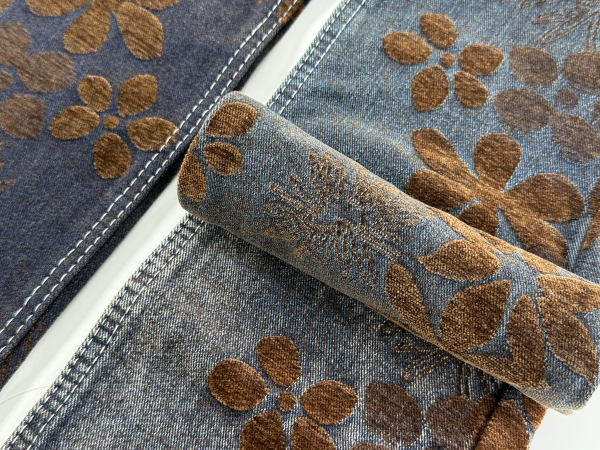
Instead of relying on color-heavy printing or embroidery, the floral motif is integrated directly into the denim structure through chenille jacquard construction. The flower becomes part of the fabric itself rather than a graphic placed on top.
The result feels more refined, more tactile, and more contemporary.
The Origins of Floral Motifs in Fashion
Floral motifs have existed in textile history for thousands of years.
Some of the earliest floral textiles can be traced to:
- Ancient Persia
- China
- India
- Ottoman Turkey
These regions developed highly sophisticated floral weaving traditions that later influenced European textile production.
By the 18th and 19th centuries, floral patterns became central to luxury fabrics produced in France and England.
The most significant commercial boom occurred during:
- Victorian fashion
- Art Nouveau design
- Mid-century decorative textiles
- 1970s bohemian fashion
- Early 2000s romantic womenswear
Each period interpreted flowers differently, but the underlying appeal remained constant.
Flowers symbolize beauty, nature, and emotional connection.
Why Are Floral Motifs Returning Today?
The current revival differs significantly from previous floral trends.
Historically, flowers were often presented through:
- Bright colors
- Dense prints
- Embroidery
- Decorative embellishments

floral-chenille-jacquard-denim-fabric-j2079-five-petal-bloom.
Today’s consumers generally prefer a more subtle aesthetic.
Instead of obvious decoration, they seek materials that reveal complexity gradually.
This explains why textured floral denim is gaining attention.
Modern floral interpretation focuses on:
- Surface depth
- Material contrast
- Tonal variation
- Tactile richness
- Quiet luxury
Rather than shouting for attention, the fabric invites closer inspection.
This shift aligns closely with broader consumer preferences toward understated sophistication.
Cultural Meaning and Symbolism
One reason floral motifs continue to survive trend cycles is their symbolic flexibility.
Flowers can communicate:
- Renewal
- Growth
- Optimism
- Softness
- Craftsmanship
- Natural beauty
Unlike highly specific graphics, floral imagery is culturally adaptable.
A flower can feel romantic in one market, artistic in another, and premium in a third.
This versatility makes floral motifs particularly attractive for global denim brands serving multiple regions.
Visual Characteristics of Five-Petal Bloom
The Five-Petal Bloom design is intentionally restrained.
Instead of oversized botanical illustrations, the pattern utilizes a clean, balanced flower structure distributed across the surface.
Key visual features include:
Controlled Repetition
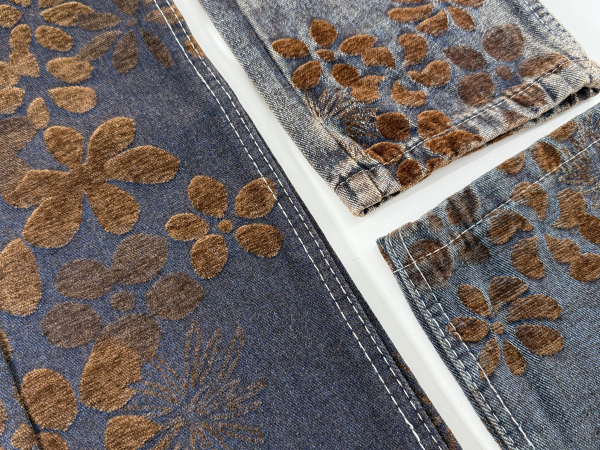
The floral elements repeat consistently, creating rhythm without overwhelming the garment.
Soft Dimensionality
Chenille yarn introduces a raised texture that creates depth through shadow and light interaction.
Balanced Density
The spacing allows the fabric to breathe visually.
This prevents the pattern from becoming visually exhausting when applied to larger garments.
Material-Led Decoration
The beauty comes from texture rather than color contrast.
This distinction is important because it increases design longevity.
Industry Analysis: The Structural Logic Behind Texture Denim
Why Is “Comfort Texture” Becoming a Major Post-Pandemic Trend?
The pandemic fundamentally changed consumer priorities.
For years, fashion focused heavily on visual impact.
Today, consumers increasingly value:
- Comfort
- Emotional reassurance
- Sensory experience
- Material authenticity
As a result, fabrics are expected to provide more than appearance.
They must also create emotional comfort.
This shift has given rise to what many designers call “Comfort Texture.”
Soft chenille surfaces satisfy this demand perfectly.
Even before touching the garment, consumers visually perceive softness.
The fabric communicates comfort through appearance alone.
This phenomenon is becoming increasingly important in denim development.
Why Does Texture Denim Work Better for Large Surface Designs?
Traditional prints often face scalability problems.
A print that looks attractive on a small sample may become overwhelming when applied across:
- Wide-leg jeans
- Oversized jackets
- Long skirts
- Matching sets
Texture behaves differently.
Because texture interacts with light rather than relying solely on color, it remains visually stable over larger areas.
Chenille jacquard allows large garments to maintain interest without becoming visually chaotic.
This makes texture denim particularly suitable for contemporary oversized fashion.
Why Does Texture Denim Pair Naturally with Oversized Silhouettes?
Oversized garments dominate many current fashion segments.
The challenge is that larger silhouettes require stronger visual structure.
Without sufficient surface interest, oversized garments can appear flat.
Texture solves this problem.
Chenille jacquard creates:
- Surface movement
- Light variation
- Visual depth
- Material richness
These qualities help oversized garments maintain visual energy while preserving a relaxed silhouette.
This is one reason texture denim continues to gain traction among contemporary designers.
Why Is Chenille Denim Ideal for “Simple From Afar, Rich Up Close” Design?
One of the most successful luxury product strategies involves layered discovery.
Consumers enjoy products that reveal more detail over time.
From a distance, Five-Petal Bloom appears relatively clean.
The floral structure does not dominate the silhouette.
However, upon closer inspection, viewers notice:
- Raised chenille texture
- Floral geometry
- Material contrast
- Surface depth
This creates a rewarding visual experience.
The garment feels sophisticated because it avoids instant visual overload.
Why Is Fashion Increasingly Focused on Tactile Design?
For decades, fashion communication relied primarily on visuals.
Today, brands increasingly discuss:
- Touch
- Kết cấu
- Sensory interaction
- Material experience
Digital shopping has contributed significantly to this shift.
Since consumers cannot physically touch products online, designers must create materials that visually communicate texture.
This concept is often referred to as “visual tactility.”
Chenille jacquard denim performs exceptionally well in this area because consumers can almost imagine the texture simply by looking at the garment.
Application Analysis: Why Five-Petal Bloom Works Particularly Well in Denim
Ideal Garment Categories
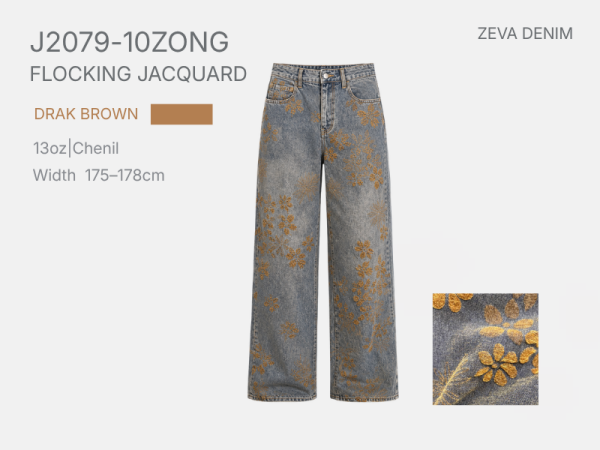
Based on its structure and visual balance, Five-Petal Bloom is especially suitable for:
Women’s Denim
- Wide-leg jeans
- Barrel-leg jeans
- Denim skirts
- Cropped jackets
- Coordinated denim sets
Men’s Denim
- Oversized jackets
- Workwear-inspired overshirts
- Relaxed-fit trousers
- Contemporary streetwear pieces
Gender-Neutral Collections
The balanced floral geometry avoids excessive femininity.
As a result, it adapts well to modern unisex styling.
Which Fashion Trends Does It Match?
Five-Petal Bloom aligns strongly with several major market directions:
Soft Retro
The floral motif references historical textile traditions while remaining contemporary through texture.
Quiet Decoration
Consumers increasingly prefer subtle detail over loud graphics.
This fabric fits that preference perfectly.
Elevated Casualwear
The texture introduces sophistication without sacrificing wearability.
Nature-Inspired Design
Organic motifs continue to gain importance as consumers seek stronger emotional connections to natural imagery.
What Makes This Floral Texture Different from Traditional Floral Denim?
Most floral denim historically relied on:
- Printing
- Embroidery
- Laser artwork
- Patchwork applications
Five-Petal Bloom achieves decoration through structure.
Structural Difference
The floral motif is woven directly into the fabric.
Color Difference
Visual interest comes primarily from texture rather than color contrast.
Density Difference
The pattern distribution remains balanced, preventing visual fatigue.
Longevity Difference
Because texture ages more gracefully than prints, the design often remains relevant for multiple seasons.
This makes it especially attractive for brands seeking longer product lifecycles.
Final Thoughts
The growing importance of texture denim reflects a broader transformation in fashion.
Consumers increasingly seek products that offer depth, authenticity, and sensory richness rather than purely visual novelty.
Five-Petal Bloom demonstrates how a familiar floral motif can be reimagined through material innovation. By combining timeless botanical inspiration with chenille jacquard construction, it creates a fabric that feels contemporary, versatile, and commercially relevant.
For brands exploring floral denim beyond conventional printing, textured jacquard approaches offer an opportunity to build products that feel both emotionally familiar and visually fresh.
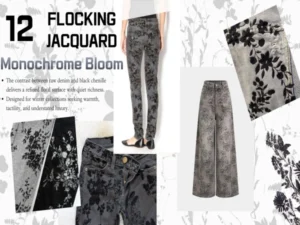
You can explore the product specifications, development details, and garment applications of J2079 Five-Petal Bloom Chenille Jacquard Denim through the product page and accompanying video presentation below, where the texture, dimensionality, and styling possibilities can be observed in greater detail.
 Vietnamese
  English
  Russian
  Spanish
  Arabic
  French