
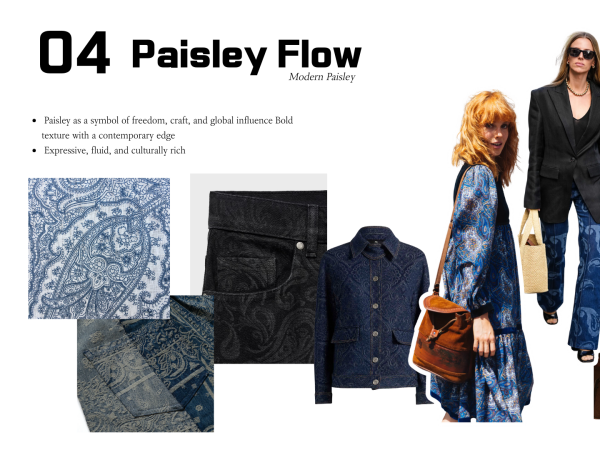
Paisley has long existed at the intersection of craft, culture, and movement. Unlike florals that emphasize softness, paisley carries flow — curved, directional, and expressive. When translated into jacquard denim, this motif behaves differently from both traditional prints and geometric textures. It does not sit on the surface; it becomes part of the fabric’s architecture.
J1051 introduces a paisley flow jacquard denim direction defined by fluid movement and layered tonal contrast. The pattern does not rely on bold outlines. Instead, it emerges gradually through woven structure and becomes more visible through washing and wear. This makes paisley jacquard particularly relevant today, as denim design shifts toward fabrics that evolve over time rather than remain static.
This article explores three key dimensions:
• Decoding paisley as a structural jacquard element
• Process adaptability and washing behavior of paisley flow jacquard denim
• Industry positioning and garment application of this design direction
PART 1
Decoding Paisley Flow in Jacquard Denim
Why Paisley Is Worth Revisiting
Paisley is one of the few textile motifs that communicates motion. Its curved teardrop shapes create directional flow across fabric. In denim, this movement contrasts with the rigid twill base, producing a layered visual dynamic.
This contrast is precisely why paisley is returning. Modern denim increasingly values surfaces that feel expressive but not chaotic. Paisley offers fluidity without randomness. When woven into jacquard, the motif gains structure while preserving movement.
Unlike printed paisley, jacquard paisley evolves with washing. Indigo fading highlights different parts of the curve, creating depth. This gives the fabric a sense of progression rather than static decoration.
Historical Origin and Cultural Context
Paisley originated from Persian boteh motifs, symbolizing life, growth, and continuity. The pattern later spread to India, where it became widely used in Kashmir shawls. During the 18th and 19th centuries, the design entered Europe through trade routes. The Scottish town of Paisley became known for mass-producing the motif, giving it its modern name.
The design reached a cultural peak in the 1960s and 1970s, associated with counterculture, freedom, and artistic expression. It appeared frequently in textiles, scarves, and later fashion garments.
In denim, paisley appeared mostly as prints during vintage-inspired periods. However, printed paisley often lacked durability and depth. The modern reinterpretation through jacquard changes this. Instead of surface decoration, paisley becomes woven structure. This transforms the motif from nostalgic to contemporary.
Cultural Meaning — Freedom and Craft
Paisley has long symbolized individuality and artistic expression. Unlike symmetrical florals, paisley feels spontaneous. Its asymmetry conveys motion and freedom.
When translated into denim, this meaning shifts slightly. The rugged nature of denim grounds the pattern. The result is expressive but wearable. It retains cultural richness while becoming more practical.
This balance aligns with current denim trends emphasizing craft authenticity. Consumers increasingly value fabrics that appear artisanal rather than digitally perfect. Paisley jacquard supports this perception.
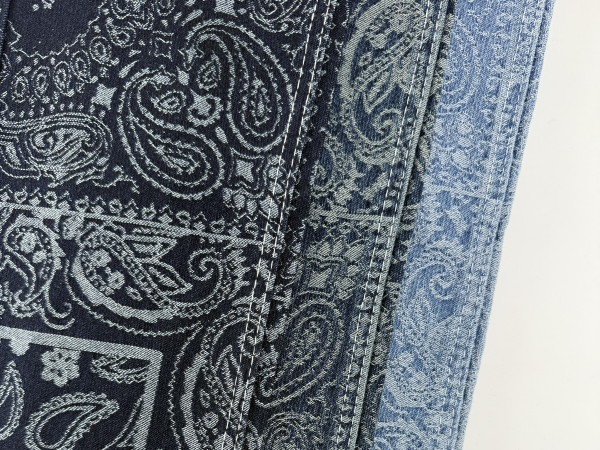
Visual Characteristics
Paisley jacquard in denim is defined by directional flow. The pattern moves across the fabric rather than repeating in rigid blocks. This creates a continuous surface.
Key visual features include:
• curved paisley silhouettes
• tonal layered contrast
• medium to high pattern density
• directional surface flow
• soft transitions rather than sharp outlines
These features allow the fabric to appear dynamic without overwhelming the garment.
Why Paisley Works Particularly Well in Jacquard Denim
Paisley shapes contain internal variation. Some areas are dense, others open. When woven into jacquard, these variations respond differently to washing. Indigo fades more in raised areas, creating natural shading.
This behavior enhances the pattern over time. Instead of losing clarity, the paisley becomes more dimensional. This makes jacquard paisley especially suited to denim finishing processes.
PART 2
Process Adaptability — Washing and Dry Process Behavior
How Jacquard Structure Influences Wash Contrast
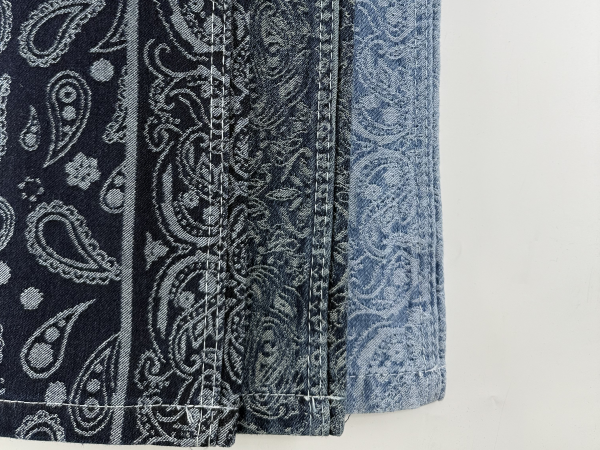
In paisley jacquard, different weave densities exist within one motif. Dense areas hold more indigo, while open structures fade faster. During washing, this produces natural contrast.
This contrast is not uniform. It follows the flow of the pattern, reinforcing directional movement. As a result, paisley becomes more visible after washing.
Compared with flat prints, jacquard paisley gains depth through abrasion. This is a key advantage in denim development.
Performance in Dry Process
Dry processes such as hand sanding, brushing, and PP spray behave differently on paisley jacquard. Raised areas receive more abrasion, highlighting curved outlines. Recessed areas remain darker.
This creates organic contrast rather than artificial highlights. The pattern appears integrated into the fabric rather than applied afterward.
Laser processes can also be used selectively. Because paisley already contains curvature, laser highlighting can follow the motif. This enhances structure without adding new shapes.
Stability After Multiple Washes
Paisley jacquard remains relatively stable across repeated washes. Because the pattern is woven, it does not peel or distort easily. Instead, tonal differences gradually soften.
This progressive fading often improves visual depth. The pattern becomes more integrated with the denim base. For long-wear garments, this is beneficial.
However, excessive bleaching may reduce tonal layering. Balanced washing maintains structure.
Enhancing Paisley Through Washing
Moderate enzyme wash is effective for revealing texture. Stone wash adds depth but should be controlled to avoid flattening details. Rinse wash maintains a clean aesthetic for premium applications.
Combining light PP with enzyme wash can highlight directional flow. This method preserves structure while increasing contrast.
The goal is to emphasize curvature rather than create random fading.
Common Failures and Solutions
One common issue is over-washing. Excessive abrasion can reduce tonal variation. This makes paisley appear flat. Controlled washing solves this.
Another issue is heavy PP spray across the entire garment. This overrides pattern direction. Selective PP following the motif is recommended.
Laser applied without pattern alignment may create visual conflict. Using directional laser improves consistency.
Understanding these interactions ensures stable production.
PART 3
Industry Application of Paisley Jacquard Denim
Garment Applications
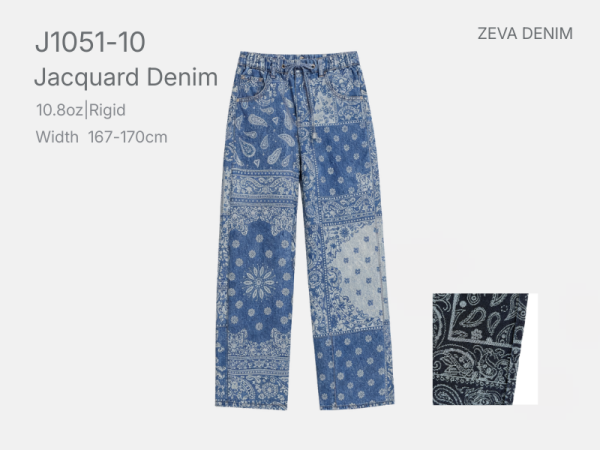
Paisley jacquard performs best when fabric flow remains uninterrupted. Large panels allow the pattern to move naturally.
Recommended applications include:
wide-leg jeans
straight-leg denim
denim jackets
overshirts
relaxed trousers
These silhouettes allow directional movement to remain visible.
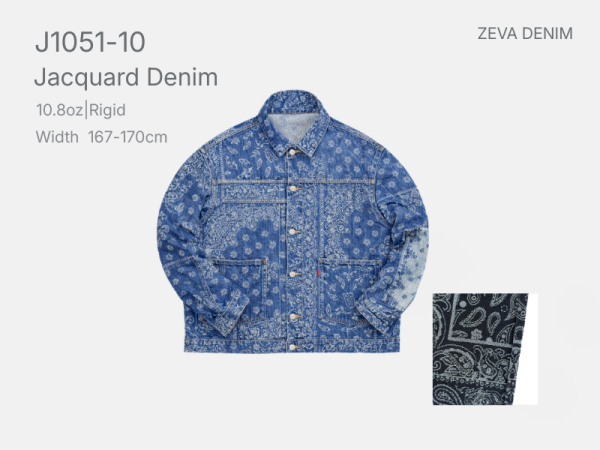
Highly segmented garments break the flow. Tight fits may distort curvature. Relaxed shapes are more suitable.
Trend Alignment
Paisley jacquard aligns with several current directions:
retro revival denim
craft-inspired fashion
expressive womenswear
modern bohemian denim
premium casual collections
These trends emphasize individuality and texture. Paisley supports this through fluid movement.
What Makes Paisley Different in Denim
Structure
curved woven pattern creates motion
Цвет
tonal fading enhances depth
Density
continuous pattern improves surface richness
These factors distinguish paisley jacquard from geometric or floral denim.
PART 4
Closing
As denim evolves, expressive textures are gaining importance. Instead of relying only on heavy washing, fabrics increasingly carry visual identity. Paisley jacquard represents this shift.
It combines cultural heritage with modern textile structure. The pattern evolves through washing, gains depth through wear, and remains stable in production. This makes it both visually distinctive and technically practical.
J1051 illustrates this direction through fluid paisley movement woven directly into denim. The result is expressive, layered, and adaptable across garment categories.
For designers exploring structured jacquard denim, paisley offers a balance between heritage and modernity. It provides movement without losing clarity, and texture without excessive decoration.
This makes paisley jacquard denim a relevant option for collections seeking craft-driven differentiation.
 Russian
  English
  Spanish
  Arabic
  French
  Vietnamese