
As denim product development becomes increasingly competitive, differentiation is gradually moving away from washing alone and toward fabric structure itself. Among various specialty denim categories, chenille denim has emerged as one of the fastest-growing segments because it combines texture, visual depth, and emotional storytelling in a way that printing and traditional jacquard often cannot.
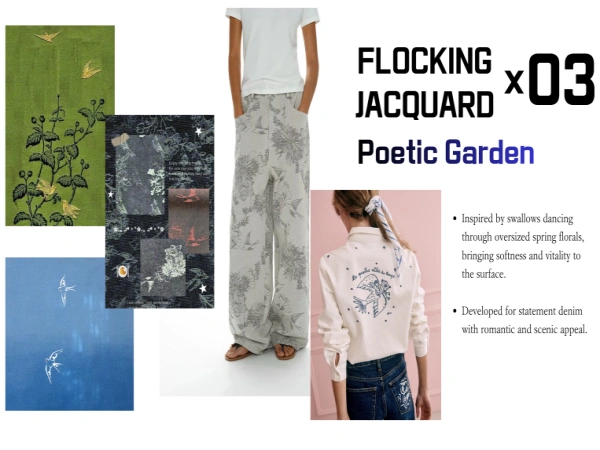
This article explores Poetic Garden, a chenille denim inspired by swallows dancing through oversized spring florals, and uses it as a starting point to analyze broader industry trends. Specifically, we will examine:
- Why botanical and swallow motifs continue to return to fashion cycles
- How modern chenille denim differs from traditional floral denim
- Chenille denim vs jacquard, flocking, velvet, brushed, and printed denim
- Why texture-driven denim is gaining momentum globally
- Where this type of fabric fits in modern denim collections and garment applications
- What commercial opportunities buyers should understand when evaluating texture-based denim
The goal is not simply to understand a pattern, but to understand why certain fabric categories are becoming increasingly relevant in the future denim market.
PART 1
Decoding Botanical and Swallow Motifs in Chenille Denim
Why This Design Is Worth Attention — When Texture Begins to Replace Graphics
Floral motifs have always occupied a unique position in fashion.
Unlike geometric patterns or abstract graphics, flowers are universally understood. They communicate beauty, nature, and emotion without requiring explanation.
Yet floral designs have historically struggled in denim.
The reason is simple.
Denim naturally fades, washes down, and develops irregularity over time. Many floral treatments—especially prints—depend on visual precision. As the garment evolves, the design often loses clarity.
This is where Poetic Garden becomes interesting.
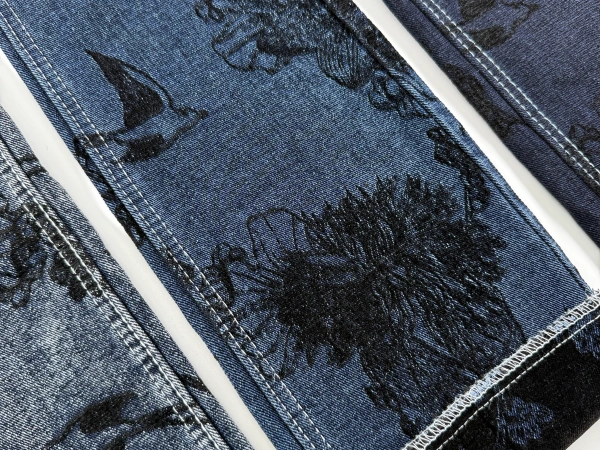
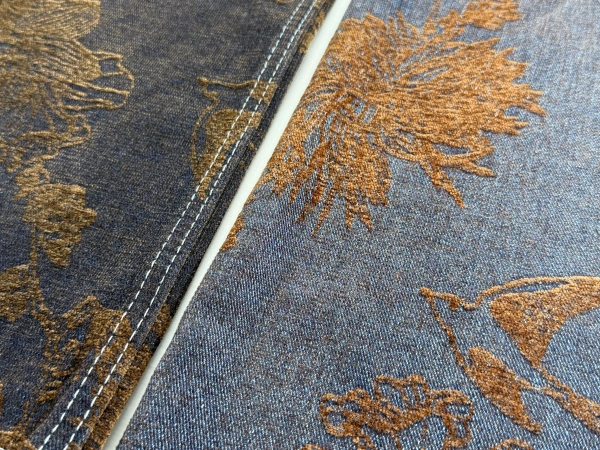
Instead of treating flowers as decoration applied onto denim, the design integrates oversized florals and swallow motifs into a chenille structure that becomes part of the fabric itself.
The result is fundamentally different.
The pattern is not simply seen.
It is experienced through:
- texture
- movement
- light reflection
- garment washing
This shift reflects a larger industry movement.
Consumers are becoming increasingly saturated with graphics and logos. Texture is becoming a more valuable form of differentiation because it offers something digital images cannot fully reproduce.
In many ways, Poetic Garden is less about floral imagery and more about how texture can create atmosphere.
From Botanical Heritage to Modern Fashion Cycles
Botanical imagery has appeared repeatedly throughout global fashion history.
Several major periods stand out.
European Romanticism (18th–19th Century)
Flowers symbolized emotion, nature, and artistic freedom.
Textiles frequently featured floral illustrations intended to evoke beauty and sentimentality.
Arts and Crafts Movement (Late 19th Century)
Designers reacted against industrialization by returning to nature-inspired motifs.
Botanical forms became central to textiles, wallpaper, furniture, and decorative arts.
Cottagecore and Romantic Revival (2020–Present)
Following years dominated by minimalism and streetwear, oversized florals returned to fashion.
Consumers increasingly sought softer and more emotionally engaging visual environments.
This latest revival differs from earlier periods.
Traditional floral textiles focused on decoration.
Modern floral textiles focus on atmosphere.
The objective is no longer to display flowers.
The objective is to create a feeling.
The Symbolism of Swallows — Why They Continue to Appear in Design
The swallow is one of the most recognizable symbolic birds across multiple cultures.
In Europe, swallows traditionally represented:
- spring arrival
- hope
- safe return home
- renewal
In East Asia, they often symbolized:
- prosperity
- family harmony
- happiness
- good fortune
Historically, swallows appeared frequently in:
- embroidery
- porcelain decoration
- architecture
- traditional painting
What makes the swallow particularly effective in textile design is movement.
Flowers create stillness.
Birds create motion.
Together they transform a surface pattern into a narrative scene.
This combination gives Poetic Garden a visual dynamic that many floral designs lack.
Why Modern Botanical Chenille Feels Different
Traditional floral fabrics typically rely on illustration.
Their success depends on recognition.
Modern chenille fabrics operate differently.
Their success depends on experience.
Instead of asking:
“What is this pattern?”
Consumers increasingly ask:
“What does this fabric feel like?”
Chenille supports this shift because it introduces a second sensory dimension.
The raised yarn structure creates:
- depth
- softness
- changing texture under light
- stronger tactile engagement
The fabric therefore communicates through both vision and touch.
This dual experience is one reason chenille categories have become increasingly attractive since approximately 2022–2023.
Visual Characteristics — Softness, Movement, and Dimensional Depth
Several visual elements define Poetic Garden.
Oversized Floral Scale
Rather than dense floral repetition, large motifs dominate the surface.
Benefits include:
- stronger visual identity
- improved readability from distance
- better compatibility with oversized garments
The design feels modern because it allows space between motifs rather than filling every area.
Swallow-Driven Rhythm
The swallow elements introduce movement across the surface.
This creates:
- directional flow
- visual continuity
- natural rhythm
Without the birds, the design would appear static.
With them, the surface feels alive.
Chenille Texture
The most important characteristic is arguably texture itself.
Chenille yarn creates:
- raised dimensional effects
- soft handfeel
- velvet-like visual richness
- enhanced depth perception
The pattern therefore remains interesting even when color contrast is relatively subtle.
Why This Type of Pattern Works Naturally with Denim
Denim is not a static fabric.
It changes.
It fades.
It develops character through washing and wear.
Many decorative treatments struggle under these conditions.
Chenille structures often benefit from them.
Because texture exists independently of color:
- fading increases dimensional contrast
- washing enhances surface variation
- chenille remains visible over time
Instead of fighting denim’s natural evolution, the design works with it.
This compatibility is one reason texture-driven denim is attracting increasing attention from both designers and buyers.
Closing Insight of Part 1
The value of Poetic Garden is not simply that it contains flowers and birds.
Its value lies in how those elements are translated into fabric structure.
It represents a broader shift occurring throughout fashion:
- from graphics to texture
- from decoration to atmosphere
- from visual novelty to sensory experience
And that shift explains why botanical chenille denim is becoming increasingly relevant in modern denim development.
PART 2
Chenille Denim vs Other Specialty Denims — Why Texture Is Becoming the New Differentiation
Chenille Jacquard Denim vs Traditional Jacquard Denim
Although both categories use jacquard weaving principles, their market roles are becoming increasingly different.
Traditional jacquard primarily creates visual differentiation through weave structure.
Chenille jacquard creates differentiation through both structure and texture.
Traditional jacquard offers:
- sharper motif definition
- cleaner appearance
- stronger graphic clarity
Chenille jacquard offers:
- tactile depth
- softer handfeel
- greater dimensionality
The difference can be summarized simply:
Traditional jacquard is designed to be seen.
Chenille jacquard is designed to be seen and felt.
As consumers place more value on sensory experiences, chenille has gained momentum across fashion denim categories.
Flocking Denim vs Velvet Denim — Which Works Better for Denim?
Flocking and velvet both create soft surfaces, but their construction methods differ significantly.
Flocking applies fibers onto the surface using adhesives.
Velvet creates pile through specialized weaving structures.
Both can produce luxurious appearances.
However, denim presents unique requirements.
Denim products typically undergo:
- garment washing
- abrasion
- repeated wear
Under these conditions:
Flocking may wear unevenly.
Velvet may feel disconnected from traditional denim aesthetics.
Chenille often occupies a more balanced position.
It introduces softness while maintaining the structural identity of denim.
This is one reason many modern fashion brands are increasingly choosing chenille over flocking or velvet for denim collections.
Chenille Denim vs Brushed Denim
These two categories are often confused because both create soft surfaces.
The key difference lies in how softness is achieved.
Brushed denim creates texture through finishing.
Chenille denim creates texture through yarn construction.
Brushed effects gradually reduce through wear.
Chenille remains part of the fabric structure.
As a result:
Brushed denim provides temporary softness.
Chenille provides structural texture.
For buyers seeking long-term visual consistency, chenille generally offers greater stability.
Why Chenille Denim Often Ages Better Than Printed Denim
Printed denim relies heavily on graphics.
Its visual value is tied to color contrast and image clarity.
Over time:
- washing softens graphics
- abrasion reduces sharpness
- repeated wear diminishes detail
Chenille behaves differently.
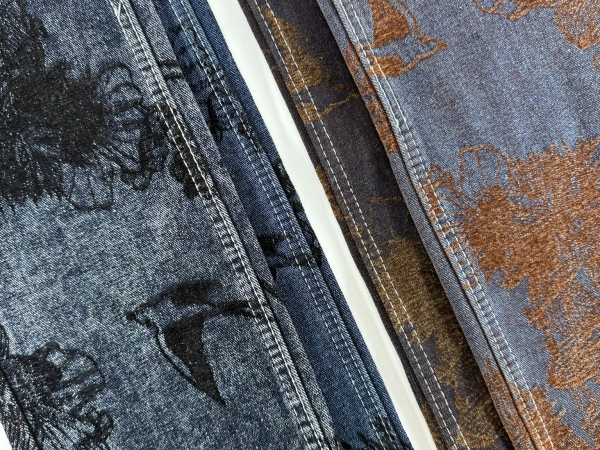
Even when colors fade, texture remains.
In many cases, fading actually enhances the visual complexity of the surface.
This creates a longer product lifecycle.
Consumers often become tired of graphics.
Texture tends to remain interesting for longer periods.
Texture Denim vs Printed Denim — Which Has Greater Growth Potential?
One of the most important developments in denim today is the shift toward texture-based differentiation.
Several factors support this trend.
First, digital commerce has increased visual competition.
Thousands of products now compete on screens.
Texture offers a form of differentiation that extends beyond graphics.
Second, consumers increasingly associate texture with quality.
Texture communicates value more naturally than prints.
Third, sustainability pressures encourage fabrics that require fewer additional decorative processes.
Texture can create interest without relying on extra printing or embellishment.
For these reasons, texture-driven denim categories—including chenille—are expected to outperform many purely printed categories over the next several years.
PART 3
This Design Element in Practice — Poetic Garden Chenille Denim in Modern Collections
Where This Fabric Works Best
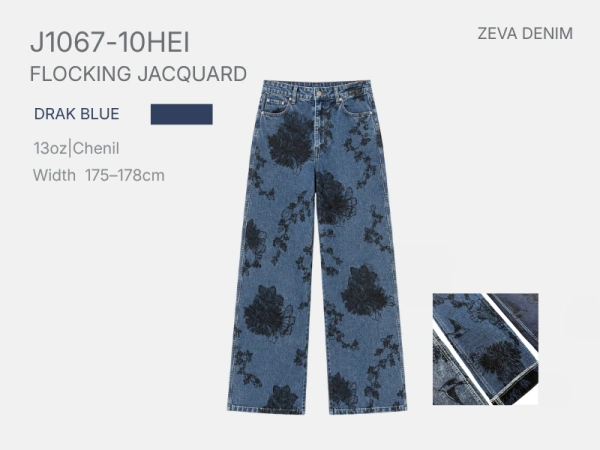
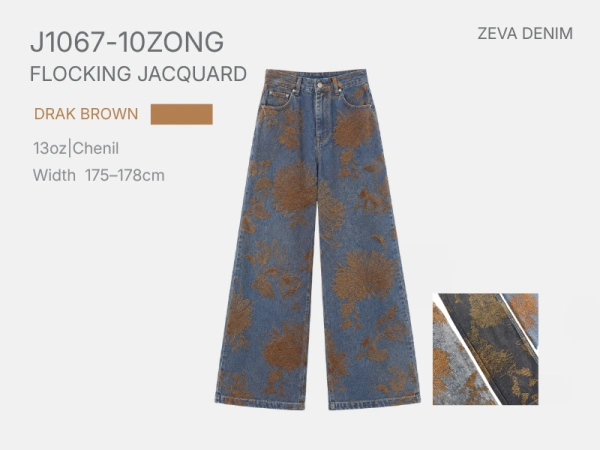
Because Poetic Garden is a non-stretch chenille denim with oversized motifs, silhouette selection becomes particularly important.
The fabric performs best when garment panels remain relatively uninterrupted.
Recommended applications include:
Women’s wear:
- wide-leg jeans
- straight-leg jeans
- A-line skirts
- denim dresses
- cropped jackets
- overshirts
Girlswear:
- denim skirts
- matching sets
- lightweight outerwear
The romantic botanical theme naturally aligns with younger and fashion-oriented demographics.
Less suitable applications include:
- skinny fits
- heavily segmented garments
- highly technical constructions
These applications interrupt pattern continuity and reduce visual impact.
Trend Alignment — Where This Design Fits Today
Poetic Garden aligns with several active fashion directions.
Modern Romantic
The floral and swallow motifs create emotional softness without excessive decoration.
Soft Retro
The design references historical botanical themes while using contemporary scale and texture.
Nature-Inspired Fashion
Since 2022, nature-based storytelling has become increasingly important across fashion categories.
Quiet Statement
Rather than relying on aggressive graphics, the fabric creates impact through detail and texture.
This makes it suitable for consumers seeking individuality without excessive visual noise.
What Makes This Design Different on Denim
Three factors distinguish Poetic Garden from conventional floral denim.
Structure
The pattern is woven into the fabric.
Not printed.
Not embroidered.
This improves durability and washing performance.
Color Behavior
Chenille texture remains visible even when colors soften.
The fabric therefore retains interest throughout its lifecycle.
Density
Oversized motifs create breathing room across the surface.
The design feels refined rather than crowded.
This improves wearability and styling flexibility.
Closing Insight of Part 3
Poetic Garden succeeds because it balances three increasingly important qualities:
- emotional storytelling
- tactile experience
- commercial practicality
It is not simply a floral denim.
It is a texture-driven interpretation of botanical design.
And that distinction is becoming increasingly valuable in contemporary denim collections.
PART 4
Closing Insight — When Texture Begins to Outperform Graphics
As denim continues evolving, more value is moving upstream into the fabric itself.
Instead of relying entirely on washing, printing, or embellishment, differentiation is increasingly being built directly into the material.
Chenille denim reflects this transition.
Its appeal comes from texture, depth, and sensory engagement rather than graphic intensity.
Poetic Garden demonstrates how botanical storytelling can evolve beyond traditional floral prints.
By combining oversized spring florals, symbolic swallows, and chenille texture, it creates a fabric that remains relevant across multiple washes, seasons, and product categories.
For buyers and designers, the implication is increasingly clear:
The future of specialty denim may not belong to the loudest graphic.
It may belong to fabrics that continue revealing new details through touch, movement, washing, and wear.
One example of this approach can be seen in a development like J1067 Poetic Garden, where texture, motion, and botanical imagery are integrated directly into the fabric structure.
 Russian
  English
  Spanish
  Arabic
  French
  Vietnamese