
PART 1
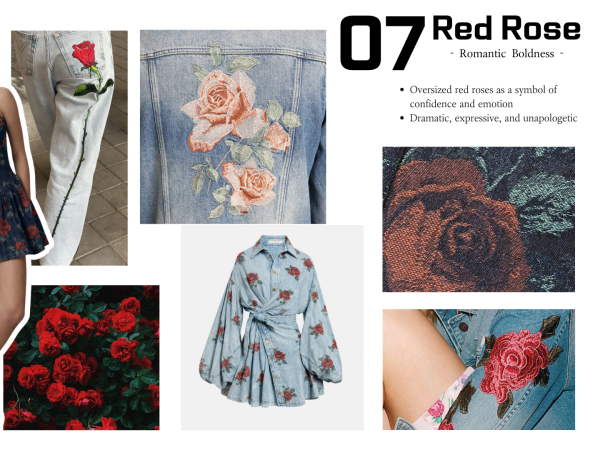
Decoding Oversized Rose Patterns in Jacquard Denim
Romantic Boldness as a Structural Design Language
Why This Design Is Worth Attention — When Romance Becomes Bold
Floral motifs in denim are not new. Red Rose Jacquard Denim
But oversized red roses behave differently.
Traditional floral denim often communicates softness, delicacy, or femininity.
This design does not.
Instead of small scattered flowers, the pattern uses oversized red roses — bold, expressive, and emotionally direct. The result is not decorative, but declarative.
This changes the role of florals in denim:
- Not subtle background decoration
· Not seasonal feminine detail
· But a central visual identity
In modern denim collections — where differentiation is increasingly pushed into the fabric itself — this shift matters. Because the pattern is no longer supporting the garment. It becomes the garment’s personality.
This is why oversized rose jacquard is gaining attention again:
it transforms a familiar motif into a structural statement.
The Origin of Rose Symbolism — From Romance to Power
Roses have long carried strong cultural meaning across regions.
In European fashion history, roses symbolized romance and femininity.
In Latin American aesthetics, roses often represented passion and emotional intensity.
In East Asian reinterpretations, roses became decorative but controlled, used more subtly.
What is different today is not the symbol — but the scale and execution.
Historically:
· Small repeated florals
· Decorative placement
· Supporting visual element
Modern reinterpretation:
· Oversized scale
· Reduced repetition
· Fabric-dominant presence
This transforms the rose from ornament into structure.
Instead of reading as “floral decoration”, it reads as “patterned surface”.
That difference is critical in denim, where large-scale surfaces define product perception more than small details.
From Soft Romance to Expressive Confidence
Another important shift is emotional tone.
Traditional floral denim communicates softness.
Oversized rose jacquard communicates confidence.
This is created through three design decisions:
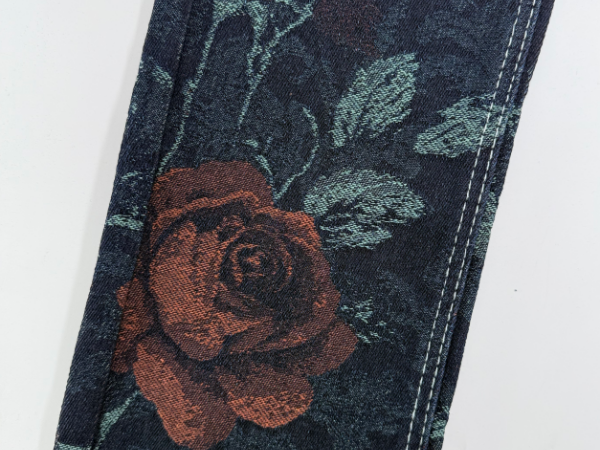
Scale
· Large roses instead of scattered florals
· Pattern becomes dominant rather than supportive
Color behavior
· Deep red tones against denim base
· High emotional contrast but controlled structurally
Spacing
· Intentional breathing space between motifs
· Avoids visual overcrowding
Together, these elements create a different aesthetic:
Romantic — but bold
Decorative — but controlled
Expressive — but wearable
This balance is what makes this design commercially relevant.
Visual Characteristics — Dramatic but Structured
Oversized rose jacquard works through controlled drama rather than complexity.
Key visual traits:
Pattern scale
· Large motif size
· Clear recognition from distance
· Reduced visual noise
Surface rhythm
· Balanced spacing
· Non-overcrowded layout
· Structured repeat system
Color interaction
· Red motif against indigo / dark base
· Contrast without excessive brightness
· Depth revealed after washing
Texture behavior
· Jacquard structure adds dimension
· Pattern visible even after color fade
· Fabric-level differentiation instead of surface decoration
This makes the design suitable for denim, where washing changes the surface over time.
Unlike printed florals, which often lose clarity after washing, jacquard roses remain visible because the pattern is built into the weave.
Cultural Meaning — Emotional Expression in Modern Denim
Modern denim is moving away from neutral basics toward emotional storytelling.
But the storytelling is no longer loud graphics or logos.
It is embedded into materials.
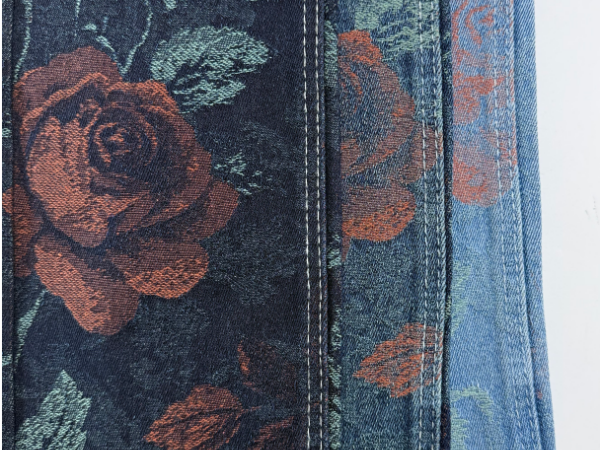
Oversized rose jacquard fits this shift.
It communicates:
- Confidence
· Bold femininity
· Emotional expression
· Romantic but modern identity
This aligns particularly well with current womenswear denim direction, where fabric plays a stronger role in defining the garment.
Instead of relying on:
heavy washing
patchwork
prints
The fabric itself already provides character.
Why Roses Work Naturally with Denim
Not every motif translates well into denim.
Denim fades.
Denim distorts slightly.
Denim evolves with washing.
Patterns that rely on precision often break under these conditions.
Oversized rose jacquard behaves differently.
Because:
· Organic shape tolerates fading
· Large scale survives distortion
· Structural weave maintains visibility
After washing:
· Indigo fades
· Red softens
· Texture becomes more pronounced
The pattern becomes more integrated — not weaker.
This is a key advantage over printed floral denim.
A Practical Advantage: Statement Without Over-Design
One overlooked benefit of oversized rose jacquard is that it reduces the need for additional design elements.
Because the fabric already carries strong identity:
Less need for:
· heavy washing
· embroidery
· patchwork
· printing
This simplifies development while maintaining differentiation.
For designers and buyers, this creates:
- Faster sampling
· Lower development risk
· Cleaner product design
· Stronger fabric-driven identity
Closing Insight of Part 1
Oversized rose jacquard is not simply a floral pattern.
It is a shift in how emotional expression is built into denim.
It transforms:
romance → confidence
decoration → structure
detail → surface identity
This is why this type of design is becoming relevant again.
Not because florals returned —
but because florals evolved into fabric language.
PART 2
Jacquard Denim Industry Analysis
MOQ & Order Structure Behind Jacquard Denim Growth
Why Jacquard Denim MOQ Is Usually Lower Than Basic Denim
One of the most misunderstood aspects of jacquard denim is MOQ.
Many buyers assume jacquard requires higher MOQ because it is more complex.
In reality, the opposite is often true.
Jacquard denim frequently runs with lower MOQ than basic denim.
This is not accidental — it reflects how jacquard is used in the market.
Basic denim is typically designed for:
· Core programs
· Long-running styles
· Repeat bulk production
· Stable color continuity
Because of this, mills prefer large MOQ to maintain efficiency.
Jacquard denim behaves differently.
It is usually developed for:
· Capsule collections
· Fashion drops
· Seasonal programs
· Differentiation SKUs
These programs naturally require smaller quantities per style.
Instead of:
1 style × 20,000 meters
The order structure becomes:
5 styles × 3,000 meters
Total volume may be similar — but MOQ per style is lower.
This is why jacquard denim often supports smaller MOQ:
not because production is easier,
but because the order logic is different.
The Feasibility of Small-Batch Jacquard Orders
Small-batch jacquard orders are not only possible — they are becoming standard.
This shift is driven by three industry changes.
First, SKU fragmentation
Collections now contain more fabric variations, each in smaller volume.
Jacquard fits this model because each pattern already creates differentiation.
Second, faster development cycles
Brands test more styles before committing to large orders.
Jacquard allows quick visual differentiation without heavy washing development.
Third, risk control
Buyers prefer testing market response before scaling.
Jacquard fabrics naturally work as testable SKUs.
Typical small-batch jacquard order scenarios:
- Capsule collection launch
· Seasonal womenswear drops
· E-commerce exclusive styles
· Limited retail programs
· Market testing before bulk order
These scenarios do not require large MOQ.
Instead, flexibility becomes more valuable than scale.
Is Jacquard Denim Better for Development Styles or Bulk Programs?
Traditionally, jacquard denim was considered a development fabric — not a volume fabric.
That perception is changing.
Today, jacquard plays two roles simultaneously.
Role 1 — Development styles
Used for:
· Collection highlights
· Visual differentiation
· Trend testing
· New silhouette launches
These orders are usually small.
Role 2 — Structured volume styles
Some jacquards evolve into repeatable programs.
This happens when:
· Pattern is wearable
· Washing is stable
· Cost remains controlled
· Market acceptance is strong
When this occurs, jacquard transitions from:
fashion item → core program
This is increasingly common in:
- Women’s denim
· Fashion basics
· Statement casualwear
· Seasonal carry-over styles
So jacquard is no longer limited to development.
It can become volume — but only after market validation.
How Combining Orders Helps Reduce Jacquard MOQ Risk
Another key advantage of jacquard denim is that MOQ risk can be shared.
This happens through combined order models.
Example:
Buyer A — 1,500 meters
Buyer B — 1,200 meters
Buyer C — 1,300 meters
Combined → production MOQ achieved
Because jacquard patterns are not always market-exclusive,
multiple buyers can share the same base fabric.
This reduces risk for:
- Small brands
· Wholesalers
· New collections
· Market testing programs
This is different from exclusive designs, which require full MOQ commitment.
Shared jacquard programs allow:
· Lower entry barrier
· Faster decision-making
· Reduced inventory risk
This is one reason jacquard is growing in wholesale markets.
Jacquard Denim Order Structure in Wholesale Markets
Wholesale markets show a very specific pattern.
Basic denim orders:
· Fewer styles
· Larger volume per style
· Slower change cycle
Jacquard denim orders:
· More styles
· Smaller volume per style
· Faster rotation
Typical wholesale structure:
Basic denim
3 styles × 10,000 meters
Jacquard denim
10 styles × 2,000 meters
Total volume similar — but strategy different.
Jacquard helps wholesalers:
- Expand SKU range
· Test new designs
· Reduce risk per style
· Improve visual differentiation
This is particularly important in markets where:
- Competition is high
· Product lifecycle is short
· Buyers want variety
· Inventory risk must be controlled
Small Orders vs Large Orders — Where Jacquard Fits
Jacquard denim rarely replaces bulk basics.
Instead, it complements them.
A balanced order structure often looks like:
70% basic denim
30% jacquard / structured fabrics
Basics provide:
· Stability
· volume
· price competitiveness
Jacquard provides:
· differentiation
· freshness
· visual identity
This hybrid structure is becoming common in:
- Latin America wholesale
· Middle East distributors
· E-commerce brands
· Women’s fashion collections
Why Buyers Are Increasing Jacquard Percentage
The proportion of jacquard in collections is slowly increasing.
Not because it is cheaper.
But because it reduces other development costs.
Jacquard can:
- Reduce washing complexity
· Reduce design work
· Reduce sampling rounds
· Reduce SKU duplication
This makes it operationally efficient.
Even with slightly higher fabric cost,
total development cost may decrease.
This is why jacquard share is gradually increasing in modern denim programs.
Closing Insight of Part 2
Jacquard denim is not defined by high MOQ.
It is defined by flexible order logic.
It supports:
· small batch testing
· shared production
· multi-SKU strategy
· hybrid order structure
This flexibility is one of the main reasons jacquard denim is expanding.
Not as a replacement for basics —
but as a complementary strategy for differentiation.
PART 3
This Design Element in Practice: Red Rose Jacquard in Denim
Where Oversized Rose Jacquard Actually Works — Garment Application Logic
Oversized rose jacquard behaves differently from small floral patterns.
Because the motif scale is large, garment construction becomes critical.
If the fabric is heavily segmented, the pattern breaks.
If the silhouette is too tight, the roses distort.
If the washing is too aggressive, the emotional tone disappears.
This means the success of this fabric depends heavily on product application.
The most suitable garment categories share one common feature:
they allow the fabric surface to remain visually continuous.
High compatibility applications:
Bottoms
· Wide-leg jeans
· Straight-leg jeans
· relaxed fit denim
· A-line denim trousers
These silhouettes provide large panels, allowing the rose motif to remain readable.
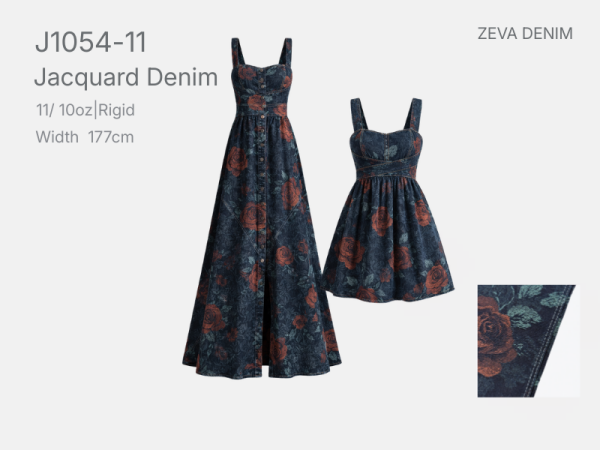
Skirts & dresses
· Midi skirts
· A-line skirts
· denim dresses
· structured skirt silhouettes
Movement enhances the pattern, rather than distorting it.
Jackets & overshirts
· boxy jackets
· cropped denim jackets
· overshirts
· lightweight outerwear
Flat surfaces preserve motif clarity.
Less suitable applications:
Slim-fit jeans
· pattern distortion
· loss of visual balance
Heavy panel construction
· motif fragmentation
· visual inconsistency
Over-designed garments
· embroidery + jacquard conflict
· excessive washing overrides pattern
The key takeaway:
this fabric works best when the garment lets the pattern lead.
Womenswear vs Girlswear — Where This Pattern Performs Strongest
Oversized rose jacquard naturally aligns with womenswear.
The emotional tone — bold romance — matches fashion-oriented silhouettes.
Large-scale florals also feel more intentional in women’s collections.
Typical womenswear applications:
Statement jeans
Fashion skirts
Denim dresses
Short jackets
Co-ord sets
However, this pattern also works well in girlswear.
For girlswear, the roses create:
- playful visual identity
· softer emotional tone
· clear differentiation in retail
Compared to small florals, oversized roses appear more modern and less traditional.
This makes them suitable for:
Girls denim skirts
Kids denim jackets
Mini wide-leg pants
Matching sets
This dual applicability increases commercial flexibility.
Trend Alignment — Romantic Boldness Meets Modern Denim Direction
Oversized rose jacquard aligns with multiple trend directions simultaneously.
Modern Romantic
· emotional expression
· bold feminine identity
· statement fabric focus
Retro Revival
· vintage floral inspiration
· updated scale and contrast
· nostalgic but modern
Statement Casual
· fabric-led design
· minimal garment construction
· strong visual identity
Soft Expressive Denim
· less rigid than workwear
· more emotional tone
· fashion-oriented silhouette
This multi-trend compatibility is important.
It means the fabric is not limited to one season or one category.
Instead, it can transition across:
Spring collections
Fall collections
Capsule drops
Fashion programs
What Makes Rose Jacquard Different on Denim
When oversized rose patterns are applied to denim, three differences appear.
Structure — Pattern Built Into Fabric
Unlike prints, jacquard roses are woven into the structure.
This means:
- pattern survives washing
· texture remains visible
· fading enhances depth
The motif evolves with denim rather than disappearing.
Color Behavior — Contrast That Softens Over Time
Red against indigo creates initial impact.
After washing:
- indigo fades
· red softens
· tonal variation increases
This creates a more integrated final garment.
Instead of high-contrast decoration,
the fabric becomes layered and mature.
Density — Bold But Not Overcrowded
Oversized roses are spaced intentionally.
This creates:
- strong visual focus
· breathable surface
· reduced visual fatigue
Compared with dense florals,
this pattern feels more modern and wearable.
A Practical Advantage — Fabric-Led Differentiation
One of the biggest advantages of oversized rose jacquard is that the fabric itself becomes the design.
This reduces dependence on:
- heavy washing
· embroidery
· printing
· patchwork
For buyers, this means:
- faster development
· lower sampling cost
· more stable production
· consistent garment outcome
In modern denim programs,
this type of fabric reduces complexity while maintaining impact.
Closing Insight of Part 3
Oversized rose jacquard is not just a decorative floral.
It functions as a structural design element.
It works best when:
- garment panels remain large
· silhouette supports pattern
· washing remains controlled
When applied correctly, it provides:
strong identity
emotional expression
stable production
flexible application
This balance is what makes this design commercially viable in modern denim collections.
PART 4
Closing Insight — When Emotional Pattern Becomes a Practical Denim Strategy
As denim continues evolving, one subtle shift is becoming increasingly clear:
fabric is no longer just the starting point — it is becoming part of the final design language.
In the past, most denim products relied heavily on washing, distressing, or surface decoration to create differentiation. The base fabric remained neutral, while identity was added later in development. But this model is changing.
Today, buyers are looking for fabrics that already contain character.
Not loud decoration — but built-in differentiation.
Oversized rose jacquard fits precisely into this transition.
It embeds emotional expression directly into the structure.
It creates visual identity without additional processes.
It supports flexible order quantities.
And it reduces development complexity.
This combination makes it particularly relevant for modern denim programs, where speed, differentiation, and risk control must coexist.
A Fabric That Balances Expression and Commercial Practicality
Oversized rose jacquard is visually bold, but operationally practical.
From a design perspective, it offers:
· strong emotional identity
· clear visual differentiation
· fashion-oriented direction
From a production perspective, it provides:
· stable pattern visibility after washing
· reduced reliance on heavy processing
· simplified garment development
From a sourcing perspective, it supports:
· smaller batch testing
· flexible MOQ structure
· multi-SKU assortment building
This balance is what allows expressive fabrics to move from niche to commercially viable.
Where This Type of Fabric Fits in a Modern Collection
In practical product planning, oversized rose jacquard rarely replaces core basics.
Instead, it functions as a differentiation layer.
A typical assortment structure may look like:
Core basics
· solid indigo denim
· rigid twill denim
· stretch basics
Differentiation layer
· jacquard denim
· dobby structures
· textured fabrics
Within this structure, rose jacquard serves as:
statement piece fabric
capsule collection fabric
fashion-forward SKU
visual anchor within range
This positioning allows buyers to introduce variety without increasing risk.
A Subtle but Important Advantage — Longevity Beyond Trend Cycles
Highly decorative fabrics often face one challenge:
they age quickly.
Oversized rose jacquard behaves differently.
Because:
· pattern is structural
· contrast softens after washing
· motif integrates into denim
The fabric evolves over time instead of becoming outdated.
This makes it suitable not only for trend-driven programs,
but also for carry-over seasonal collections.
Final Thought
The return of floral jacquard in denim is not about decoration.
It is about redefining how emotion is embedded into fabric.
Oversized roses transform a familiar motif into a structural surface language — bold, expressive, and commercially flexible.
They allow denim to communicate identity before washing,
and maintain it after production.
In that sense, this type of jacquard is not just visually different.
It represents a shift toward fabric-led product development.
One example of this approach can be seen in a red rose jacquard development like J1054-11, where oversized floral motifs create a confident and expressive surface while remaining structurally integrated into denim.
If exploring how expressive jacquard fabrics can fit into a future collection, it is often useful to evaluate not only visual impact, but also how the fabric behaves across washing, garment construction, and flexible order structures.
 Spanish
  English
  Russian
  Arabic
  French
  Vietnamese