
PART 1
Decoding Check & Bold Stripe Patterns in Jacquard Denim
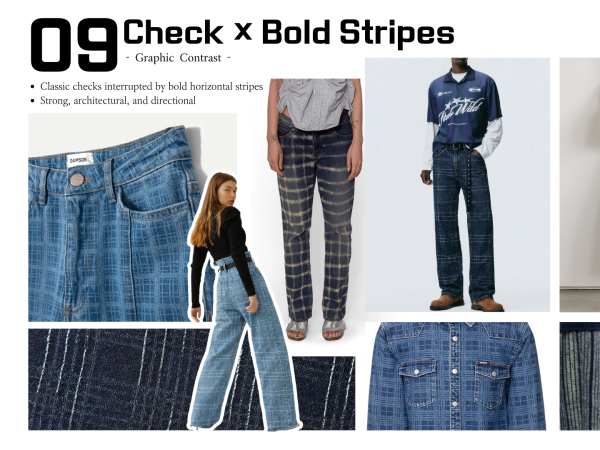
Why This Pattern Is Worth Attention — Contrast as Structure, Not Decoration
At first glance, check and stripe combinations feel familiar.
They are not new.
They are not seasonal.
And they are not inherently “fashion-forward.”
But when translated into jacquard denim, something changes.
The pattern is no longer just visual—it becomes directional.
In traditional fabrics, checks and stripes exist as surface graphics.
They are applied, printed, or dyed.
But in jacquard denim, they are constructed through weave.
That difference shifts their role entirely:
- Checks define the base rhythm
· Stripes interrupt that rhythm
· The fabric becomes a controlled system of tension and release
This is why this design is worth attention.
It is not about combining two classic elements.
It is about restructuring how the surface behaves.
From Classic Pattern to Structural Language: Where This Combination Comes From
Checks and stripes are among the oldest pattern systems in textile history.
Their origins can be traced across multiple regions:
- Checks → European heritage textiles (Scotland, England)
· Stripes → maritime uniforms, workwear, and industrial fabrics
Historically, they served different purposes:
- Checks → balance, symmetry, identity
· Stripes → direction, movement, hierarchy
For a long time, these two systems rarely coexisted in equal importance.
When they did, one usually dominated the other.
But in modern jacquard denim, this relationship is being redefined.
Instead of hierarchy, we now see interruption.
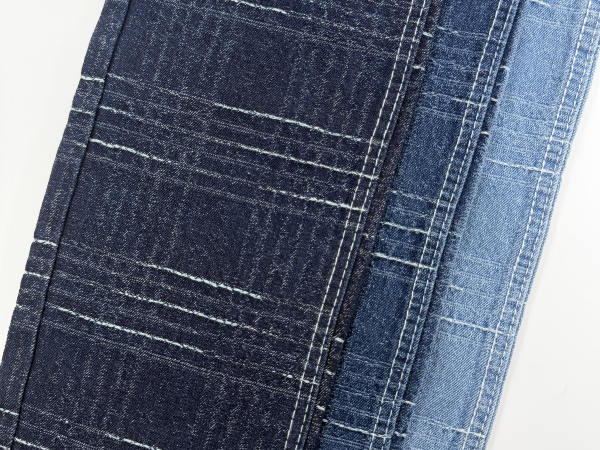
The check grid establishes stability.
The bold horizontal stripe cuts through it—breaking predictability.
This creates a new type of pattern logic:
- Not decorative layering
· But structural contrast
Since around 2022–2024, this type of graphic contrast has started to reappear in fashion collections—not as statement prints, but as fabric-built tension systems.
That shift—from visual composition to structural interaction—is what makes this pattern relevant again.
Cultural Meaning: From Identity Patterns to Neutral Structure
Traditionally, checks carried strong cultural identity.
They were linked to:
- Clan systems (Scottish tartans)
· Regional identity
· Formalwear and uniform systems
Stripes, on the other hand, carried a different meaning:
- Utility (workwear)
· Authority (military / uniforms)
· Directional emphasis
But in modern denim, these meanings are being neutralized.
What remains is not symbolism—but function.
Checks are no longer about identity.
Stripes are no longer about hierarchy.
Instead, both become tools for organizing space.
This reflects a broader shift in fashion:
From meaning-driven design → to structure-driven design
Consumers today are less interested in symbolic storytelling,
and more interested in how a product feels visually balanced and usable.
In this context, check + stripe jacquard becomes:
- Less narrative
· More architectural
· More adaptable across markets
Visual Characteristics: Direction, Interruption, and Scale Conflict
This type of jacquard is defined by three key visual behaviors.
1. Directional Conflict
Checks are inherently static.
They create a grid—stable, predictable.
Stripes introduce direction.
When horizontal stripes cut through a check structure, the result is:
- Visual movement across a stable base
· A controlled disruption of symmetry
This creates tension—not chaos, but controlled imbalance.
2. Scale Contrast
In this design:
- Checks → medium-density, repetitive
· Stripes → bold, spaced, dominant
This difference in scale creates hierarchy without relying on color contrast.
Even in tonal executions, the pattern remains readable.
This is particularly important in denim, where color fades over time.
Structure—not color—carries the design.
3. Architectural Surface
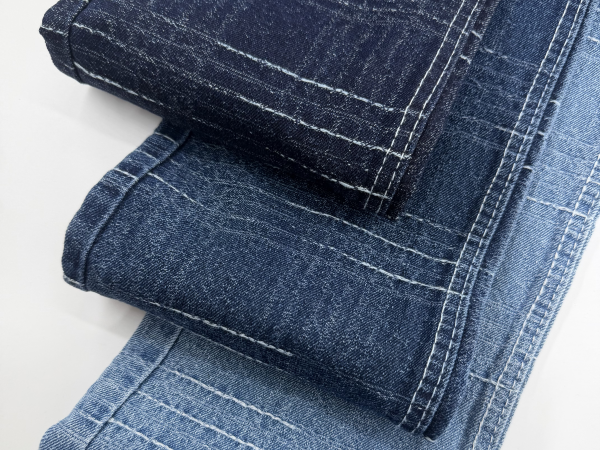
Unlike floral or organic jacquards, this pattern feels constructed.
It behaves more like:
- Architectural grids
· Industrial layouts
· Structured frameworks
This gives the fabric a masculine, directional, and product-oriented feel.
It is less emotional, more controlled.
Why This Pattern Works Naturally with Denim
Not all patterns translate well into denim.
Because denim:
- Fades
· Distorts slightly after washing
· Gains irregularity over time
Patterns that rely on precision often break under these conditions.
Check & stripe jacquard behaves differently.
Because:
- The grid structure absorbs distortion
· The stripe interruption remains readable even after fading
· The pattern does not depend on sharp edges
In fact:
Fading enhances the contrast between elements.
Wear reinforces the directional effect.
Instead of losing clarity, the pattern gains character.
This is why structured patterns like this perform better in denim than many decorative designs.
A Practical Advantage: Built-In Visual Differentiation Without Overdesign
One of the biggest challenges in denim today is balancing:
- Differentiation
· Wearability
· Production stability
This type of jacquard solves part of that problem.
Because:
- It provides visual identity at fabric level
· It reduces reliance on heavy washing
· It avoids over-designed appearance
From a distance:
→ clean, structured, wearable
From up close:
→ detailed, layered, distinctive
This dual readability is increasingly important in modern retail:
- Online → needs instant structure
· Offline → benefits from depth
Closing Insight of Part 1
Check and stripe jacquard is not about mixing two classic patterns.
It is about redefining how contrast works inside a fabric.
Not as decoration.
But as structure.
Its value lies in three things:
- It survives washing
· It maintains readability
· It creates controlled differentiation
And that is exactly why this type of design is becoming relevant again in modern denim development.
PART 2
Jacquard Denim Industry Analysis: Supply Chain Structure & Production Challenges
Jacquard Denim Development Is Shorter — But More Dependent on Early Decisions
One of the most misunderstood aspects of jacquard denim is development time.
Many buyers assume jacquard fabrics require long development cycles because of pattern complexity.
In reality, the opposite is often true — jacquard denim sampling can be faster, but only if decisions are made early.
A typical jacquard denim timeline looks like this:
Design confirmation
→ weave simulation / file preparation (1–2 days)
→ loom setup & sampling (2–3 days)
→ finishing & washing test (1–2 days)
Total: 5–7 days sampling cycle
Compared to:
Basic denim + wash development
→ fabric sampling (3–5 days)
→ multiple wash trials (5–10 days)
→ re-sampling
Total: 10–20 days
The difference is structural.
Jacquard builds pattern directly into fabric.
Basic denim relies on washing to create differentiation.
That means:
Jacquard shifts complexity forward — into weaving
instead of backward — into washing.
For buyers, this has two important implications:
- Faster sampling when pattern is confirmed early
· Slower sampling when design changes frequently
In other words:
Jacquard denim is not slower —
it is less tolerant of late changes.
Why Jacquard Denim Shows Lower Quality Variation — Especially Rigid Jacquard
Another often-overlooked advantage of jacquard denim is production consistency.
Especially in 0% stretch jacquard denim, variation between batches is usually lower than stretch denim.
There are three main reasons.
1. Pattern Comes from Structure, Not Tension
In stretch denim, elastane introduces instability:
- Yarn tension varies
· Recovery varies
· Washing behavior changes
But rigid jacquard denim:
- No elastane distortion
· Stable warp & weft structure
· Repeat pattern remains consistent
This reduces visual variation.
2. Less Dependence on Aggressive Washing
Traditional denim often depends on:
- heavy stone wash
· bleaching
· hand scraping
Each step introduces variation.
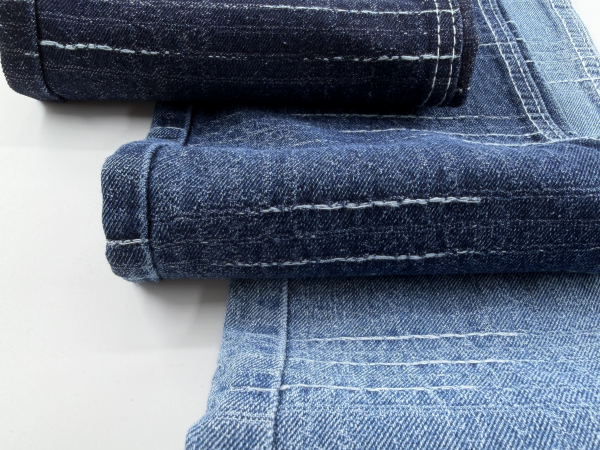
Jacquard denim already contains texture.
Washing becomes refinement, not creation.
This significantly reduces risk.
3. Structural Repeat Controls Fabric Behavior
Jacquard patterns create repeat systems.
These repeats:
- distribute stress evenly
· reduce local distortion
· stabilize fabric surface
This makes jacquard denim more predictable in bulk production.
Especially important for:
- large repeat patterns
· grid-based designs
· check structures like this one
This is why check-based jacquard tends to show very stable results.
Why Jacquard Denim Relies More on Experience-Based Technicians
Unlike basic denim, jacquard denim requires a different type of technical knowledge.
It is not just weaving — it is pattern engineering.
Key decisions include:
- yarn count selection
· density planning
· repeat size control
· float length balancing
· contrast planning
These cannot be solved by formula alone.
They depend heavily on experience.
For example:
If floats are too long
→ fabric snags easily
If floats too short
→ pattern becomes unclear
If density too high
→ pattern compresses
If density too low
→ pattern breaks
These trade-offs must be balanced simultaneously.
This is why jacquard denim production often relies on:
- senior loom technicians
· experienced pattern engineers
· trial-based adjustments
Not just machine settings.
In many mills, jacquard capability is not defined by machines —
but by people.
The Three Most Common Mistakes in Jacquard Denim Production
Even experienced suppliers sometimes make critical errors.
The most common three are:
Mistake 1 — Designing for Swatch, Not Garment
Some jacquard designs look strong in small swatches, but fail in garments.
Problems include:
- pattern too dense
· repeat too small
· no visual breathing space
On finished garments:
→ pattern becomes noisy
→ difficult to read
→ visually heavy
This happens when development ignores garment scale.
Mistake 2 — Over-Emphasizing Contrast
Many suppliers try to increase visibility by increasing contrast.
But in denim:
High contrast + washing
→ pattern breaks
→ edges blur
→ design becomes inconsistent
Better approach:
Use structural contrast, not color contrast.
Mistake 3 — Ignoring Weaving Stability
Some designs prioritize visuals over weaving feasibility.
Examples:
- excessive float length
· unstable repeat structures
· uneven density zones
This leads to:
- weaving difficulty
· higher defect rate
· unstable bulk production
Stable jacquard requires design for production, not just aesthetics.
How to Evaluate Whether a Supplier Has Stable Jacquard Capability
From a buyer perspective, evaluating jacquard suppliers is critical.
Key indicators include:
1. Repeat Consistency
Ask supplier:
Can they guarantee repeat alignment in bulk?
If not, pattern shift may occur.
2. Sampling vs Bulk Match
Check:
Does bulk match sample structure?
Not only color — structure.
3. Experience with Rigid Jacquard
Rigid jacquard requires different expertise than stretch.
Ask:
Have they produced similar structures before?
4. Washing Behavior Knowledge
Strong jacquard suppliers understand:
How pattern changes after washing.
Weak suppliers only show greige fabric.
5. Loom Capability Is Not Enough
Many factories have jacquard looms.
But capability depends on:
- technicians
· pattern engineers
· QC understanding
Machines alone do not guarantee stability.
Closing Insight of Part 2
Jacquard denim is not complicated in production —
but it is sensitive to decisions.
Its advantages:
- shorter sampling cycle
· lower quality variation
· stable bulk production
But only when:
- design is production-ready
· technicians are experienced
· supplier understands structure
For buyers, the key is not choosing a pattern.
It is choosing a supplier who understands how that pattern behaves in real production.
That is where jacquard denim either succeeds —or fails.
PART 3
This Design Element in Practice: Check & Bold Stripe Jacquard in Denim
Where This Pattern Actually Works in Garment Development
When evaluating check and stripe jacquard denim, the key question is not:
“Is the pattern attractive?”
But rather:
“Where will this fabric work best in real garments?”
Because unlike decorative jacquards, this type of pattern relies on structure continuity.
It performs best when:
- Fabric surface remains uninterrupted
· Panels are large
· Silhouette is structured
This directly affects garment application.
Most Suitable Applications
- Menswear jeans (primary application)
- Straight leg
· relaxed fit
· workwear-inspired silhouettes
These allow the stripe direction to remain visible
and the check grid to read clearly.
- Jackets & outerwear
- trucker jackets
· chore jackets
· utility jackets
Flat panels allow pattern continuity.
The architectural feel enhances structure-driven garments.
- Shirts / overshirts
Especially in midweight jacquard denim:
- structured overshirts
· boxy shirts
· casual outer shirts
Pattern remains readable without overwhelming the product.
- Youthwear / kidswear
Check + stripe combinations naturally suit:
- boyswear
· unisex kidswear
· playful structured designs
The graphic nature makes the fabric expressive
without requiring prints.
Less Suitable Applications
Slim-fit garments
- pattern distortion
· stripe direction lost
Highly panelled designs
- check grid breaks
· pattern becomes fragmented
Heavy washing styles
- strong bleaching reduces structure clarity
Trend Alignment — Why This Pattern Fits Current Market Direction
This design does not belong to one single trend.
Instead, it aligns with multiple ongoing directions.
1. Graphic Minimalism
Clean base
Strong structure
Low decoration
This fits brands looking for differentiation without prints.
2. Modern Workwear
Check grids resemble:
- industrial layouts
· utility fabrics
· structured surfaces
This supports workwear-inspired denim collections.
3. Retro Geometry Revival
Checks connect with heritage
Stripes modernize the layout
This creates a retro but not nostalgic direction.
4. Youth Street Casual
The bold stripe interruption creates a graphic effect
that works well in:
- streetwear
· casual denim
· youth collections
This flexibility increases commercial viability.
What Makes This Pattern Different on Denim
When applied to denim, this pattern behaves differently from:
- printed check fabrics
· basic striped denim
· traditional jacquard motifs
The difference comes from three aspects.
1. Structure: Grid + Direction
Checks provide stability
Stripes introduce movement
This creates a layered structure.
Unlike prints, the pattern remains after washing.
2. Color Behavior: Tonal Contrast Instead of Sharp Contrast
Usually executed in:
- indigo tones
· blue-black
· tonal blue
The pattern appears through structure
not high color contrast.
This improves wash performance.
3. Density Balance
This design avoids:
- overly dense jacquard
· overly sparse patterns
Instead it creates:
- breathing space
· readable rhythm
· controlled repetition
This is particularly important in denim
where patterns must survive fading.
A Practical Advantage for Buyers
From a commercial perspective, this type of jacquard offers:
Lower design risk
→ not trend-specific
Stable production outcome
→ structure-driven
Wide garment applicability
→ menswear / kidswear / outerwear
Reduced wash dependency
→ lower development cost
This combination makes it highly suitable for:
- wholesale programs
· capsule collections
· mid-volume fashion lines
Closing Insight of Part 3
Check and stripe jacquard is not visually loud.
Its strength lies in structure.
It works across:
- garments
· trends
· production
· washing
This balance is what makes it commercially practical.
PART 4
Closing — When Pattern Becomes Structure in Denim Development
As denim continues evolving, one shift is becoming clear:
Patterns are moving from decoration
to construction.
In the past:
- Fabric = base
· Washing = design
Today:
- Fabric itself carries identity
Jacquard plays a key role in this shift.
Especially structured jacquards like:
check + bold stripe combinations.
They do not rely on:
- prints
· heavy washing
· added decoration
Instead, they create value directly within fabric structure.
This changes how denim products are developed.
Design begins earlier — at fabric level.
Risk reduces — because washing becomes refinement.
Consistency improves — because pattern is structural.
In this context, structured graphic jacquards like J1056-10 represent a practical direction:
not louder design,
but smarter structure.
If you are exploring how this type of structured jacquard can work in your next denim collection,
it is worth observing how the pattern behaves:
- after washing
· in garment panels
· under repeated wear
That is where its true advantage becomes visible.
Product Reference
J1056-10 Check & Bold Stripes Jacquard Denim
Bold Stripe & Check Jacquard Denim Page
Bold Stripe & Check Jacquard Denim Video
 Spanish
  English
  Russian
  Arabic
  French
  Vietnamese