
PART 1
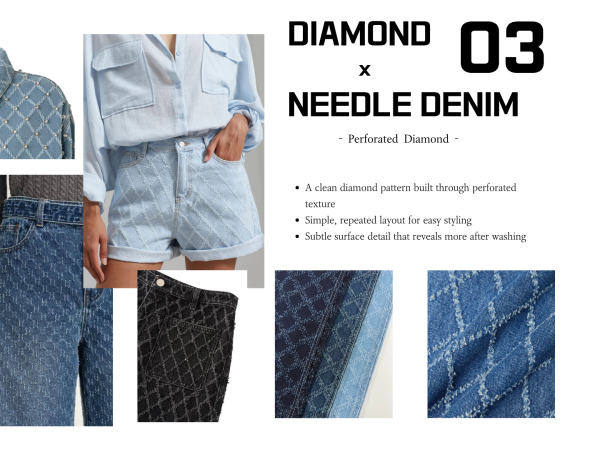
Decoding Perforated Diamond Patterns in Needle-Punched Denim
Why This Pattern Is Worth Attention — When Simplicity Becomes a Controlled Surface System
At first glance, a diamond pattern built through needle-punching may appear almost too simple to stand out. The layout is clean, repetitive, and familiar, lacking the visual intensity often associated with jacquard or heavily textured denim. However, this apparent simplicity is precisely where its value begins.
Unlike clipped denim, which introduces visible fringe and movement, needle-punched denim operates through a more restrained approach. The pattern is not created by adding or lifting yarns, but by selectively perforating and disrupting the surface. This creates a subtle, almost hidden layer of texture that does not compete for attention, but instead reveals itself gradually.
The result is a fabric that behaves differently from both flat denim and more aggressive textured constructions. It does not rely on contrast, nor does it depend on dramatic surface effects. Instead, it builds interest through micro-level variation—small disruptions that accumulate across the surface to create depth.
In a market where many fabrics compete through immediate visual impact, this type of design takes a different position. It does not aim to capture attention instantly. It is designed to maintain interest over time, particularly in garments that are worn repeatedly and observed under different conditions. This shift from “instant visibility” to “long-term readability” is what makes the pattern commercially relevant.
From Traditional Geometry to Perforated Structure
Diamond patterns are among the most universal motifs in textile history. They appear across a wide range of weaving traditions, from Central Asian rugs to Middle Eastern decorative fabrics and European industrial textiles. In most cases, these patterns are constructed through weaving or printing, relying on clear outlines and consistent repetition.
In denim, however, geometric motifs have always faced a challenge. The material itself is unstable in appearance. It fades, softens, and changes under washing and wear. Patterns that depend on sharp edges or precise alignment often lose their clarity over time.
Needle-punched denim addresses this issue not by reinforcing the pattern, but by redefining it.
Instead of building the diamond through contrast or structure alone, the pattern is formed through controlled perforation. Small openings or disruptions are introduced into the fabric surface, creating a tactile difference rather than a purely visual one. The geometry remains, but it is no longer defined by solid lines. It is suggested through a combination of density, spacing, and surface variation.
This approach transforms the role of the pattern. It is no longer a fixed graphic element. It becomes part of the material system—something that interacts with light, movement, and washing rather than resisting them.
Cultural Context: From Symbolic Motif to Functional Pattern System
Historically, diamond patterns often carried symbolic meaning. In many cultures, they represented protection, continuity, or balance. These meanings were embedded in the visual clarity of the motif, where each shape could be clearly identified and interpreted.
In modern denim, this symbolic layer is largely removed.
Instead, the diamond functions as a structural framework. It provides a recognizable order that can be easily integrated into garments, but its role is more practical than narrative. The repetition of the pattern creates rhythm, while its simplicity allows it to adapt across different product categories.
This shift reflects a broader change in design priorities. Rather than using patterns to communicate meaning, contemporary denim increasingly uses them to support usability and longevity. A pattern that is too strong may limit styling options, while one that is too weak may fail to create differentiation. The perforated diamond sits between these extremes, offering enough structure to be recognizable, but enough subtlety to remain versatile.
Visual Characteristics: Precision at Distance, Texture Up Close
One of the defining features of needle-punched diamond denim is its dual behavior across viewing distances.
From a distance, the fabric appears relatively clean and organized. The diamond layout provides a clear sense of structure, which makes the material easy to integrate into products. This is particularly important for commercial applications, where overly complex patterns can limit usability.
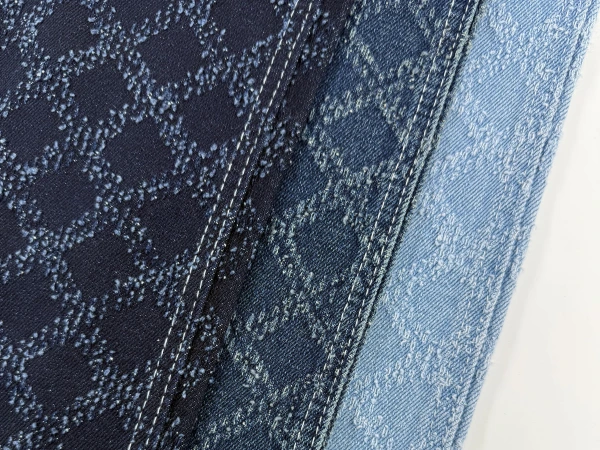
At a closer range, the surface begins to change. The perforations become visible, breaking the continuity of the fabric. Instead of a flat plane, the surface shows small variations in depth and density. Light interacts differently with these areas, creating a subtle play between highlights and shadows.
This layered perception allows the fabric to function in two ways simultaneously:
- As a clean, structured base for styling
- As a detailed surface that adds depth upon closer inspection
This duality is increasingly important in modern denim, where products need to balance simplicity with differentiation.
Behavior Under Washing: Subtle Activation Rather Than Transformation
In needle-punched denim, washing does not dramatically transform the pattern. Instead, it enhances what is already present.
Before washing, the perforations are visible but controlled. The surface appears relatively stable, with the diamond pattern clearly defined through spacing and density.
After washing, especially with light to medium processes, several changes occur:
- Fibers around the perforations soften
- Edges become less rigid
- Tonal variation increases slightly
These changes do not alter the structure of the pattern. Instead, they make it more integrated into the fabric. The surface becomes less mechanical and more natural, without losing its underlying order.
This behavior is particularly valuable in production. Because the pattern does not rely on high contrast or fragile detailing, it is less sensitive to variations in washing conditions. This results in more consistent outcomes across batches.
A Practical Advantage: Stability with Built-In Differentiation
One of the key advantages of needle-punched denim lies in its balance between differentiation and stability.
Highly textured fabrics often introduce risk. Their appearance can vary significantly depending on processing, and small changes in production can lead to inconsistent results. Flat fabrics, on the other hand, are stable but lack differentiation.
Needle-punched denim occupies a middle position.
It introduces texture at a controlled level. The perforations create variation, but they do not fundamentally alter the structure of the fabric. This makes the material more predictable while still offering a degree of uniqueness.
For buyers and developers, this translates into a practical benefit. The fabric can provide differentiation without requiring complex finishing or introducing significant production risk. It allows products to stand out in a subtle way, while maintaining the consistency needed for scalable production.
Closing Insight of Part 1
The value of perforated diamond needle-punched denim does not lie in the novelty of the pattern itself, but in how the pattern is constructed and how it behaves over time.
By shifting from visual definition to surface variation, the design aligns more closely with the natural characteristics of denim. It does not attempt to preserve a fixed image. Instead, it creates a system that remains readable even as the fabric evolves.
In this context, the pattern is not the final result. It is the starting point for a surface that develops through washing, wear, and repeated use.
PART 2
Industry Analysis:
Why Texture Denim and Needle Techniques Are Gaining Ground Again
Why Texture Denim Is Returning — Not a Trend, but a Structural Shift
Over the past few years, one shift has become increasingly clear in denim development: texture is coming back.
Not as decoration.
Not as a seasonal highlight.
But as a structural requirement.
For a long time, denim differentiation relied heavily on washing. Strong contrasts, aggressive fades, and complex finishing defined product identity. This approach worked when visual novelty was enough to drive sales.
But the market has changed.
- Washing techniques are widely accessible
- Effects are easier to replicate
- Visual differences are narrowing
As a result, many products today look different at first glance—but similar after comparison.
This is where texture-driven fabrics re-enter.
Instead of creating difference after production, they introduce it before processing even begins. The fabric itself carries part of the visual and tactile identity.
This is the key shift:
From process-driven differentiation → to fabric-driven differentiation
Is Needle Denim a Trend or a Long-Term Direction?
At a glance, needle-punched denim might seem like a niche technique. It is less visible than clipped denim and less expressive than heavy jacquard. This often leads to a common question: is it just a temporary variation, or does it represent a longer-term direction?
The answer depends on how we define its role.
Needle denim does not compete in the “statement fabric” category. It does not aim to create immediate impact. Instead, it operates in a more stable space: subtle differentiation.
This positioning makes it less dependent on trend cycles.
- It is not tied to a specific season
- It does not rely on bold visual language
- It integrates easily into existing product structures
Because of this, needle denim behaves differently from short-term trend fabrics.
👉 It scales more easily.
👉 It adapts across categories.
👉 It survives longer in collections.
In practical terms, this suggests that needle denim is not a peak-driven trend, but part of a broader shift toward controlled texture in commercial denim.
Why “Fabric Itself Is Doing the Design” Matters More Today
Another important shift in denim is where design responsibility is located.
Traditionally:
- Fabric = base
- Washing = design
- Finishing = differentiation
Today, this hierarchy is changing.
More and more, brands are asking:
“What can the fabric already do before we process it?”
There are several reasons behind this change:
- Faster development cycles
- Pressure to reduce sampling rounds
- Need for more consistent production results
When fabric already contains part of the design, several things improve:
- Less dependence on complex wash programs
- More predictable outcomes
- Faster decision-making during development
Needle denim fits this direction naturally.
It does not require dramatic finishing to show its value.
It works with light processing.
It remains stable across variations.
In other words:
It reduces the workload of downstream processes.
How Needle Denim Creates Differentiation Without Overdesign
One of the biggest challenges in denim today is balancing differentiation with wearability.
Highly designed products often face two problems:
- They are difficult to style
- They lose relevance quickly
Needle denim takes a different approach.
Its differentiation is subtle.
- Pattern is visible, but not dominant
- Texture is present, but not aggressive
- Structure is clear, but not rigid
This creates a specific advantage:
The product stands out—without standing apart.
From a buyer’s perspective, this matters.
Because differentiation that is too strong increases risk.
Differentiation that is too weak adds no value.
Needle denim sits in between:
- Noticeable enough to create identity
- Neutral enough to remain wearable
Why Fabric Is Replacing Washing as the Core of Product Differentiation
Perhaps the most important shift in the current denim market is this:
Fabric is starting to replace washing as the primary source of differentiation.
This does not mean washing becomes irrelevant.
It means its role is changing.
Before:
- Washing created the effect
- Fabric supported it
Now:
- Fabric provides the base effect
- Washing refines it
There are clear reasons behind this transition:
- Consistency
Heavy washing introduces variation. Fabric-based effects are more stable. - Cost control
Complex washes increase production cost and risk. Fabric-level design reduces this dependency. - Speed
Fabric-driven products shorten development cycles.
Needle denim aligns perfectly with this logic.
It does not eliminate washing.
But it reduces how much washing needs to do.
The result is a more balanced system:
Structure + Light Processing → Final Product
Closing Insight of Part 2
Texture denim is not returning because of nostalgia or fashion cycles. It is returning because the industry needs a more stable and efficient way to create differentiation.
Within this shift, needle-punched denim occupies a specific and increasingly relevant position.
It does not compete through intensity.
It competes through control.
By embedding subtle variation into the fabric itself, it allows products to achieve:
- differentiation without complexity
- stability without uniformity
- value without overdesign
For buyers, the implication is clear:
the future of denim differentiation is not about doing more in finishing,
but about building more into the fabric from the start.
PART 3
This Design Element in Practice:
Perforated Diamond Needle Denim in Product Development
Where This Fabric Works Best — Clean Structure, Controlled Detail
When evaluating needle-punched geometric denim, the key is not how strong the pattern appears, but how consistently it can support the product. This type of fabric is not built to dominate a garment. It is built to stabilize it.
Because the pattern is subtle and evenly distributed, it performs best in products where balance is required. Womenswear and unisex casual categories are particularly suitable, especially in silhouettes that allow the fabric surface to remain relatively uninterrupted.
Typical strong applications include:
- Straight-leg and wide-leg jeans
- A-line or mid-length skirts
- Lightweight jackets and overshirts
- Casual shirts and co-ord sets
These categories share one important characteristic: they allow the fabric to remain readable without distortion. The diamond layout provides structure, while the perforated texture introduces just enough variation to avoid flatness.
In contrast, highly fitted garments tend to reduce the effectiveness of the fabric. When the surface is stretched or compressed, the subtle perforation loses clarity, and the pattern becomes less meaningful. Similarly, heavily segmented designs—those with multiple panels or complex construction—break the continuity of the layout, reducing the overall impact.
The principle is simple:
This fabric works best when the garment keeps things simple.
Trend Alignment — Clean, Textured, and Commercially Safe
One of the key strengths of perforated diamond needle denim is how easily it aligns with current market directions without being tied to any single trend.
First, it fits naturally into the “clean but not flat” aesthetic. From a distance, the fabric appears minimal and structured, making it easy to integrate into a wide range of products. Up close, the perforation introduces depth, preventing the surface from feeling too basic. This dual behavior is increasingly important in modern retail, where products must perform both visually and practically.
Second, it connects with the shift toward texture-driven denim, but in a more controlled way. While some textured fabrics rely on strong visual effects, needle denim takes a quieter approach. It adds surface interest without overwhelming the product, making it more adaptable across seasons and categories.
Third, it supports the growing demand for versatile fabrics. Because the pattern is simple and repetitive, it does not limit styling. It can be used in both casual and slightly elevated products without feeling out of place.
In short:
- It is not trend-dependent
- It is not season-specific
- It is not design-restrictive
What Makes It Different on Denim — Subtle Structure Instead of Strong Contrast
When applied to denim, perforated diamond patterns create a different kind of differentiation compared to both traditional jacquard and basic twill.
The difference can be summarized in three aspects:
- Structure — Disruption Without Breaking the Surface
Unlike clipped denim, which introduces visible layering, needle denim works through micro-level disruption. The perforations alter the surface without fundamentally changing its integrity.
- No raised structure
- No heavy texture
- But clear surface variation
This creates a more controlled and stable effect.
- Color Behavior — Depth Through Light Interaction
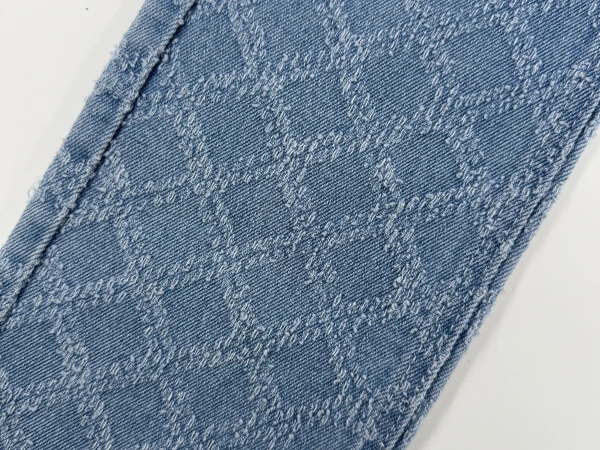
Because the surface is perforated, light interacts differently with the fabric. Instead of relying on color contrast, the pattern becomes visible through small changes in reflection.
- Subtle highlight and shadow
- Slight tonal variation after washing
- No dependence on high contrast
More compatible with denim fading.
- Density — Repetition Without Fatigue
The diamond layout is regular, but the perforation introduces variation within that repetition. This prevents the pattern from becoming visually tiring over time.
- Clear structure at macro level
- Variation at micro level
Balanced and long-wearing.
A Practical Advantage — Low Risk, High Usability
From a commercial perspective, one of the biggest strengths of this type of fabric is its usability.
Highly expressive fabrics often come with higher risk. They may look strong in development, but become difficult to scale or maintain consistency. Basic fabrics, on the other hand, are easy to produce but offer limited differentiation.
Needle denim sits between these two extremes.
- It adds value without increasing complexity
- It differentiates without limiting application
- It remains stable across production
For buyers, this translates into a more reliable development process:
- easier to integrate into collections
- lower risk of over-design
- more predictable production outcomes
It is not a “hero fabric.”
It is a “working fabric” with added value.
Closing Insight of Part 3
The strength of perforated diamond needle denim lies in its balance.
It is structured but not rigid.
It is detailed but not dominant.
It is different but not difficult.
In practical terms, this makes it one of the few fabrics that can enhance a product without forcing the design to adapt around it.
PART 4 — Closing
Final Thought: When Subtle Structure Becomes a Long-Term Advantage
As denim continues to evolve, one of the most important changes is not in how bold products look, but in how consistently they perform.
In an environment where visual differentiation is easy to achieve but difficult to sustain, fabrics that offer controlled, stable variation are becoming more valuable. They allow products to stand out without increasing risk, and to remain relevant without relying on constant reinvention.
Perforated needle denim fits precisely into this space.
It does not attempt to replace washing or traditional fabric structures. Instead, it rebalances their roles. By embedding subtle variation into the fabric itself, it reduces the need for heavy processing while maintaining a clear identity.
For product developers and buyers, this creates a more efficient path to differentiation. The fabric carries part of the design from the beginning, making the final outcome more predictable and easier to manage.
A development such as G1001-705117, with its perforated diamond layout, illustrates this approach. The pattern is simple, but its behavior is not static. It evolves slightly with washing and wear, creating a surface that remains interesting without becoming overwhelming.
For those exploring how to build products that balance clarity, versatility, and differentiation, fabrics like this offer a practical direction. The difference may not be immediate, but it becomes more evident over time—through use, movement, and repeated wear.
Diamond Patterns in Needle-Punched Denim Stylish Denim Fabric For Lady and Men Jean
Diamond Patterns in Needle-Punched Denim Stylish Denim Fabric For Lady and Men Jean-Video
 Arabic
  English
  Russian
  Spanish
  French
  Vietnamese