
PART 1
Decoding Clipped Floral Patterns in Denim
Why This Pattern Is Worth Attention — When Texture Starts to Replace Pattern
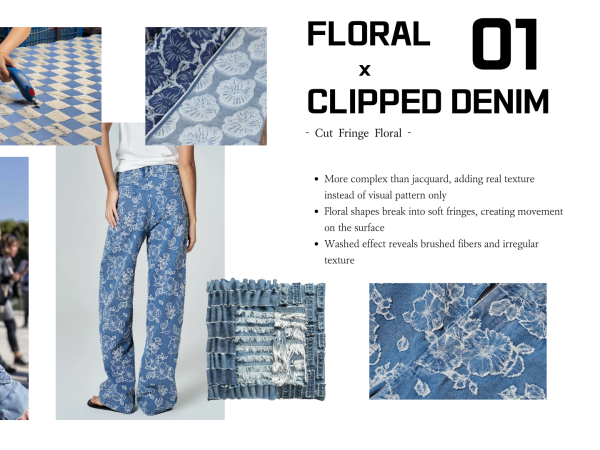
At first glance, clipped floral denim may seem familiar.
It carries floral shapes.
It follows a repeated structure.
And it still belongs to the broader jacquard family.
But the moment you look closer, the difference becomes clear.
This is not just a pattern.
It is a surface.
Unlike traditional jacquard—where the pattern is visual—
clipped denim introduces a second layer:
physical disruption of the fabric surface itself.
The floral shapes are not only woven in.
They are partially cut, lifted, and released into soft fringes.
This creates something that standard jacquard cannot achieve:
- The pattern is visible
- The texture is touchable
- The surface is moving, not static
In a market where most fabrics compete visually, this type of construction shifts the competition to another dimension: tactile perception.
That shift is subtle—but commercially important.
—————————————————————————————————————–
From Floral Decoration to Surface Movement: A Structural Evolution
Floral motifs are one of the oldest visual languages in textiles.
Historically, they were used to express:
- femininity
- decoration
- seasonal storytelling
- cultural symbolism
In denim, however, floral patterns have always faced a limitation:
They either become:
- too decorative→ difficult for everyday wear
- or too subtle→ lost after washing
Clipped denim changes this balance.
Instead of relying on contrast or color,
it builds interest through surface behavior.
The process itself is what defines the design:
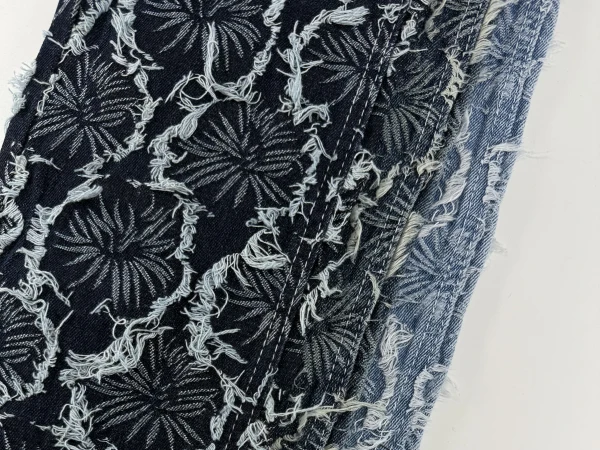
- Jacquard weaving builds the base pattern
- Selected yarns are cut or clippedafter weaving
- The surface opens into irregular fringe textures
This creates a hybrid structure:
- Part pattern
- Part texture
- Part movement
The key difference from traditional jacquard is:
This is not an upgrade in decoration.
It is a shift in how the fabric communicates.
—————————————————————————————————————–
A Quiet Cultural Shift: From “Perfect Surface” to “Imperfect Texture”
The rise of clipped denim is not isolated.
It reflects a broader change in how materials are perceived.
For a long time, premium textiles were defined by:
- smoothness
- precision
- clean finishes
- controlled uniformity
But this definition is changing.
Across fashion and product design, there is a growing preference for:
- irregularity
- tactility
- natural variation
- “already lived-in” surfaces
Not as a nostalgic reference,
but as a response to over-produced, over-polished materials.
Clipped floral denim fits directly into this shift.
Because it does not simulate imperfection through washing.
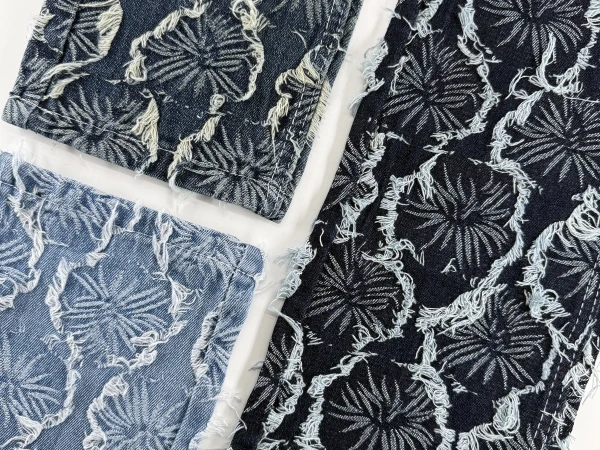
It builds imperfection into the structure itself.
The fringe is not damage.
It is intentional.
The irregularity is not a defect.
It is controlled.
This creates a different perception:
- Not decorative → but material-driven
- Not expressive → but sensory
- Not seasonal → but textural
—————————————————————————————————————–
Visual Identity: Soft Fragmentation Instead of Clear Motifs
One of the most defining characteristics of clipped floral denim is how the pattern behaves visually. It does not present itself as a complete, readable flower.
Instead, it appears as:
- broken outlines
- soft-edged shapes
- partially revealed motifs
The fringe disrupts the clarity of the pattern. But instead of weakening it,this actually strengthens the fabric’s identity.
Because:
- The eye cannot read everything instantly
- The surface changes with movement
- The pattern reveals itself gradually
This creates a layered visual experience:
- From distance → soft, textured surface
- From mid-range → fragmented floral shapes
- From close → fiber-level detail and irregularity
In denim—where garments move, crease, and fade—
this type of pattern behaves differently from static designs.
It does not rely on precision.
It benefits from variation.
—————————————————————————————————————–
What Happens After Washing — Where the Real Value Appears
Like all denim, clipped denim is not defined before washing.
Its real performance begins after.
Before washing:
- Fringe remains relatively controlled
- Pattern appears more structured
- Surface texture is present but subtle
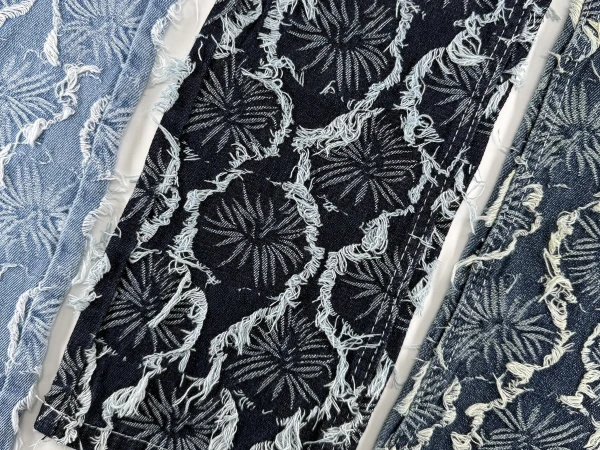
After washing (enzyme / light stone):
- Fibers open and soften
- Fringe becomes more visible
- Texture gains volume and irregularity
After repeated wear:
- Micro-fraying increases
- Surface becomes more dynamic
- Pattern transitions from “defined” → to “organic”
Key difference:
The pattern is not reduced by washing — it is activated by washing.
This is particularly important in denim development, because:
- Washing defines a large part of the final product
- Many patterns lose clarity after processing
- Surface-added effects often degrade
Clipped denim behaves in the opposite way. It becomes more expressive over time.
—————————————————————————————————————–
A Practical but Underrated Advantage: Natural Variation Without Extra Process
One of the less discussed—but highly relevant—advantages of clipped denim is this:
It creates variation without relying on heavy processing.
In traditional denim:
- Texture → created by washing
- Variation → created by chemical or mechanical treatment
In clipped denim:
- Texture → already built into fabric
- Variation → enhanced, not created, by washing
This leads to:
- More consistent production results
- Lower dependence on aggressive wash programs
- Reduced risk of over-processing
For buyers and developers, this is not just aesthetic.
It is operational.
—————————————————————————————————————–
Closing Insight of Part 1
Clipped floral denim is not simply a more complex version of jacquard.
It represents a shift in how pattern, texture, and process interact.
It does not rely on visibility alone.
It does not depend on color contrast.
Instead, it builds value through three things:
- Surface dimension
- Tactile interaction
- Evolution over time
In this context, the role of the pattern changes.
It is no longer something you only see.
It is something you experience.
—————————————————————————————————————–
PART 2
Clipped Denim in the Market:
From Niche Craft to a Commercial Leverage Tool
Clipped Denim Is Not Just “More Complex Jacquard” — It Occupies a Different Market Layer
At a surface level, clipped denim is often grouped into jacquard.
But in real commercial practice, it behaves very differently.
The key distinction is this:
Jacquard = visual differentiation
Clipped denim = structural + tactile differentiation
This difference directly affects how the fabric is perceived in the market:
- Jacquard competes on pattern design
- Clipped denim competes on material experience
And this shift—from visual to physical—
is what allows clipped denim to move into a different price and product positioning layer.
—————————————————————————————————————–
Why Clipped Denim Is More Suitable for High-Value Products
One of the most consistent observations across markets is:
Clipped denim is easier to position as a premium product
Not because it is “luxury” by default—
but because it naturally supports perceived value.
There are three key reasons behind this.
- It Creates Immediate Perceived Complexity
In product evaluation—especially in wholesale and retail—
buyers and consumers often make decisions within seconds.
Clipped denim has a built-in advantage:
- Surface is visibly complex
- Texture is immediately noticeable
- Fabric looks “worked on” even before washing
This reduces the need for explanation.
The value is not abstract.
It is visible and touchable at first contact.
- It Is Harder to Replicate Consistently
Unlike printing or basic jacquard:
clipped denim requires:
- controlled weaving structure
- precise yarn selection
- post-weaving clipping process
- stable finishing to avoid over-fraying
This combination creates a higher technical barrier.
From a market perspective, this means:
- fewer suppliers can execute it well
- results vary significantly between mills
- consistency becomes a differentiator
In other words:
it is not easily commoditized
- It Reduces Dependence on Heavy Washing for “Premium Look”
In many denim products, premium perception comes from:
- complex washing
- heavy processing
- multiple finishing steps
Clipped denim shifts part of that value upstream:
- texture already exists in fabric
- washing becomes enhancement, not creation
This leads to:
- more stable outcomes
- lower risk of over-processing
- easier control of final appearance
For brands, this translates into:
more predictable premium positioning
—————————————————————————————————————–
The Real Commercial Barrier: Why Clipped Denim Is Not for Everyone
Despite its advantages, clipped denim is not universally adopted.
Because its barrier is not only technical.
It is also commercial and product-level.
There are three main constraints.
- Cost vs. Application Alignment
Clipped denim carries:
- higher fabric cost
- higher development complexity
If applied to:
- basic SKUs
- price-sensitive categories
- high-volume entry-level products
→ the value cannot be fully realized.
This creates a mismatch:
High-cost fabric in low-value product structure
- Garment Design Dependency
Unlike basic denim, clipped denim requires:
- sufficient panel space
- controlled silhouette
- minimal interruption of surface
If the garment:
- cuts the fabric too much
- adds too many design elements
- over-competes with the texture
→ the fabric loses its advantage.
This means:
clipped denim is not “plug-and-play”
It requires design coordination.
- Market Acceptance of Texture
Not all markets respond equally to tactile fabrics.
In some segments:
- clean surfaces are preferred
- texture is perceived as “too fashion”
- durability concerns may arise
This creates a selection effect:
clipped denim works best in markets ready for material-driven products
—————————————————————————————————————–
Who Should Actually Develop Clipped Denim
From a buyer perspective, the key question is not:
“Is this fabric good?”
But:
“Is this fabric right for my product structure?”
Based on current market behavior, clipped denim is most suitable for:
- Mid-to-High-End Fashion Brands
- Need differentiation beyond washing
- Focus on material storytelling
- Willing to support slightly higher cost
- Women’s Wear & Fashion Denim Segments
- Larger surface areas (skirts, wide-leg, outerwear)
- More tolerance for texture and variation
- Higher acceptance of design-led fabrics
- Capsule Collections / Drop-Based Retail
- Need quick differentiation
- Smaller volumes per SKU
- Focus on visual uniqueness
- Brands Moving Away from Heavy Washing Dependency
- Want to reduce processing complexity
- Seek more stable production results
- Need fabric-driven identity
In contrast, clipped denim is less suitable for:
- purely price-driven wholesale
- uniform / workwear basics
- highly standardized product lines
—————————————————————————————————————–
Why Clipped Denim Creates Stronger Product Memory
In today’s market, one of the biggest challenges is: products look increasingly similar.
Most differentiation comes from:
- washing variations
- minor design changes
- color adjustments
But these are:
- easy to replicate
- easy to forget
Clipped denim behaves differently. Because it engages multiple senses:
- visual → pattern & texture
- tactile → surface irregularity
- dynamic → changes with wear
This creates a stronger memory effect:
- easier to recognize
- harder to substitute
- more likely to be remembered after interaction
It is not just “different”
It is memorable
—————————————————————————————————————–
How Clipped Denim Helps Brands Move Up the Product Ladder
One of the most practical roles of clipped denim is:
acting as a bridge between basic and high-value products
In a typical denim range:
- Basics → stable, volume-driven
- Statement pieces → high-risk, low-volume
Clipped denim sits in between:
- More distinctive than basics
- More wearable than extreme designs
This allows brands to:
- introduce differentiation without high risk
- elevate average selling price
- build layered product structure
From a collection strategy perspective:
It is a controlled upgrade tool
Closing Insight of Part 2
Clipped denim is not simply a more decorative fabric.
It represents a shift in where product value is created.
Instead of relying entirely on:
- washing
- finishing
- external design
It moves part of that value into: fabric structure itself.
This creates a new kind of advantage:
- harder to copy
- easier to position
- more stable in production
- more memorable in the market
For buyers, the key is not whether to use clipped denim.
But: where in your product structure it actually makes sense?
—————————————————————————————————————–
PART 3
This Design Element in Practice:
Clipped Floral Denim in Real Product Development
The practical applications of this fabric – think beyond the fabric
When evaluating a fabric like clipped floral denim,
one of the most common mistakes is focusing only on the sample.
But in reality:
The value of the fabric is defined by the garment, not the swatch.
Clipped denim is not a pattern-driven fabric.
It is a surface-driven fabric.
That distinction changes everything.
Unlike traditional floral jacquard—which requires visual readability—
clipped floral denim depends on:
- surface continuity
- space for texture to develop
- freedom for fibers to move
This directly determines where it should be used.
—————————————————————————————————————–
Recommended Applications — Where the Fabric Can Perform Fully
The key principle is simple:
The fabric needs space to “breathe.”
- Women’s Bottoms (Primary Application)
- Wide-leg / straight-leg / A-line jeans
- Skirts with moderate structure
- Relaxed silhouettes
Why it works:
- Large panels preserve pattern continuity
- Movement enhances fringe behavior
- Texture becomes part of garment expression
- Skirts & Dresses
- Midi skirts
- Panel skirts with controlled segmentation
- Casual dresses with simple cuts
Why it works:
- Flow + texture creates dynamic surface
- Fringe reacts naturally to movement
- Floral element aligns with category
- Jackets / Overshirts
- Boxy jackets
- Lightweight outerwear
- Casual overshirts
Why it works:
- Flat surfaces maintain texture visibility
- Less distortion from body movement
- Fabric becomes the visual focus
- Lightweight Statement Pieces (Emerging Use)
- Co-ord sets
- Summer fashion denim
- Capsule items
Why it works:
- High differentiation needed
- Fabric carries design identity
- Reduces need for additional decoration
—————————————————————————————————————–
Less Suitable Applications — Where Value Gets Reduced
Understanding where not to use clipped denim is equally important.
- Slim-Fit Garments
- Skinny jeans
- Tight-fitting tops
Problem:
- Texture gets compressed
- Fringe loses movement
- Pattern becomes unreadable
- Highly Segmented Designs
- Patchwork styles
- Multi-panel constructions
Problem:
- Surface continuity is broken
- Pattern becomes fragmented
- Fabric loses its “field effect”
- Over-Designed Products
- Heavy embroidery
- Strong prints layered on top
- Aggressive washing
Problem:
- Competes with the fabric
- Destroys texture balance
- Reduces perceived value
👉 Key takeaway:
Clipped denim works best when the garment design steps back.
—————————————————————————————————————–
Trend Alignment — Why It Fits Current Market Directions
Clipped floral denim is not limited to a single trend.
Its strength lies in aligning with multiple directions simultaneously.
- Softened & Textural Denim Direction
- Less rigid
- More surface-driven
- Focus on comfort + visual softness
Clipped denim fits because:
- Fringe softens the visual effect
- Texture replaces heavy washing
- Creates a more relaxed surface identity
- Premium Casual / Elevated Everyday Wear
- Everyday products with higher material value
- Subtle differentiation instead of bold design
Clipped denim supports this by:
- adding depth without loud contrast
- keeping garments wearable
- enhancing perceived quality
- Feminine but Not Decorative Trend
- Moving away from overly “pretty” designs
- More focus on texture than print
Clipped floral fits because:
- floral is present, but fragmented
- decoration is softened into structure
- result feels modern, not traditional
- “Clean but Not Flat” Aesthetic
One of the strongest current directions:
garments that look simple from distance,
but reveal detail up close
Clipped denim naturally delivers this:
- From distance → textured surface
- From close → floral + fiber detail
—————————————————————————————————————–
What Makes This Design Different on Denim
When floral clipped design is applied to denim,
it behaves very differently from both:
- traditional jacquard
- printed denim
- basic 3/1 twill
The difference comes from three key dimensions.
- Structure: Layered, Not Flat
- Base pattern woven into fabric
- Surface partially cut into fringe
- Texture sits above fabric plane
Compared to:
- Printing → only surface color
- Jacquard → structural but flat
Clipped denim = multi-layer structure
- Color Behavior: Revealed Through Texture, Not Contrast
- Usually tonal (indigo / overdyed bases)
- Pattern appears through light and shadow
- Fringe creates micro-contrast
This works better with denim because:
- fading enhances texture
- no reliance on sharp color difference
- visual effect remains stable after washing
- Density & Distribution: Controlled Irregularity
- Floral elements are not fully defined
- Density varies across the surface
- No strict repeat grid perception
This creates:
- natural rhythm
- less visual fatigue
- stronger long-term wearability
—————————————————————————————————————–
A Practical Advantage: Lower Design Risk, Higher Product Stability
From a product development perspective, clipped denim offers a rare balance:
Low Design Risk
- Not trend-dependent
- Not overly expressive
- Works across seasons
High Versatility
- Applicable across categories
- Compatible with multiple wash levels
- Can be styled up or down
Stable Outcome
- Less reliance on exact wash execution
- More predictable results
- Lower sampling iteration
For buyers, this translates into:
- easier range planning
- lower development uncertainty
- better margin control
—————————————————————————————————————–
Closing Insight of Part 3
The value of clipped floral denim is not defined by the pattern alone.
It lies in how it connects:
- fabric and garment
- texture and movement
- design and production
It does not need strong styling to work.
It performs best when the product allows the fabric to lead.
In that sense, this type of fabric is not about adding more design.
It is about letting material become the design itself.
—————————————————————————————————————–
PART 4 — Closing
Final Thought: When Surface Becomes Strategy
As denim continues to evolve, one shift is becoming increasingly clear:
not all value comes from process anymore.
For a long time, product differentiation in denim relied heavily on:
- washing techniques
- finishing complexity
- visual contrast
But this approach has its limits.
Because:
- washing can be replicated
- effects can be standardized
- visual impact fades quickly in a saturated market
What is changing now is not just how denim looks—
but where its value is created.
Clipped denim represents one direction of that shift.
It moves part of the product’s identity upstream, into the fabric itself.
Not by adding more decoration,
but by redefining how the surface behaves.
Instead of asking:
“how can we make this fabric look different after washing?”
the question becomes:
“what can the fabric already do before washing?”
This shift matters because it affects more than design.
It influences:
- how products are developed
- how consistently they can be produced
- how easily they can be differentiated
- how long they remain relevant in the market
—————————————————————————————————————–
A Practical Perspective for Buyers and Developers
For buyers, the relevance of clipped denim is not universal.
It is specific.
It makes sense when:
- the product needs material-driven differentiation
- the garment allows the fabric to remain continuous
- the goal is to balance uniqueness with wearability
It becomes less effective when:
- design elements compete with the surface
- cost structure does not support added value
- the product relies purely on price competition
In other words:
clipped denim is not a replacement for basic fabrics.
it is a tool for strategic upgrade within a range.
—————————————————————————————————————–
From Fabric to Product — Where the Difference Actually Appears
In practice, the real difference of this type of fabric is rarely visible on a hanger alone.
It appears over time:
- after washing
- after movement
- after repeated wear
That is when:
- texture becomes more expressive
- surface becomes less predictable
- pattern becomes less defined—but more interesting
And that is where clipped denim creates its value:
not in a single visual moment,
but across the lifecycle of the product.
—————————————————————————————————————–
From Concept to Application
One example of this approach can be seen in a clipped floral denim development like J1D01-10, where floral structures are partially released into soft fringes to create a surface that evolves with washing and wear.
If you are exploring how this type of texture-driven fabric could fit into your next collection, it is often worth looking beyond the swatch—and observing how it behaves after processing and in real garment applications.
 Arabic
  English
  Russian
  Spanish
  French
  Vietnamese