
Why Weathered Industrial Textures Are Becoming the Next Evolution of Flocking Jacquard Denim?
As denim design moves beyond traditional floral, camouflage, and vintage fades, a new category is emerging: architectural texture-inspired denim. Rather than borrowing from nature, these designs draw inspiration from urban surfaces, oxidation marks, concrete walls, rusted steel, and the beauty of materials shaped by time.
In this article, we’ll explore:
- Why industrial patina textures are attracting attention in modern denim development
- The historical roots and cultural meaning behind weathered surface aesthetics
- Why chenille jacquard denim aligns naturally with Retro and Quiet Luxury trends
- How texture-based denim creates a premium appearance without relying on prints
- The garment applications and market potential of J2077 Urban Patina
- Why textured denim may become a stronger long-term product strategy than printed denim
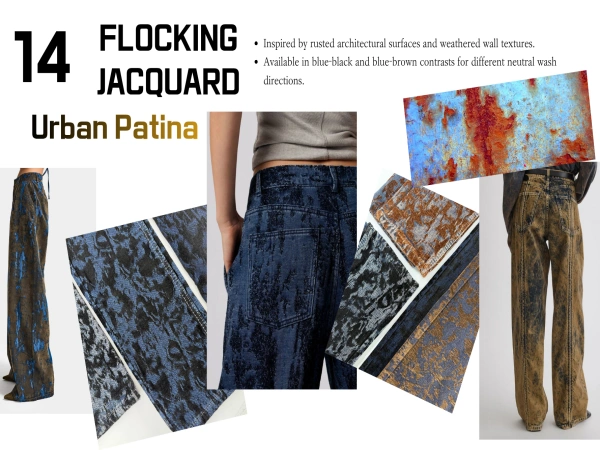
Understanding the Design Element: Urban Patina
Why Is This Design Worth Attention?
At first glance, J2077 does not resemble a traditional denim pattern.
There are no flowers, no geometric repeats, and no obvious motifs.
Instead, the design captures something much more subtle: the visual language of aging materials.
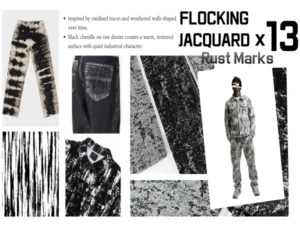
The irregular surface resembles:
- Rusted steel plates
- Weathered concrete walls
- Oxidized architectural facades
- Peeling paint textures
- Industrial surfaces exposed to decades of natural aging
This category of design has become increasingly important because fashion consumers are moving away from obvious decoration and toward texture-driven storytelling.
Rather than asking:
“What pattern is this?”
Consumers increasingly ask:
“What does this surface feel like?”
That shift is one of the biggest design movements currently influencing premium denim development.
The Origins of Weathered Surface Aesthetics
The appreciation of aged surfaces has deep roots across multiple cultures.
Japan: Wabi-Sabi
Perhaps the most famous example is the Japanese concept of Wabi-Sabi, which celebrates imperfection, aging, and the beauty of time.
Cracked ceramics, weathered wood, and oxidized metals are valued not despite their flaws, but because of them.
The marks of time become part of the object’s identity.
Europe: Industrial Heritage
In Europe, particularly in cities such as:
- Manchester
- Liverpool
- Berlin
- Antwerp
Old factories, abandoned warehouses, and industrial districts have long inspired fashion and interior design.
Weathered brick walls and oxidized steel structures became visual symbols of authenticity.
This aesthetic later influenced:
- Workwear fashion
- Vintage denim
- Industrial-inspired luxury collections
Why Has This Aesthetic Returned Recently?
Since 2020, several major trends have converged:
The End of Excessive Decoration
Consumers are becoming less interested in loud graphics and logo-heavy products.
Instead, they seek products that communicate quality through materials and texture.
The Rise of Quiet Luxury
Quiet Luxury focuses on:
- Material richness
- Surface depth
- Understated sophistication
- Timeless appearance
Urban Patina aligns perfectly with this movement because it creates visual complexity without appearing overly designed.
Growing Interest in Texture
Fashion forecasting agencies have repeatedly highlighted texture as one of the key directions for upcoming collections.
Consumers increasingly respond to:
- Touch
- Dimension
- Material contrast
- Surface variation
Rather than flat surfaces.
The Visual Characteristics of Urban Patina
Unlike traditional jacquard motifs, Urban Patina is intentionally irregular.
Key characteristics include:
Non-Repeating Texture
The pattern feels organic and naturally evolved rather than mechanically repeated.
This creates greater visual authenticity.
Multi-Layer Depth
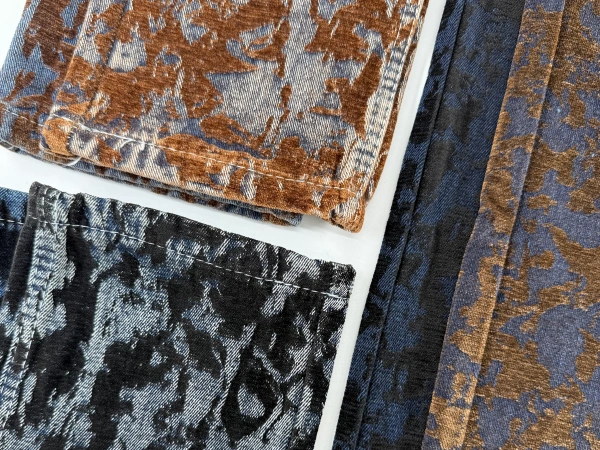
The combination of raw denim and chenille generates several visual layers:
- Denim base
- Raised chenille surface
- Shadow effects
- Light reflection differences
This layered construction creates depth impossible to achieve through printing alone.
Architectural Character
The design feels structural rather than decorative.
It resembles surfaces found in cities rather than gardens.
This distinction gives it broader commercial flexibility across different product categories.
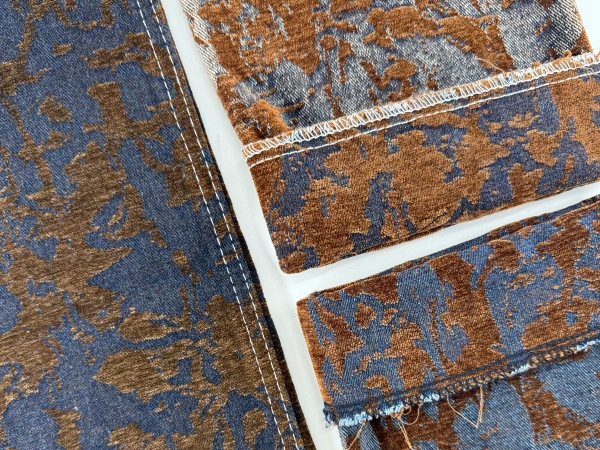
Flocking Jacquard Denim Industry Analysis: Product Applications & Fashion Direction
Why Is Chenille Denim Particularly Suitable for the Retro Trend?
Retro fashion is not simply about reproducing old garments.
Modern Retro focuses on recreating emotional experiences associated with age, history, and authenticity.
Weathered textures naturally support this goal.
Chenille jacquard denim creates:
- A worn appearance
- Vintage depth
- Surface irregularity
- Historical character
without requiring aggressive washing techniques.
As a result, brands can achieve a Retro feeling while maintaining better fabric integrity.
How Does Soft Texture Denim Increase Perceived Premium Value?
One of the most overlooked aspects of luxury products is surface complexity.
Consumers often perceive products as expensive when they display:
- Multiple visual layers
- Tactile richness
- Material depth
rather than simply expensive materials.
Chenille jacquard introduces a soft raised surface that interacts with light differently than standard denim.
This creates a premium appearance even before any garment washing takes place.
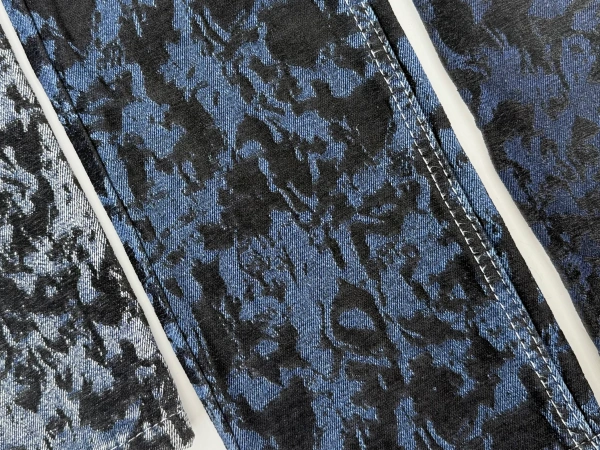
Why Does Flocking-Like Denim Look More Expensive?
The answer lies in visual contrast.
Traditional denim typically relies on:
- Color contrast
- Washing contrast
Chenille denim introduces an additional layer:
Texture Contrast
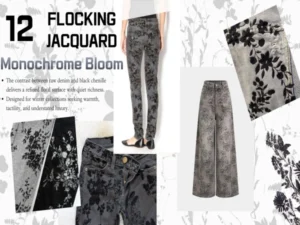
When black chenille sits on top of indigo denim:
- Some areas absorb light
- Others reflect light
- Surface shadows become visible
This effect mimics luxury textiles traditionally found in:
- Velvet
- Tapestry fabrics
- Premium jacquards
As a result, garments appear more sophisticated.
Why Are Warm Visual Textures Influencing Denim Trends?
Fashion cycles often react to broader social conditions.
In recent years consumers have increasingly sought:
- Comfort
- Security
- Emotional connection
Warm visual textures contribute to these feelings.
Unlike smooth technical fabrics, chenille surfaces feel:
- Softer
- Richer
- More human
This explains why textured denim is becoming especially relevant for autumn and winter collections.
Why Is Texture Denim Better Than Printed Denim for Long-Term Development?
Printed denim can create dramatic visuals quickly.
However, it often faces several challenges:
Limited Lifespan
Printed trends can become outdated rapidly.
Flat Appearance
Print remains on the surface.
It does not create genuine dimensionality.
Durability Concerns
Repeated washing may reduce print clarity.
By contrast, texture denim is built into the fabric structure itself.
This provides:
- Greater durability
- Longer commercial life
- Higher perceived value
- Better compatibility with premium collections
For brands developing long-term product programs, texture often proves more sustainable than seasonal graphics.
Urban Patina in Denim: A Focused Design Analysis
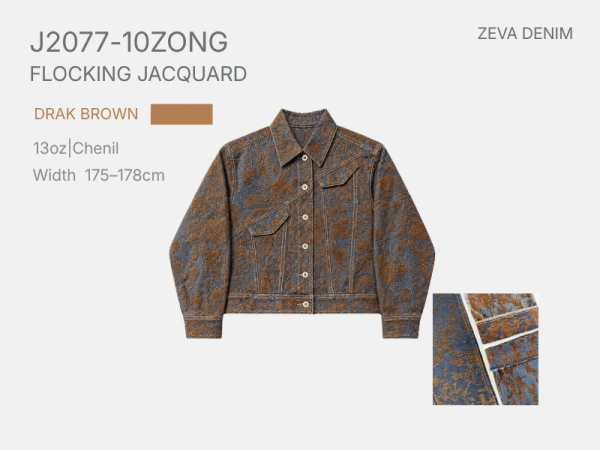
Which Garments Are Best Suited for This Fabric?
Based on the fabric structure and visual direction, J2077 is particularly suitable for:
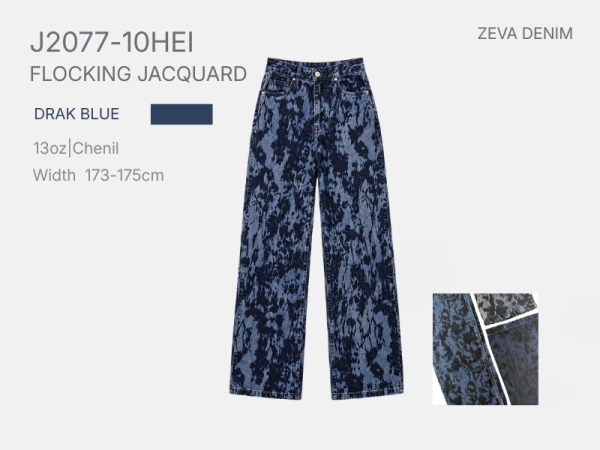
Women’s Denim
Especially:
- Wide-leg jeans
- Barrel-leg jeans
- Utility pants
- Oversized jackets
- Long skirts
The texture becomes more visible across larger garment surfaces.
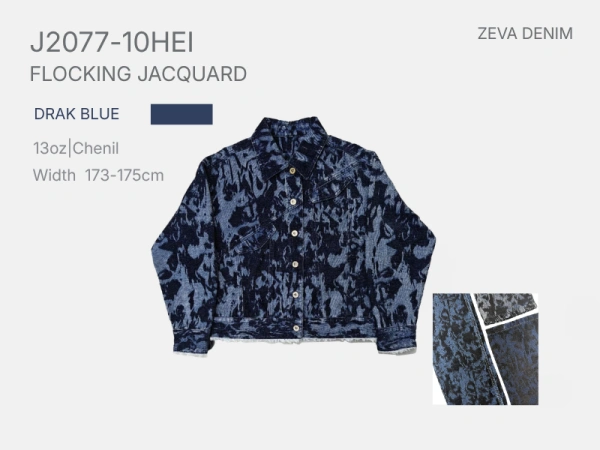
Men’s Denim
The industrial inspiration translates naturally into:
- Workwear jackets
- Carpenter pants
- Relaxed-fit jeans
- Overshirts
The architectural character feels highly compatible with modern menswear.
Gender-Neutral Collections
Perhaps the strongest opportunity lies in unisex products.
Because the pattern is not floral or overtly decorative, it works across multiple consumer groups.
Which Fashion Trend Does Urban Patina Align With?
Interestingly, Urban Patina sits at the intersection of several major trends.
Retro Workwear
The weathered appearance recalls aged industrial environments.
Quiet Luxury
The texture communicates sophistication without obvious branding.
Contemporary Utility
The architectural inspiration aligns naturally with utility and functional aesthetics.
Artisanal Denim
The irregular surface creates a handcrafted impression even within industrial production.
What Makes This Pattern Different From Traditional Denim Designs?
Structure
Traditional denim patterns often rely on recognizable motifs.
Urban Patina relies on surface evolution.
The texture appears to emerge naturally from the fabric itself.
Color Relationships
J2077 offers two distinct directions:
Blue + Black
Creates a colder, industrial aesthetic.
Suitable for:
- Contemporary fashion
- Urban collections
- Technical-inspired products
Blue + Brown
Creates a warmer, oxidized appearance.
Suitable for:
- Vintage collections
- Heritage-inspired products
- Autumn and winter ranges
Pattern Density
Unlike isolated motifs, the texture spreads across the entire fabric surface.
This creates stronger visual impact while maintaining subtlety.
The result feels sophisticated rather than decorative.
Final Thoughts
As denim continues evolving beyond traditional washes and graphics, texture is becoming one of the industry’s most important design languages.
J2077 Urban Patina demonstrates how inspiration can come not from flowers or geometric patterns, but from the built environment itself. Rusted steel, weathered walls, and architectural aging are transformed into a textile surface that feels contemporary, tactile, and emotionally resonant.
For brands seeking alternatives to conventional printed denim, texture-driven chenille jacquard offers a compelling direction—one that combines durability, premium perception, and long-term commercial relevance.
To explore the complete specifications, garment developments, and wash effects of J2077 Urban Patina, readers can continue with the dedicated product page and accompanying development video, where the fabric’s dimensional texture and color contrasts can be seen in greater detail.
 Arabic
  English
  Russian
  Spanish
  French
  Vietnamese