
In today’s denim market, the conversation is gradually shifting away from color alone. While washes, vintage effects, and new dye technologies remain important, brands are increasingly focusing on something deeper: surface texture as a design language.
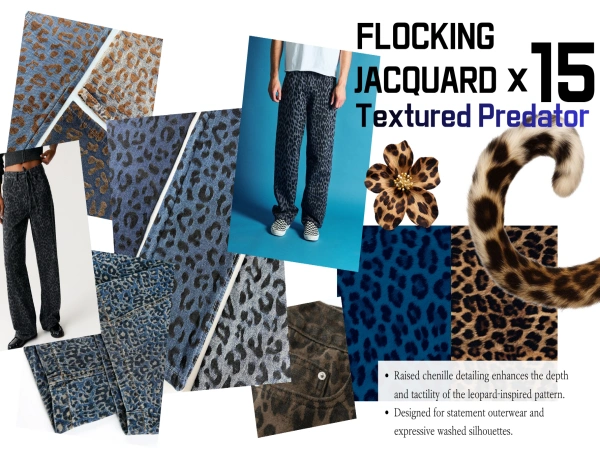
This article explores the rise of texture-driven denim through the lens of J2078 Textured Predator, a chenille jacquard denim inspired by leopard markings and developed specifically for statement outerwear and expressive silhouettes.
Key topics covered include:
- Why texture denim is evolving from a niche category into a mainstream development direction
- How “visual tactility” is reshaping consumer perception of premium denim
- Why leopard-inspired patterns continue to cycle back into fashion
- How chenille jacquard transforms a familiar animal motif into a sophisticated textile story
- The best garment applications and market opportunities for textured leopard denim
Rather than examining leopard print purely as a graphic trend, this article analyzes how texture, structure, and material innovation are redefining its role within modern denim collections.
Understanding the Design Element Behind J2078 Textured Predator
Why Is This Design Worth Paying Attention To?
Leopard patterns have existed in fashion for decades, yet their popularity never completely disappears.
What changes is not the motif itself—but the way it is interpreted.
Traditional leopard prints rely heavily on color contrast and visual boldness. They are designed to be noticed immediately.
J2078 takes a different approach.
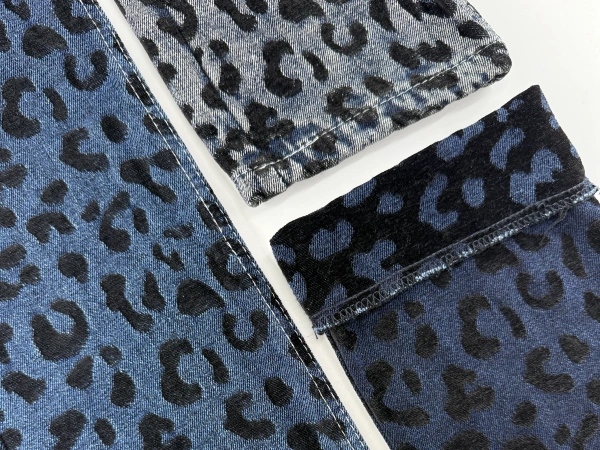
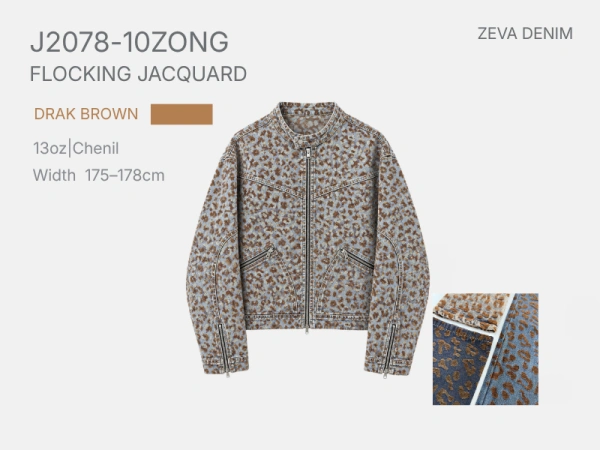
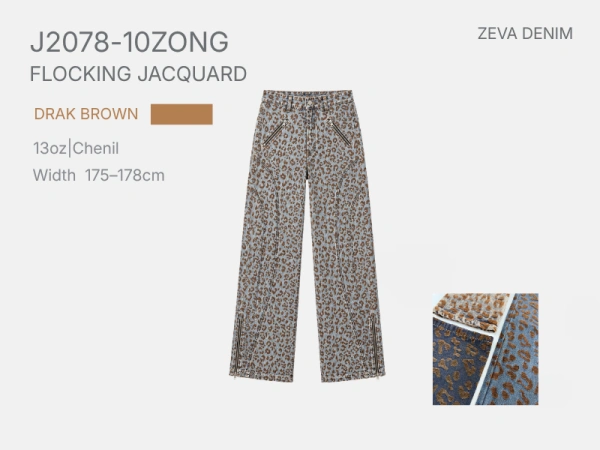
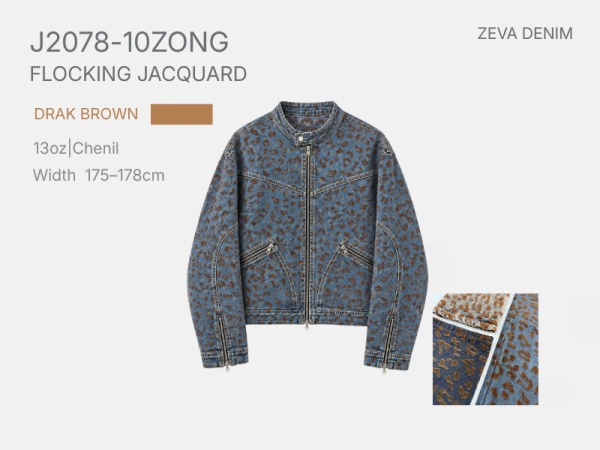
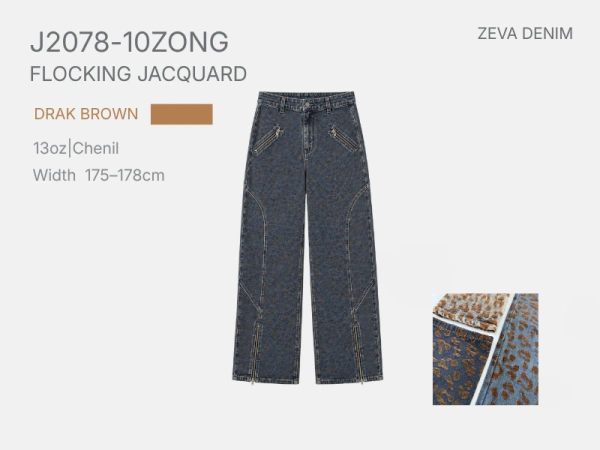
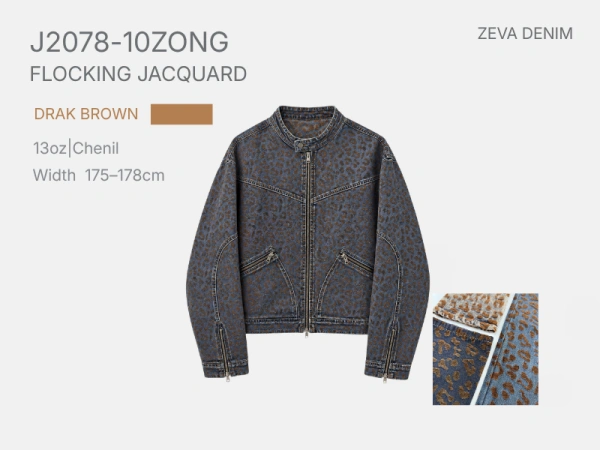
Instead of printing a leopard pattern onto denim, the design is built through raised chenille jacquard construction, allowing the pattern to emerge physically from the fabric surface.
The result is not simply a leopard print denim.
It becomes a texture-driven denim with a subtle animal influence.
This distinction matters because modern consumers increasingly seek uniqueness without excessive visual noise. They want garments that feel premium, artistic, and tactile rather than simply loud.
J2078 responds directly to that demand.
The Origins of Leopard Patterns in Fashion
Animal-inspired motifs have appeared in clothing for centuries.
Historically, leopard skins were associated with power, status, and authority in many regions of Africa, Asia, and Europe.
By the early twentieth century, leopard patterns entered mainstream fashion through luxury houses and couture designers.
The first major popularity peak occurred during the 1950s and 1960s.
A second resurgence arrived in the 1980s when bold fashion aesthetics dominated global markets.
Another significant revival emerged in the late 1990s and early 2000s.
Since 2018, leopard patterns have experienced yet another renaissance—but with an important difference.
Rather than emphasizing glamour and extravagance, contemporary fashion often reinterprets leopard motifs through:
- muted color palettes
- texture-based executions
- oversized scales
- tonal contrasts
- artisan-inspired constructions
J2078 belongs firmly within this modern reinterpretation movement.
Cultural Meaning and Symbolism
Leopard-inspired designs have long symbolized:
- confidence
- individuality
- instinct
- freedom
- strength
However, modern consumers often view leopard motifs differently.
Today, leopard patterns frequently represent:
- creative self-expression
- fashion confidence
- personal identity
- artistic styling
This shift aligns perfectly with modern denim’s transformation from workwear into a lifestyle category.
Consumers no longer buy denim solely for utility.
They buy it as a reflection of personality.
Visual Characteristics of J2078
Several visual elements make this fabric distinctive.
Raised Surface Construction
The chenille jacquard creates genuine dimensionality.
Unlike flat printing, the pattern catches light differently from every angle.
This creates movement and depth.
Tonal Animal Pattern
The motif is recognizable but not aggressive.
The pattern feels sophisticated rather than costume-like.
Soft Matte Texture
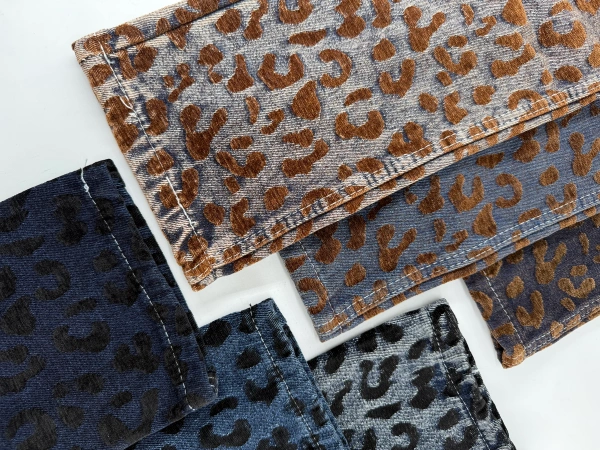
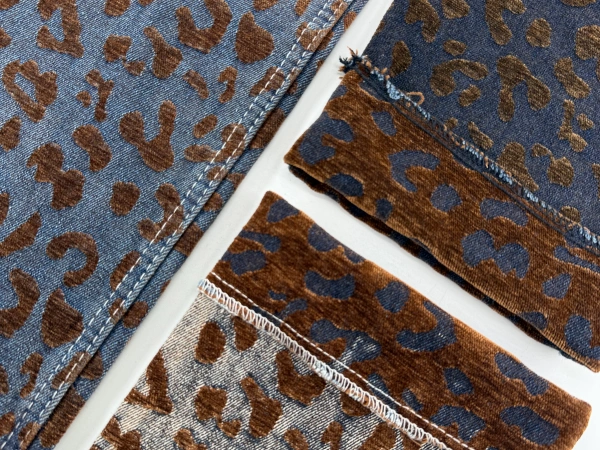
Chenille introduces warmth and softness that contrasts beautifully against traditional denim twill.
Dual Color Development
The blue-black version creates a cooler urban mood.
The blue-brown version introduces warmth and vintage character.
Both directions support entirely different styling narratives while sharing the same structural language.
Why Texture Denim Is Becoming a Mainstream Development Direction
Texture Is Replacing Novelty as the New Luxury
For many years, denim innovation focused primarily on:
- new washes
- destruction effects
- coating technologies
- unusual colors
The challenge is that many of these trends have short life cycles.
Texture operates differently.
Texture affects how a garment:
- looks
- feels
- photographs
- ages
Because texture is integrated into the fabric itself, it creates longer-lasting value.
This is why more brands are investing in jacquards, chenille constructions, dobby structures, and surface-enhanced denims.
The Rise of Visual Tactility
One of the most influential concepts in modern fashion development is visual tactility.
Visual tactility refers to a material’s ability to communicate touch through appearance alone.
Consumers should be able to look at a garment and immediately imagine how it feels.
This concept is becoming increasingly important because shopping behavior is changing.
Many purchasing decisions now happen through:
- online stores
- social media
- lookbooks
- video content
Consumers cannot physically touch the product.
The fabric must communicate texture visually.
J2078 performs exceptionally well in this context because the chenille pattern immediately suggests softness, depth, and craftsmanship.
Why Consumers Pay More for Texture-Rich Denim
Premium pricing is rarely based on material cost alone.
It is driven by perceived value.
Texture-rich denim often appears more expensive because it communicates:
- development complexity
- textile expertise
- craftsmanship
- exclusivity
Consumers may not fully understand jacquard construction, but they recognize that the garment looks different from standard denim.
That perceived uniqueness supports higher retail positioning.
Why Texture Trends Outlast Color Trends
Color trends change rapidly.
A fashionable shade this year may disappear next season.
Texture behaves differently.
Texture functions as a structural design element rather than a seasonal decoration.
This is why:
- corduroy remains relevant
- tweed remains relevant
- boucle remains relevant
Similarly, textured denim categories tend to enjoy longer commercial lifespans than purely color-driven developments.
For brands seeking longer product cycles, texture often delivers stronger long-term value.
Why Chenille Denim Creates a Premium Casual Aesthetic
Modern consumers increasingly seek clothing that feels relaxed but elevated.
This is where chenille jacquard denim excels.
The softness of chenille visually softens denim’s traditional ruggedness.
As a result, garments feel:
- comfortable
- luxurious
- approachable
- contemporary
This balance is difficult to achieve with standard rigid denim alone.
Industry Analysis: Why J2078 Works Particularly Well in Denim
Best Garment Applications
Based on the pattern scale, weight, and construction, J2078 is especially suitable for:
Denim Jackets
Perhaps the strongest application.
The textured leopard pattern creates visual impact without overwhelming the garment.
Cropped jackets, trucker jackets, and oversized silhouettes all work well.
Wide-Leg Jeans
The large surface area allows the pattern to fully develop.
The fabric creates strong movement and visual interest while walking.
Utility Outerwear
Workwear-inspired jackets gain a softer, more fashion-oriented character.
Matching Sets
Coordinated jacket-and-pant combinations align strongly with current fashion directions.
Fashion Skirts
A-line and midi silhouettes benefit from the fabric’s structured texture.
Is It Suitable for Womenswear or Menswear?
The answer is both.
Womenswear
The leopard inspiration naturally aligns with women’s fashion.
The chenille execution elevates it beyond conventional animal prints.
Menswear
Interestingly, the tonal construction makes the pattern surprisingly wearable for men’s collections.
Because the motif feels integrated into the fabric rather than printed on top, it appears more architectural and less decorative.
This supports modern men’s fashion trends emphasizing texture over graphics.
Which Trend Direction Does It Match?
Several major fashion movements intersect here.
Retro Revival
The warm chenille texture references vintage luxury and heritage fabrics.
Quiet Statement
Consumers increasingly seek individuality without excessive branding.
J2078 delivers exactly that.
Texture-First Fashion
Many contemporary collections prioritize surface interest over loud graphics.
The fabric fits naturally into this movement.
Elevated Casualwear
The material helps transform everyday denim silhouettes into premium fashion products.
What Makes This Pattern Different from Traditional Leopard Denim?
The difference lies in three areas.
Structure
Traditional leopard denim typically uses printing.
J2078 uses chenille jacquard construction.
The pattern exists physically within the fabric.
Color Strategy
Most leopard products rely on strong contrast.
J2078 uses controlled tonal development.
The result feels more sophisticated.
Density and Distribution
The pattern is evenly distributed yet visually organic.
This balance allows the design to remain impactful without becoming overwhelming.
Final Thoughts
The evolution of denim increasingly revolves around texture, depth, and material storytelling rather than color alone.
J2078 Textured Predator reflects this broader shift.
By combining a familiar leopard-inspired motif with chenille jacquard construction, the fabric transforms a classic fashion symbol into something more contemporary, tactile, and commercially versatile.
Rather than functioning as a seasonal novelty, this type of texture-driven denim aligns with long-term industry movements toward visual tactility, premium casualwear, and surface-led design.
For brands developing future denim collections, the question is no longer whether texture matters.
The question is how texture can become a meaningful part of product identity.
J2078 offers one compelling answer.
To explore the fabric in greater detail, including close-up texture views, garment applications, and development inspiration, readers can continue with the product page and accompanying video presentation for a deeper understanding of how chenille jacquard construction reshapes the possibilities of modern denim.
 Arabic
  English
  Russian
  Spanish
  French
  Vietnamese