
PART 1
Decoding Deep Sea Botanical Patterns in Jacquard Denim
Why This Pattern Is Worth Attention — Quiet at First, Revealing Over Time
At first glance, this type of jacquard does not compete for attention.
There is no strong contrast. No oversized motifs. And no immediate visual impact.
But that is exactly where its value begins.
In a market increasingly saturated with loud patterns and instant recognition, this kind of design takes a different approach:
it does not try to stand out instantly—it invites a second look.
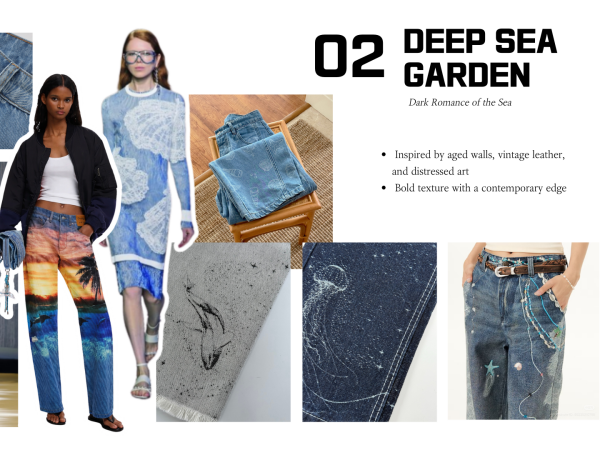
The concept of a “deep sea garden” is not expressed through obvious imagery, but through subtle integration:
whale silhouettes, octopus forms, and marine botanical elements are woven into the fabric in a way that feels almost hidden.
You don’t notice everything at once.
You discover it gradually.
This creates a different kind of user experience:
- First impression: clean, calm, wearable
- Second impression: detailed, unexpected, engaging
- Long-term impression: increasingly interesting over time
In denim, where garments are worn repeatedly and observed in different lighting, movement, and stages of washing, this kind of pattern performs differently.
It does not rely on a single moment of impact.
It builds value through continuous discovery.
That is why this pattern is not designed to be “eye-catching” in the traditional sense.
It is designed to be eye-retaining.
From Hidden Motifs to Fabric Language: How the Pattern Is Constructed
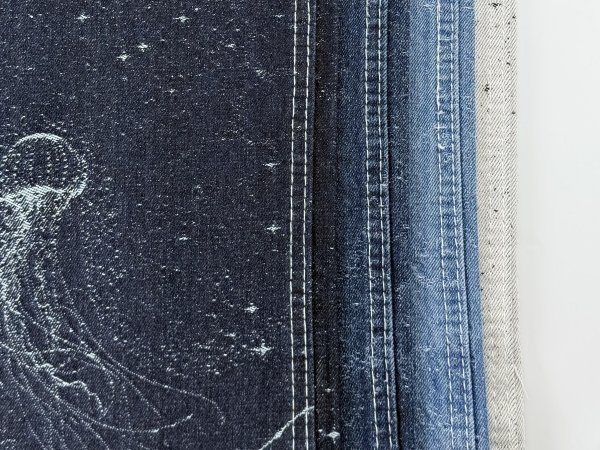
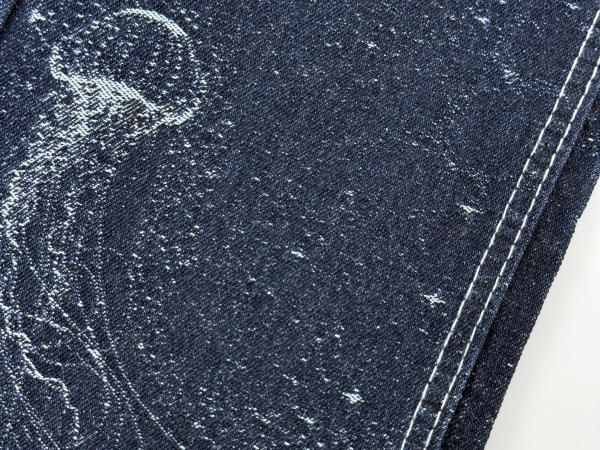
What makes this type of “deep sea garden” jacquard different is not only what it shows—but how it is built.
Unlike obvious thematic fabrics, where motifs are clearly outlined, this pattern works through controlled integration.
Marine elements such as whales, octopus forms, and underwater botanicals are not placed as isolated graphics.
They are absorbed into the weave structure, becoming part of the fabric’s rhythm rather than standing apart from it.
This creates three structural characteristics:
- Fragmented visibility (instead of full exposure)
- Motifs are partially visible, never fully outlined
- Recognition happens gradually, not instantly
- Pattern–texture overlap
- The same structure defines both pattern and surface texture
- Visual effect and tactile feel are aligned
- Non-linear repeat system
- Repeats are softened or disguised
- The fabric reads more like a natural surface than a printed pattern
This approach shifts the role of the pattern:
Not something you “see clearly”, but something you perceive over time.
Cultural and Aesthetic Layer: The Quiet Narrative of the Deep Sea
Ocean-inspired design has always carried symbolic meaning—but in modern denim, these meanings are no longer expressed directly.
Instead of storytelling, what remains is atmosphere.
The idea of a “deep sea garden” introduces a specific emotional tone:
- Depth instead of brightness
- Stillness instead of movement
- Mystery instead of clarity
This aesthetic direction connects with a broader shift in consumer perception:
From expressive fashion → to introspective design
Rather than projecting identity outward, these patterns create a more personal and subtle interaction between garment and wearer.
In this context, marine elements like whales or octopus are no longer symbols.
They become part of a visual environment—one that feels calm, slightly hidden, and continuously revealing.
Visual Behavior Under Washing: Where This Pattern Gains Value
One of the most important—but often overlooked—factors in denim design is:how the pattern behaves after washing.
Because in reality, the success of a fabric is not defined on a swatch,
but on a finished garment after processing.
This type of jacquard performs in a very specific way during washing:
Before washing
- Pattern appears subtle and low-contrast
- Motifs are partially hidden
After light to medium washing (enzyme / stone)
- Texture becomes more pronounced
- Motifs start to emerge through tonal variation
After repeated wear
- Micro-contrast increases
- Surface depth becomes richer
Key advantage:
- The pattern is not destroyed by washing
- It is activated by washing
This makes it particularly suitable for denim, where transformation is not a risk—but a requirement.
A Practical but Underestimated Advantage: Long-Term Wearability
Patterns that are immediately strong often face a common problem: they age quickly.
High-contrast or highly recognizable designs tend to create visual fatigue after repeated wear. What feels striking at first can become limiting over time.
This type of jacquard takes the opposite approach.
Because it is:
- Low contrast
- Structurally integrated
- Gradually revealed
It offers a different lifecycle:
- Not trend-dependent
- Not easily “dated”
- More adaptable across seasons
From a product perspective, this means:
- Longer retail relevance
- Higher repeat wear potential
- Reduced risk of over-design
In a market where consumers are buying fewer but expecting more from each piece,
this kind of durability—visual and emotional—becomes increasingly valuable.
Closing Insight of Part 1
The value of this deep sea jacquard is not in how quickly it can be understood.
It lies in how long it can remain interesting.
It does not deliver impact in a single moment.
It distributes it across time—through washing, wearing, and observation.
In that sense, this type of pattern is not designed to compete for attention.
It is designed to reward attention.
PART 2
Jacquard Denim Market: Growth Patterns and Structural Shifts
Jacquard Denim Is Growing — But Not for the Reasons Most Assume
In recent years, jacquard denim has shown a visible increase in demand across multiple sourcing markets—from Europe to Latin America, and increasingly in parts of the Middle East.
At a surface level, this growth is often explained as part of a “design cycle”—a return of patterns, textures, or vintage-inspired aesthetics. But this explanation is incomplete.
What is happening is not simply a shift in style. It is a shift in how denim products are expected to create value.
Over the past decade, denim has moved through two dominant phases:
- Phase 1: Product value driven by washing (heavy processing, strong visual impact)
- Phase 2: Cost-driven basics (price competition, simplified products)
- Today, the market is entering a third phase:
- Phase 3: Value shared between fabric, structure, and process
Jacquard denim fits precisely into this transition. It allows part of the product identity to exist before washing, and remain after washing. That is the real reason behind its growth.
Jacquard vs Basic Denim: A Shift in Order Structure
One of the clearest indicators of this transition can be seen in order composition.
Historically:
- Basic denim dominated large-volume orders
- Jacquard was limited to small runs or seasonal capsules
But this structure is changing.
Today, buyers are increasingly balancing between:
- Bulk basics (for stability)
- Structured fabrics like jacquard (for differentiation)
This results in a hybrid order model:
- Smaller batch sizes per SKU
- More SKUs per collection
- Faster development cycles
Key shift:
Jacquard is no longer used only for “highlight pieces.”
It is becoming part of the core assortment strategy.
Especially in:
- Women’s denim
- Fashion-oriented collections
- Capsule drops / e-commerce lines
This does not replace basic denim—but it reduces its dominance.
2026–2028: Trend or Structural Opportunity?
A key question many buyers are asking:
Is jacquard denim just another short-term trend, or does it represent a longer-term shift?
Current indicators suggest it is closer to a structural opportunity.
Three reasons support this:
- Fabric-level differentiation is harder to replicate
Wash effects can be copied relatively quickly across suppliers.
But jacquard structures require yarn planning, loom capability, and development time.
→ This creates a more defensible product position.
- Development efficiency is becoming critical
Brands are under pressure to reduce sampling cycles and time-to-market.
Jacquard reduces dependency on complex washing to create visual interest.
→ Faster development, fewer iterations.
- Alignment with sustainability pressure
While jacquard itself is not inherently sustainable, it can reduce the need for aggressive washing or chemical-heavy finishing in some cases.
→ Less processing for similar visual results.
Taken together, these factors suggest:
Jacquard denim is not just “in trend”—it is aligned with how the industry is evolving.
Online vs Offline: Where Growth Is Actually Happening
Another important dimension is channel behavior.
Jacquard denim is growing—but not equally across all channels.
E-commerce channels: faster adoption
- Need for visual differentiation in thumbnails
- Faster product turnover
- Lower tolerance for “basic-looking” products
Jacquard provides:
- Immediate texture differentiation
- More perceived value without higher cost increase
→ Higher conversion potential online
Offline retail: slower but stable growth
- Still driven by fit, price, and brand identity
- Jacquard used more selectively
→ Supports premium positioning rather than volume
This creates an interesting dynamic:
- Online drives speed and experimentation
- Offline supports refinement and stability
Jacquard benefits from both—but for different reasons.
Why “Visual Differentiation” Is Becoming a Core Driver
One of the most important structural shifts in denim is this:
visual differentiation is moving upstream—from washing to fabric.
In the past:
- Fabric = base
- Washing = identity
Today:
- Fabric itself must carry part of the identity
Why?
Because:
- Wash effects are easier to standardize
- Consumers see too many similar finishes
- Product cycles are shorter
This creates pressure on brands:
→ differentiate earlier in the process
Jacquard solves this by embedding variation at the fabric level.
Not loud differentiation— but controlled, stable differentiation.
Jacquard and Washing: Not a Replacement, But a Rebalance
A common misunderstanding is that jacquard replaces washing.
It does not.
What it does is rebalance the relationship.
In denim:
- Up to 70% of the final look is still influenced by washing
- But jacquard reduces the need for extreme processing
Instead of:
Heavy washing → create texture
We now see:
Structure + moderate washing → refine texture
This leads to:
- More stable production results
- Lower variation risk
- Better cost control
For buyers, this is not just aesthetic—it is operational.
Closing Insight of Part 2
Jacquard denim is not growing because it is visually different. It is growing because it fits how the industry is changing.
It supports:
- Faster development
- More stable production
- Earlier differentiation
- Longer product lifecycle
For buyers, the implication is clear:
Understanding jacquard today is not about recognizing patterns.
It is about understanding where fabric can take over part of the work that was previously done by process. That is where its real value lies.
PART 3
This Design Element in Practice: Deep Sea Garden Jacquard in Denim
Where This Fabric Actually Works: Thinking Beyond the Swatch
When evaluating a jacquard fabric, one of the most common mistakes is focusing too much on the swatch—and not enough on the garment.
In reality, the value of a fabric is defined by how it behaves after it is cut, sewn, washed, and worn. This type of deep sea jacquard performs best when the fabric surface can remain visually continuous and undisturbed. That directly influences where it should—and should not—be used.
Recommended applications (high compatibility)
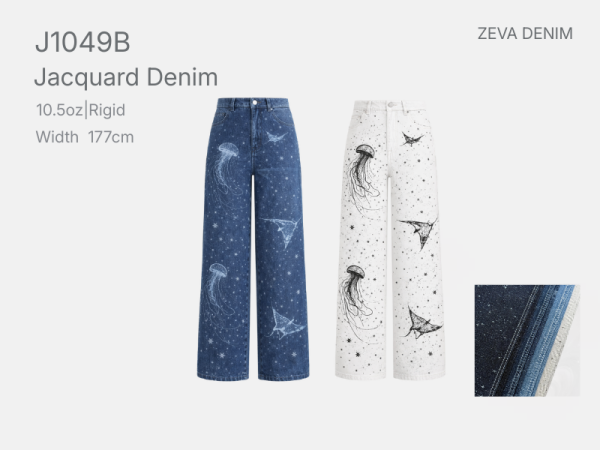
- Bottoms (especially women’s wear)
- Wide-leg / straight-leg / A-line silhouettes
- Larger panels allow the pattern to “breathe”
- Movement enhances the layered effect
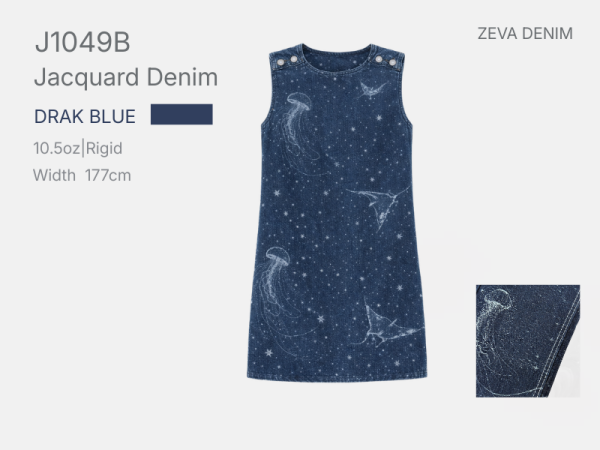
- Skirts/Dress
- Midi or structured skirts
- Flow + structure combination highlights tonal texture
- Pattern reads naturally without distortion
- Jackets / overshirts
- Relaxed fits or boxy silhouettes
- Flat surfaces preserve pattern continuity
- Works well in lightweight to mid-weight constructions
Less suitable applications (higher risk)
- Slim-fit garments
- Pattern becomes compressed or stretched
- Hidden motifs lose readability
- Heavy panel constructions
- Pattern continuity is broken into fragments
- Reduces the “discovery” effect
- Over-aggressive washing styles
- Heavy bleaching overrides subtle tonal layers
- Destroys the quiet complexity of the fabric
Trend Alignment: Why It Fits Multiple Directions at Once
One of the key strengths of this design element is that it does not belong to a single trend category.
Instead, it aligns with several major directions simultaneously.
- Quiet Luxury / Refined Casual
- Low contrast, tonal depth
- No aggressive visual branding
- Focus on material and texture
→ The fabric supports understated sophistication
- Premium Retro (but not nostalgic)
- Deep indigo / near-black tones
- Subtle surface complexity
- Feels “rich” without being decorative
→ Connects with retro mood, but through refinement—not replication
- Softened & Fluid Denim Direction
- Works well with softer handfeel constructions
- Enhances drape instead of resisting it
- Visual rhythm follows movement
→ Aligns with comfort-driven product development
- “Clean but Not Flat” Aesthetic
- From distance: clean and minimal
- From close: detailed and layered
→ Exactly what modern consumers expect from premium casual denim
What Makes It Different on Denim: Structure, Color, and Density
When this type of deep sea pattern is applied to denim, its behavior is very different from both:
- Traditional jacquard
- Basic 3/1 twill denim
The difference comes from three key dimensions.
- Structure: Integrated, Not Applied
- Pattern is built into weave, not added afterward
- Texture and motif share the same structure
- More stable across washing and wear
→ Compared to printing: more durable
→ Compared to embroidery: more integrated
- Color Behavior: Tonal, Not Contrasting
- Deep indigo / blue-black base
- Pattern revealed through subtle tonal shifts
- No reliance on high contrast
→ Works better with denim fading behavior
→ Less risk of visual “breakdown” after washing
- Density & Scale: Controlled, Not Repetitive
- Medium-density pattern distribution
- Avoids both overcrowding and emptiness
- Repeat is softened or visually hidden
→ Creates natural surface rhythm
→ Enhances “discovery” effect over time
A Practical Advantage for Buyers: Lower Design Risk, Higher Versatility
From a product development perspective, one of the biggest challenges today is balancing:
- Differentiation
- Wearability
- Production stability
This type of jacquard offers a rare combination:
Low design risk
- Not trend-dependent
- Not visually aggressive
High versatility
- Works across multiple categories
- Adapts to different washing levels
Stable outcome
- Less dependent on precise wash execution
- More predictable final appearance
For buyers, this translates into:
- Easier range building
- Lower development uncertainty
- Better margin control
Closing Insight of Part 3
The value of this deep sea jacquard is not defined by its pattern alone.
It lies in how it connects:
- Fabric and garment
- Structure and washing
- Design and production
It does not require extreme styling to stand out.
It performs best when the product allows it to remain what it is—subtle, layered, and continuously revealing.
PART 4 — Closing
Final Thought: When Subtlety Becomes a Competitive Advantage
As denim continues to evolve, one shift is becoming increasingly clear:
Not all differentiation needs to be visible at first glance.
In fact, as products become more saturated with immediate visual signals,
subtlety is starting to carry more value.
Fabrics like this—where pattern, structure, and tone are closely integrated—do not rely on instant recognition.
They rely on interaction over time.
They are not designed to impress in a single moment,
but to remain relevant across multiple moments:
- on the hanger
- after washing
- during repeated wear
This changes how fabric should be evaluated. Not just by how it looks initially, but by how it performs across its lifecycle.
For buyers and developers, this often leads to a different question:
Not “Is this pattern strong enough?”
But “can this fabric maintain the same effect and appeal after being worn multiple times?”
The real difference becomes apparent here.
From Concept to Application
One example of this approach can be seen in a deep sea-inspired jacquard development like J1049B-10LAN, where marine elements are embedded into the fabric structure to create a subtle but evolving surface effect.
If you are exploring how this type of structured jacquard could work within your next collection, it is often helpful to look beyond the swatch—and observe how it behaves after washing and in real garment applications.
Deep Sea Botanical Jacquard Denim
Deep Sea Botanical Jacquard Denim-Video


 Arabic
  English
  Russian
  Spanish
  French
  Vietnamese